Semaglutide lowered blood sugar across kidney disease stages
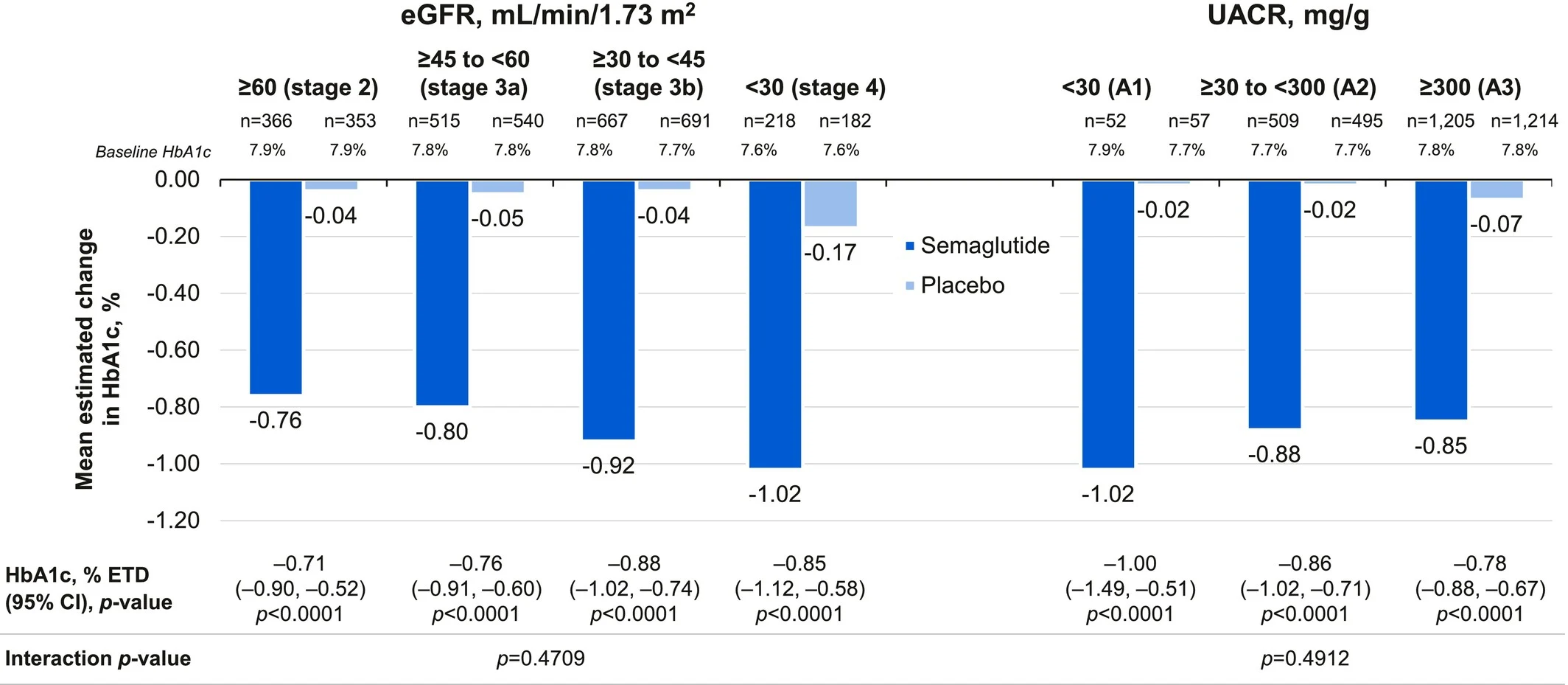
At 104 weeks, a long-term blood sugar measure fell 0.7–1.0 percentage points more with semaglutide than placebo across kidney-disease groups.
Our read
Interventions- Studied:
- Randomized trial in 3,533 adults with T2D and chronic kidney disease, Week 104 (Double-blind, placebo-controlled, multicenter, registered NCT03819153)
- What changed:
- Blood sugar (HbA1c) fell more with semaglutide than placebo across kidney disease stages, with differences of −0.7% to −0.9%
- The catch:
- Anemia and altered red blood cell turnover can distort HbA1c differently across kidney disease stages
- Stake:
- Novo Nordisk, which develops semaglutide, funded the study.
- In the record:
- The 624th paper on semaglutide with results in people; 1,594 on record in all. Its result on body weight agrees with 205 of 211 other findings on record; 2 point the other way and 4 found no change.
- Why it’s aging research:
- An intervention with evidence on lifespan or healthspan.
Editor of record: Boris Djordjevic · AgingResearch.News
The 3,533 adults in the FLOW randomized trial had type 2 diabetes and high-risk chronic kidney disease. Their average age was 66.6 years, and 69.7% were men. They received weekly injections of semaglutide, increased over eight weeks up to 1.0 mg, or placebo alongside standard care.
This post hoc analysis compared outcomes at 104 weeks across kidney-function and urine-protein groups. Semaglutide lowered HbA1c, a measure of long-term blood sugar, by 0.7–1.0 percentage points more than placebo. Weight fell 2.5–4.6 kg more, though the difference was uncertain in the lowest urine-protein group. Some groups with poorer kidney function or more urine protein also had greater reductions in systolic blood pressure, the upper reading. The analysis found no clear evidence that treatment effects differed across kidney-function or urine-protein groups.
Why it matters
For older adults with diabetes and kidney disease, the analysis addressed whether kidney disease severity alters responses to semaglutide.
Caveats
The subgroup questions were not planned in advance, and the exploratory analysis did not adjust for multiple comparisons. All participants had type 2 diabetes and high-risk chronic kidney disease; the results do not address people without those conditions.
From the paper
- Participants
A total of 3533 adults with T2D and CKD participated in FLOW, 1767 of whom were randomly assigned to once-weekly semaglutide titrated up to 1.0 mg and 1766 to placebo with a similar titration schedule.
- Limitation
These research questions were not prespecified in the original FLOW trial protocol, and the trial was not powered to address them.
Quoted word for word from the full text on dom-pubs.onlinelibrary.wiley.com.
The paper
Indiana University School of Medicine Indianapolis Indiana USA; AdventHealth Translational Research Institute Orlando Florida USA
Diabetes, Obesity & Metabolism, Nov 3, 2026, Open access, CC BY-NC


Comments
Be the first to comment.