Immune-cell packages impair energy production in lab-grown cells
Experiments in lab-grown ovarian cells found that packages from dying immune cells disrupted energy production; inhibiting a small RNA molecule eased the effects.
Our read
Mechanisms- Studied:
- Experiments in KGN granulosa cells, against cells receiving nonpyroptotic macrophage vesicles (Randomized, registered ChiCTR1800019798)
- What changed:
- Energy stores (ATP) were lower in cells receiving pyroptotic macrophage vesicles than in cells receiving nonpyroptotic macrophage vesicles
- The catch:
- ATP content is a stand-in for the rate of energy production
- Why it’s aging research:
- It looks at how biology varies with age or lifespan.
Editor of record: Boris Djordjevic · AgingResearch.News
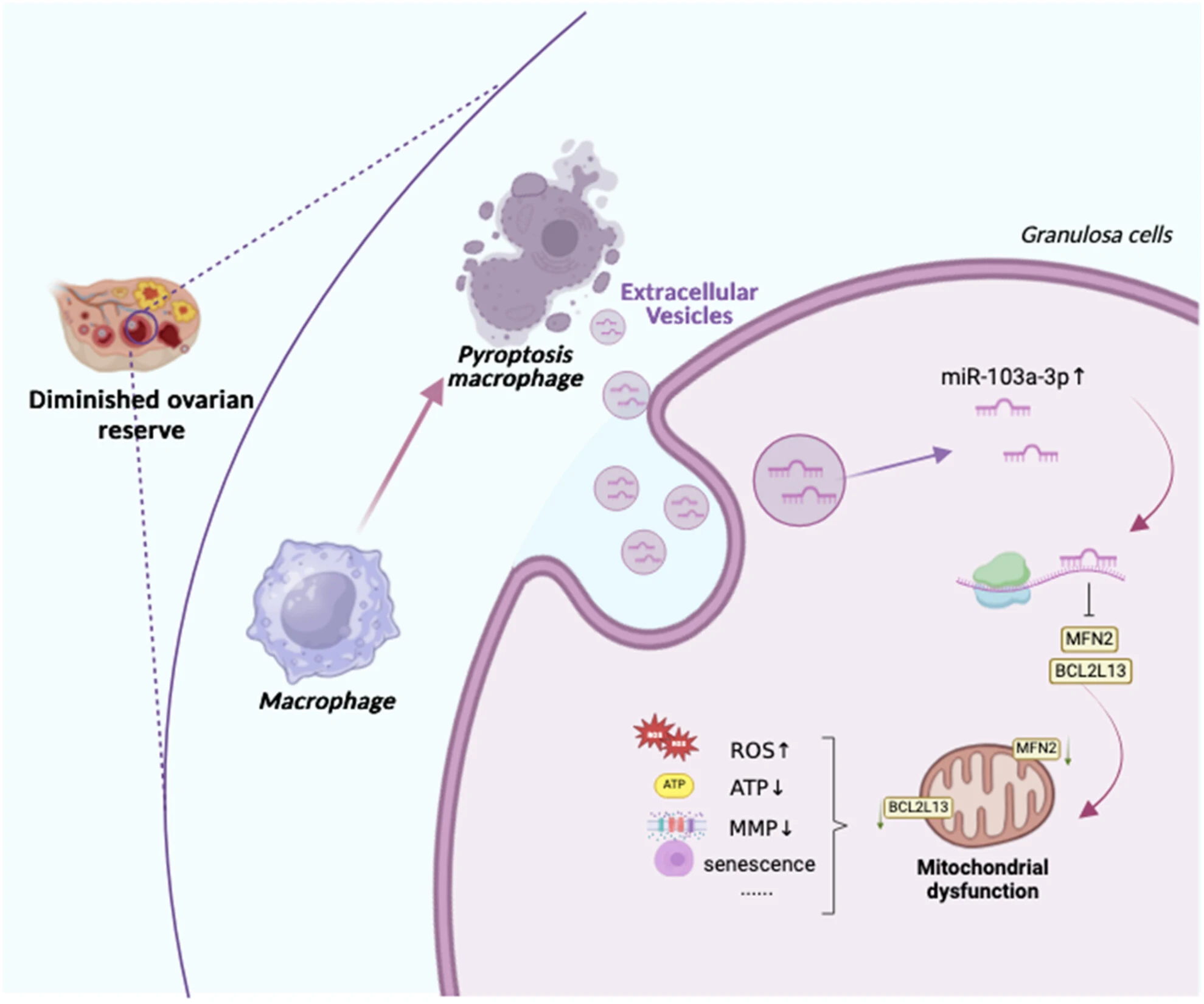
KGN granulosa cells, ovarian support cells grown in the lab, developed energy-production problems in experiments. Researchers exposed them to extracellular vesicles—tiny packages—from macrophages, immune cells undergoing pyroptosis, an inflammatory form of cell death. Compared with packages from macrophages not undergoing pyroptosis, these packages reduced cellular energy levels and increased reactive molecules and programmed cell death. Inhibiting miR-103a-3p, a small RNA molecule carried by the packages, eased these effects.
A case-control comparison included 30 fertility patients aged 38 or older with diminished ovarian reserve—fewer remaining eggs—and 30 fertility patients with normal reserves. Higher RNA levels in packages from fluid surrounding eggs were associated with lower ovarian-reserve measures. A separate experiment in female mice exposed to oxidative stress found that inhibiting the RNA improved follicle development and ovarian function.
Why it matters
Declining ovarian reserve is part of reproductive aging. The authors suggest that packages released by immune cells undergoing inflammatory death may contribute to its progression.
Caveats
The mechanism was tested in lab-grown cells, and the mice were young animals exposed to oxidative stress rather than naturally aging animals. Differences in patients’ underlying fertility conditions could also help account for the human associations.
From the paper
- Limitation
An important limitation is the lack of cell-type specificity associated with systemic AAV-mediated delivery.
Quoted word for word from the full text on onlinelibrary.wiley.com.
The paper
Department of Gynaecology Guanghua Hospital Affiliated to Shanghai University of Traditional Chinese Medicine Shanghai China; Reproductive Center of Integrated Medicine Affiliated Hospital of Shandong University of Traditional Chinese Medicine Jinan China
Aging Cell, Nov 5, 2026, Open access, CC BY
Comments
Be the first to comment.