Tea compound intake linked to slower biological aging
An observational analysis of 10,977 survey participants linked intake of a major tea compound to lower biological age acceleration and lower mortality.
Limit: Self-reported dietary recalls can misrepresent habitual EGCG intake through recall bias and daily variation
Edited by Boris Djordjevic · AgingResearch.News
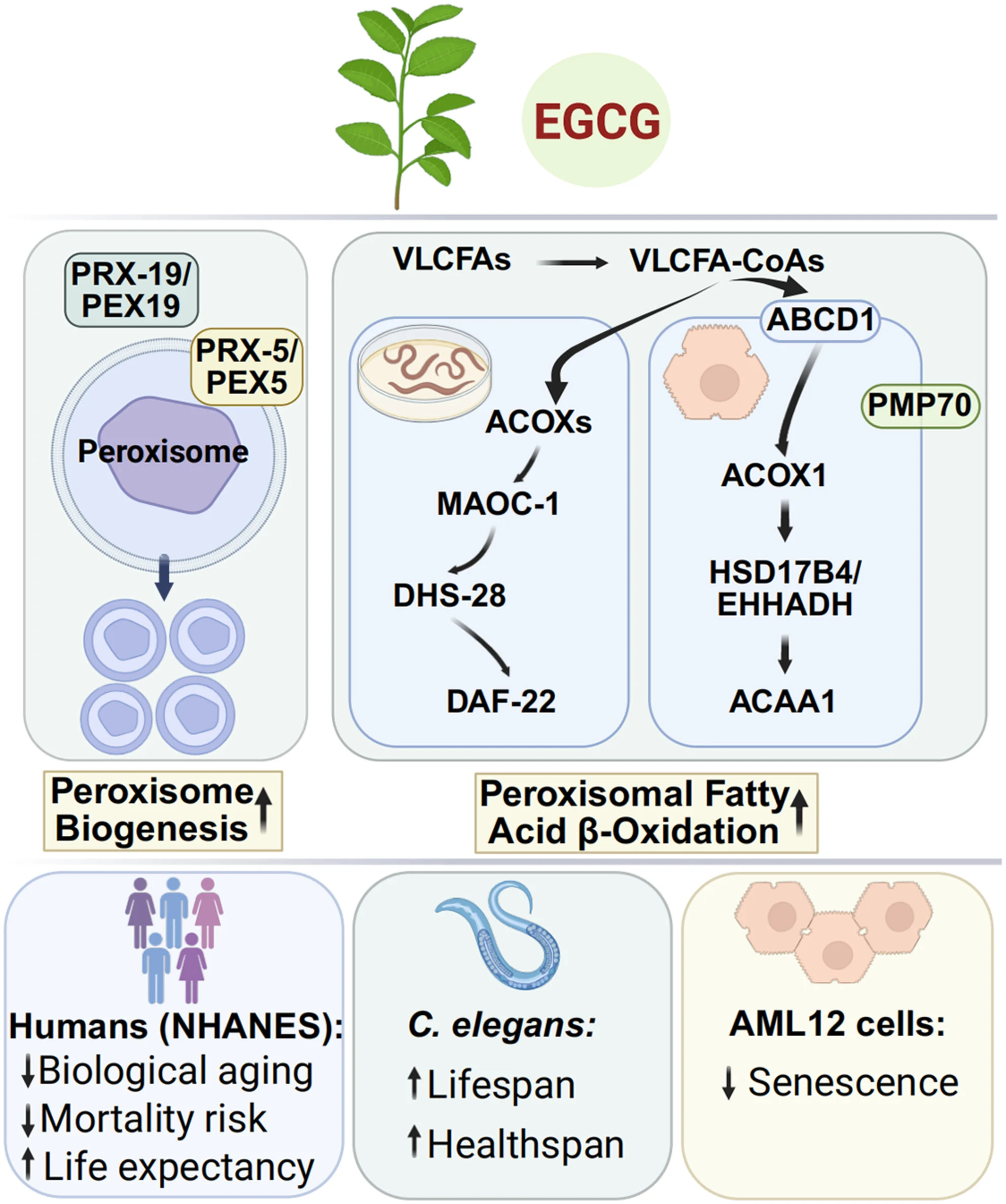
An observational analysis of 10,977 participants in the National Health and Nutrition Examination Survey examined intake of epigallocatechin gallate (EGCG), a major tea compound. Compared with non-consumers, both lower and higher intake categories were associated with lower PhenoAge acceleration, a measure of biological age relative to chronological age. Both categories were also associated with lower all-cause mortality and higher estimated remaining life expectancy.
In experiments with Caenorhabditis elegans worms, EGCG extended lifespan and health span—the time spent in good health. It increased peroxisomes, cell structures that break down fats, and enhanced their fat breakdown. Reducing the activity of certain genes involved in these processes abolished the lifespan and health span benefits. In lab-grown AML12 liver cells made senescent—a state in which cells stop dividing—by the drug doxorubicin, EGCG reduced the share of cells positive for a senescence marker.
Why it matters
The experiments address how a dietary compound might influence lifespan and healthy lifespan through cells’ fat-processing machinery.
Caveats
The human analysis was observational, so it cannot show that EGCG caused slower aging or longer life. The worm and lab-grown cell experiments do not establish benefits in people.
Where the evidence stands
Epigallocatechin gallate
- 49 independent labs in 19 countries
- 9 findings against
- 21 trials, 5 with no results posted
- Funders: National Natural Science Foundation of China and others
- 10 of 169 findings with company ties
- 1 of 21 trials sponsored by its developers
acox-1.2
- 2 independent labs in 1 country
- Funders: National Natural Science Foundation of China and 3 more
From the paper
- Participants
The cross-sectional sample comprised 10,977 adults; 10,964 participants with linked mortality data were included in mortality analyses (Figure S12).
- Follow-up
Over a mean follow-up of 7.9 years, 1276 deaths (11.6%) occurred.
Results, 2.3 Dietary EGCG Intake Is Associated With Lower Mortality Risk
- Result
Compared with non-consumers, fully adjusted hazard ratios (HRs) were 0.83 (95% CI 0.69–0.99) and 0.82 (95% CI 0.68–0.99) for the low- and high-intake groups, respectively (p < 0.05; Table S5, Model 3).
Results, 2.3 Dietary EGCG Intake Is Associated With Lower Mortality Risk
Quoted word for word from the full text on onlinelibrary.wiley.com.
The paper
Shengli Clinical Medical College of Fujian Medical University Fuzhou China
Aging Cell, Nov 2, 2026, Open access, CC BY
Comments
Be the first to comment.