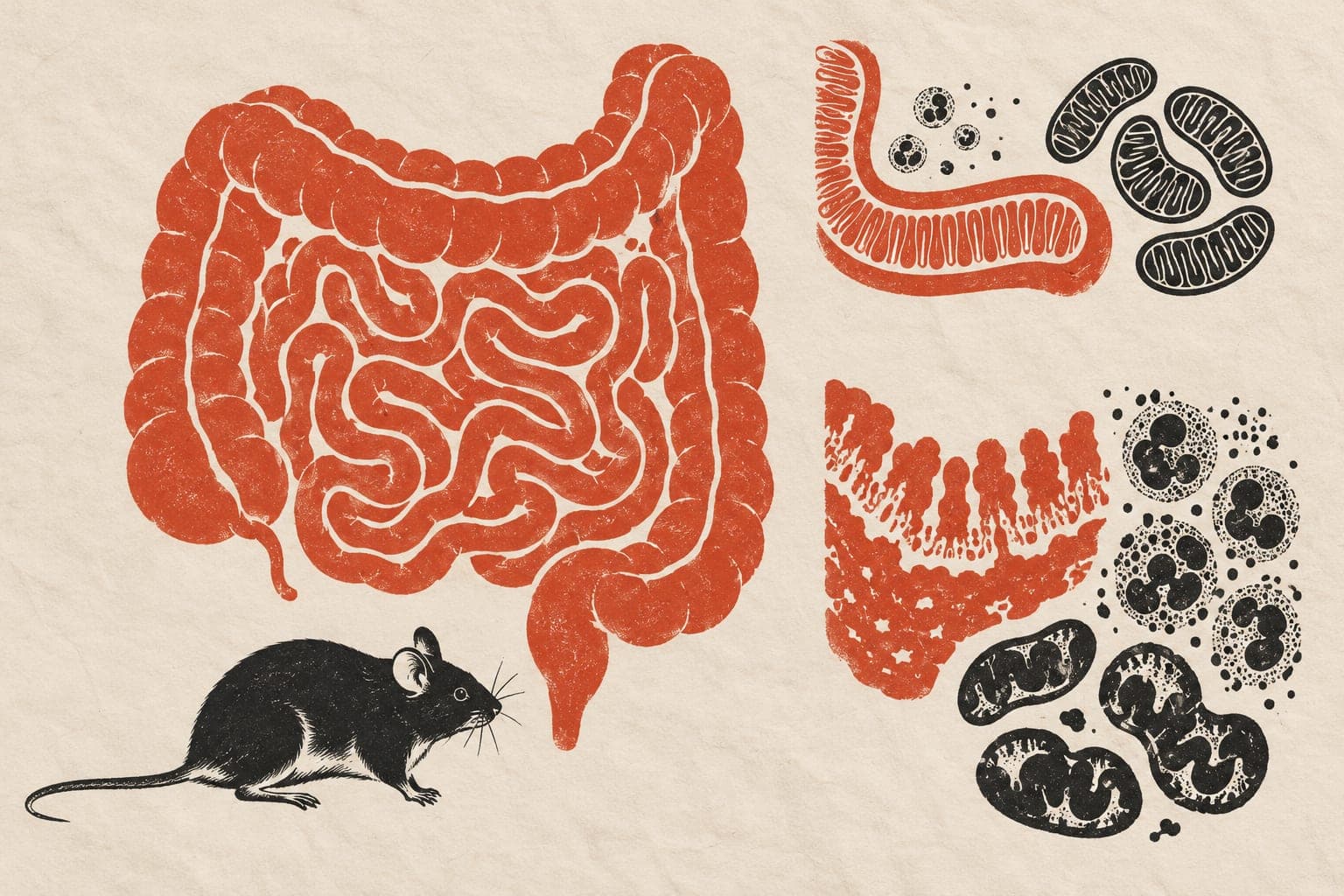
Losing one gene copy impaired heart function in mice
Experiments in mice aged 4–6 and 18–24 months found that deleting one copy of a gene also increased intestinal leakage and inflammation.
Limit: The abstract did not report sample sizes
Edited by Boris Djordjevic · AgingResearch.News
In an animal experiment, mice aged 4–6 months and 18–24 months lacked one copy of Akap1 or carried both copies. Akap1 provides instructions for a protein in mitochondria, the energy-producing structures inside cells. Researchers compared heart function, intestinal leakage, blood inflammation markers and gut microbes.
Mice missing one copy had impaired heart function, increased intestinal leakage and more inflammation. Their gut microbes differed from those of control littermates, with more pronounced changes in older mice. Transferring stool microbes between the genetic groups altered intestinal leakage, inflammation markers and heart dysfunction, supporting an effect dependent on gut microbes. Blood chemical analyses identified sphingosine-1-phosphate and phenylacetylglycine, two compounds, as key links between the gut and heart. Their circulating levels varied with age and genetic makeup.
Why it matters
Age-related heart dysfunction raises the question of whether targeting gut microbes and their chemical products might help limit chronic inflammation during aging.
Caveats
This animal experiment does not establish whether the same effects occur in people. The conference abstract did not report sample sizes or the size or direction of the changes after stool transfers.
The paper
Federico II University Hospital
ESC Congress 2026 Abstract, Oct 26, 2026
Presented at ESC Congress 2026