Education showed no clear link to five major eye disorders
An observational analysis of 13,094 people aged 30–100 found no statistically significant associations after accounting for other factors.
Limit: Nonsignificant results do not rule out relationships between education and eye disorders
Edited by Boris Djordjevic · AgingResearch.News
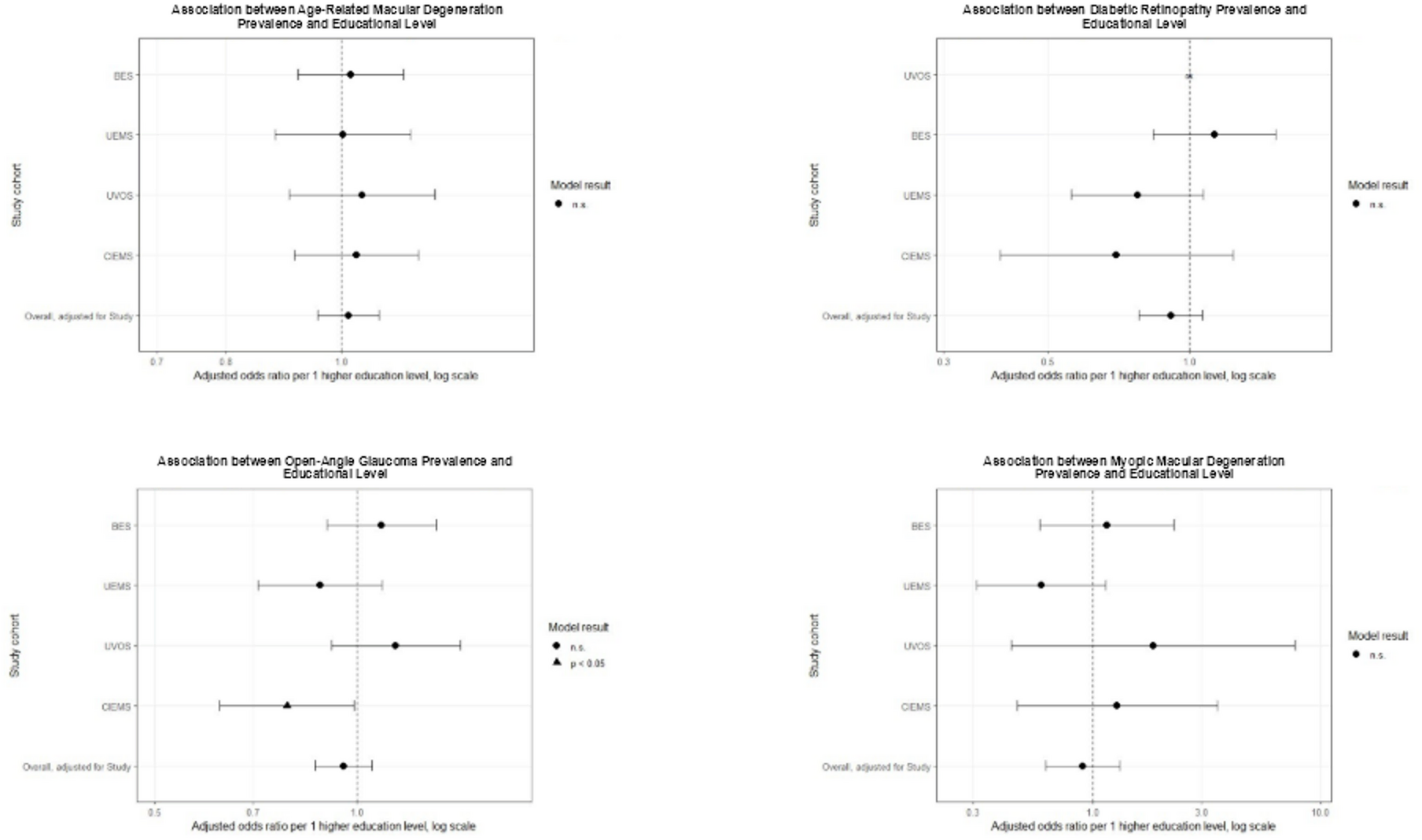
In an observational analysis, researchers examined 24,915 eyes from 13,094 people aged 30–100 in four population-based studies. They assessed relationships between educational level and five major eye disorders.
The conditions included two types of damage to the central retina—the eye’s light-sensitive layer—linked to nearsightedness or aging. They also included diabetes-related retinal damage and open-angle and angle-closure glaucoma, which damage the nerve connecting the eye to the brain. After accounting for other factors, education had no statistically significant association with any of these conditions. Older age was associated with all five disorders.
Why it matters
The reported link between education and school-age nearsightedness raises a question about whether it extends to eye diseases in later life, including age-related retinal damage.
Caveats
These observational data cannot establish cause and effect, and statistically nonsignificant results do not prove that no relationships exist. The findings concern adults aged 30–100, not school-age children.
- Educational level
- Angle-closure glaucoma
- Age-related macular degeneration
- Diabetic retinopathy
- Myopic macular degeneration
- Humans
The paper
Ocular disorders and associations with educational level
L V Prasad Eye Institute
Scientific Reports, Oct 23, 2026, Open access, CC BY-NC-ND

