A cell-based multivariate blood test (iCAP) for early detection of Alzheimer’s disease capturing non-amyloid-β biology
Independent replication
Abstract
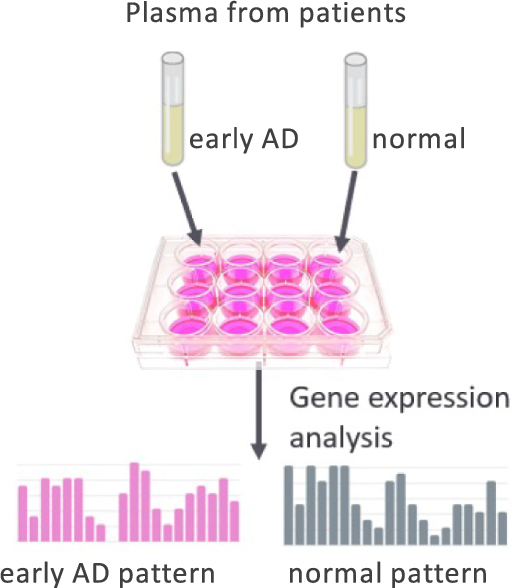
The indicator cell assay platform (iCAP) is a blood-based diagnostic approach that uses standardized cells as biosensors to transduce complex circulating signals into cell-based gene-expression profiles for multivariate disease classification. We developed an iCAP for early detection of Alzheimer’s disease (AD-iCAP) by incubating plasma from patients with early-stage AD (mild cognitive impairment or mild dementia) and non-affected controls with standardized neurons and training classifiers on transcriptomic responses. Modeling features were restricted to a predefined 84-gene panel derived independently by analyzing 5xFAD mouse plasma in the AD-iCAP. In this exploratory study, a model was trained and tested using 191 retrospectively collected human plasma samples across three cohorts. The classifier achieved AUC = 0.64 (95% CI 0.51–0.78) in an external validation set during model development (n = 82) and AUC = 0.77 (95% CI 0.57–0.96) in a blind test set (n = 23). The multivariate model incorporated 5 genes including AKT3 , GPR50 , PALLD , RGMA , and PCDH10 , implicated in AD, neuronal signaling and/or cytoskeletal dynamics. The cell-based approach is orthogonal to direct detection of circulating amyloid and tau, and these exploratory findings support further evaluation of AD-iCAP in prospective studies for combinatorial diagnostics and patient stratification for clinical trials.
The paper
Scientific Reports, 17 Oct 2026, CC BY