Seasonal heart-rate swings were smaller in older adults
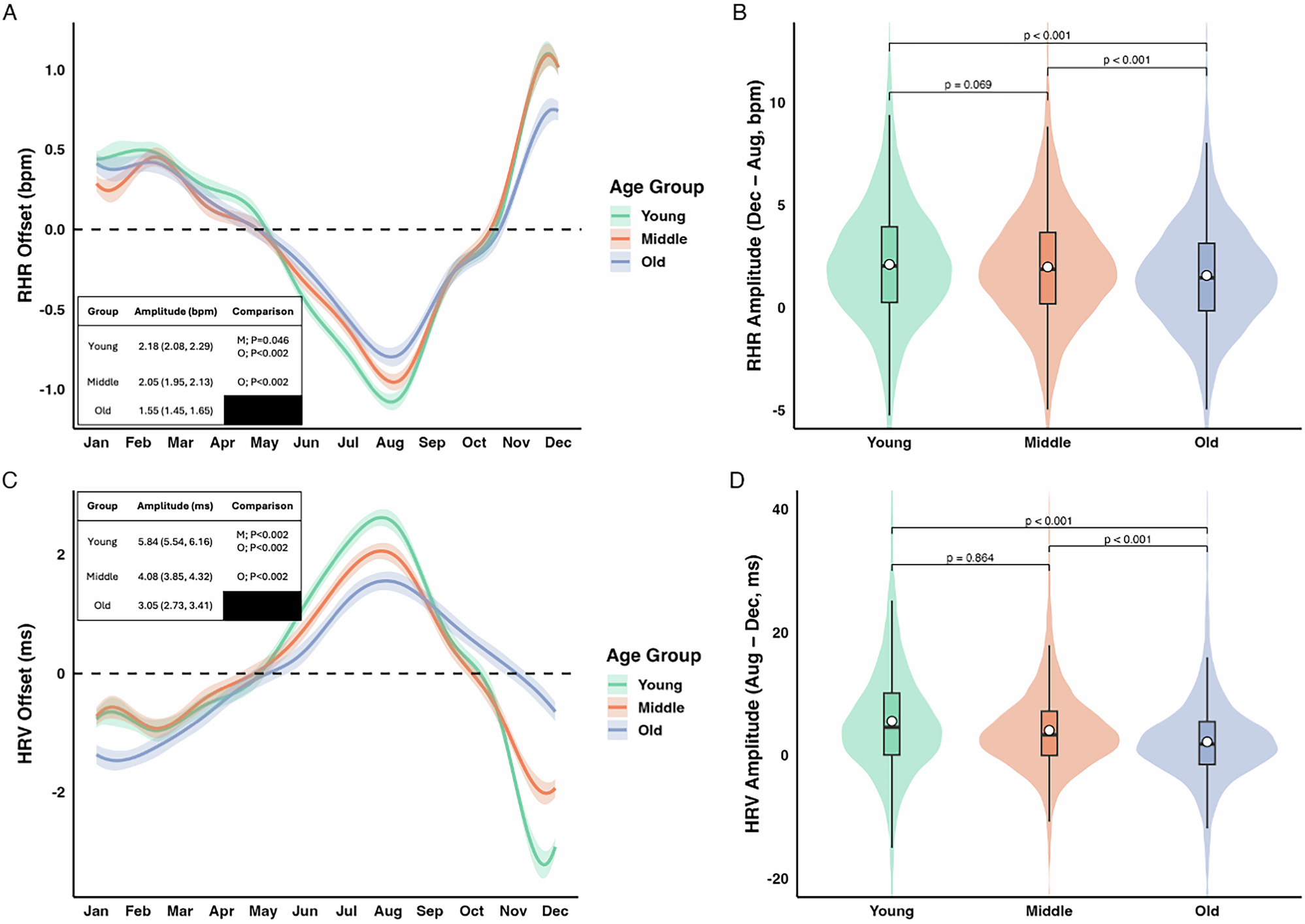
Seasonal swings in resting heart rate were about 29% smaller, and swings in heart rate variability about 48% smaller, in older than younger adults.
Limit: Only one year of data limits assessment of recurring seasonal differences by age
Edited by Boris Djordjevic · AgingResearch.News
In an observational study of 16,415 U.S. adults, researchers analyzed one year of continuous data from wearable devices. They measured resting heart rate and heart rate variability, the variation in time between heartbeats.
Resting heart rate was lower in summer than winter, while heart rate variability was higher. The seasonal peak-to-trough differences were 2.0 beats per minute and 4.2 milliseconds, respectively. Physical activity and sleep each accounted for less than 10% of the seasonal patterns, suggesting that other factors were primarily responsible. Seasonal swings were smaller in older adults but did not vary by sex. They were greater in more active people with lower body mass index, a measure of weight relative to height.
Why it matters
The findings bear on cardiovascular plasticity—the heart and circulation’s capacity to adjust to changing conditions—and how that capacity relates to age.
Caveats
The observational design cannot establish what caused the seasonal patterns or their links with age. The abstract does not define the older and younger age groups.
- Seasonal exposure
- Resting heart rate
- Heart rate variability
- Body mass index
- Seasonal amplitude of heart rate variability
- Humans
The paper
Seasonal variation in resting heart rate and heart rate variability is attenuated with advancing age
University of Georgia; WHOOP Inc.
NPJ Aging, Oct 31, 2026, Open access, CC BY-NC-ND


Comments
Be the first to comment.