One omega-3 in body fat linked to lower bleeding stroke risk
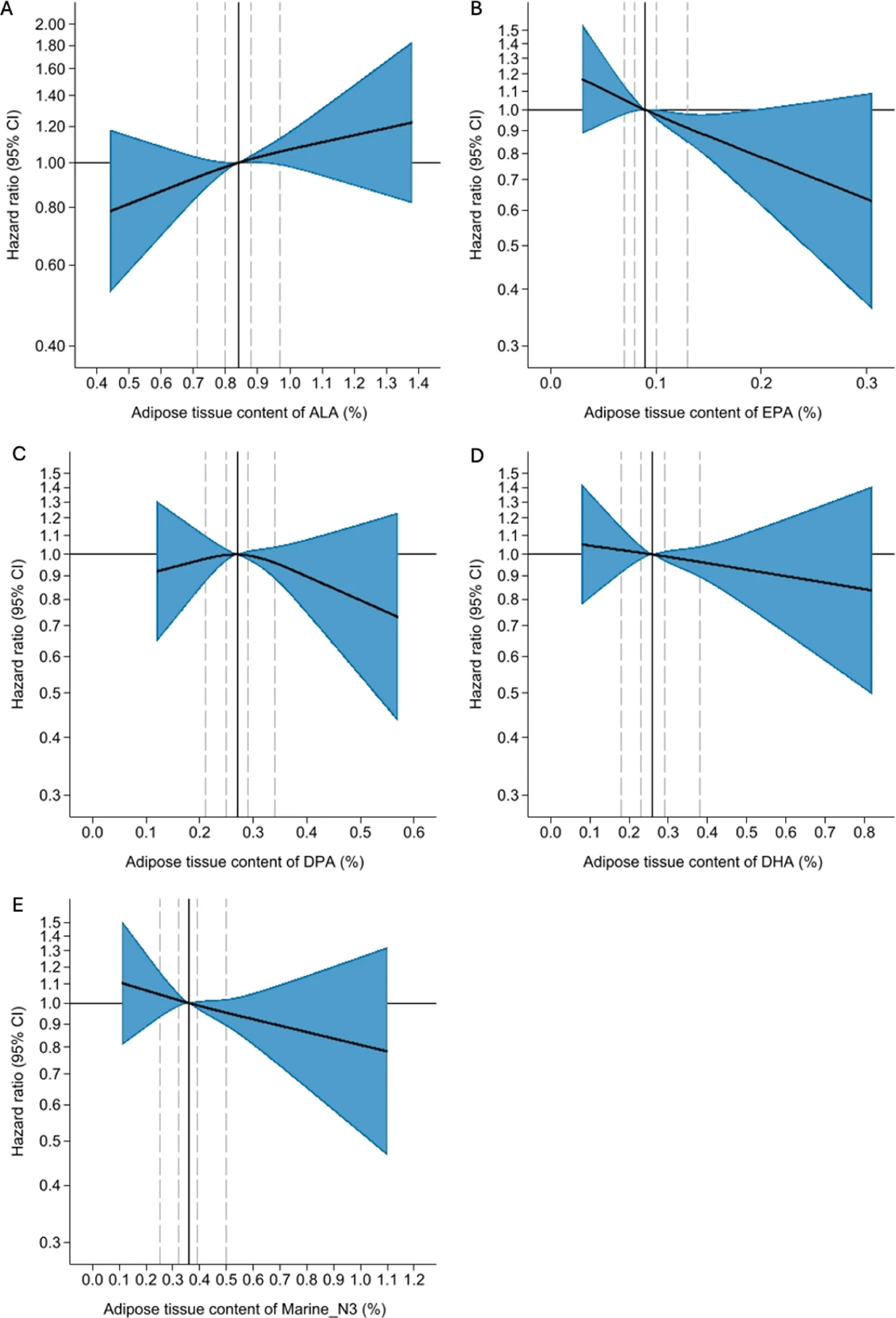
A relative risk measure was 0.64 for the highest versus lowest fifth of eicosapentaenoic acid in body fat over a median 21 years.
Edited by Boris Djordjevic · AgingResearch.News
An observational case-cohort study followed 54,546 Danish men and women aged 50 to 65 at enrollment for a median of 21 years. Researchers analyzed omega-3 fats in body-fat samples from all 729 hemorrhagic stroke cases and a randomly selected subgroup of 4,615 participants. Hemorrhagic strokes involve bleeding in or around the brain.
For eicosapentaenoic acid, an omega-3 fat, the highest fifth had a hazard ratio of 0.64 versus the lowest fifth. This measure compared relative stroke risk over follow-up. The association was similar in men and women. Alpha-linolenic acid, another omega-3 fat, showed the opposite association: the highest fifth had a hazard ratio of 1.32 versus the lowest fifth.
Why it matters
For cardiovascular health in later life, the question is whether individual omega-3 fats have different associations with stroke involving bleeding.
Caveats
This observational study cannot establish cause and effect or show whether omega-3 supplements alter stroke risk. The findings came from Danish adults aged 50 to 65 at enrollment and may not apply to other populations.
Where the evidence stands
Eicosapentaenoic acid
- 31 independent labs in 10 countries
- 29 trials, 8 with no results posted
- Funders: National Institutes of Health and others
- 10 of 51 findings with company ties
- 1 of 29 trials sponsored by its developers
Alpha-linolenic acid
- 17 independent labs in 9 countries
- 3 trials, 1 with no results posted
- Funders: National Natural Science Foundation of China and others
- 1 of 42 findings with company ties
- Eicosapentaenoic acid
- Alpha-linolenic acid
- Docosahexaenoic acid
- Hemorrhagic stroke
- Intracranial hemorrhage
- Humans
The paper
The Journal of Nutrition, Nov 2026


Comments
Be the first to comment.