Long-term heatwave exposure linked to higher death risk
Death risk was 21% higher for an increase in heatwave days spanning the middle half of exposure levels, over a median 12.8 years.
Our read
Populations- Studied:
- Cohort study of 332,175 UK Biobank adults, median 12.8 years
- What changed:
- Death risk was 21% higher for an increase in heatwave days spanning the middle half of exposure levels
- The catch:
- Differences in participants’ health or living conditions could contribute to the mortality links
- In the record:
- One of 6 papers on heatwave exposure on record: 6 with results in people.
- Why it’s aging research:
- It measures an outcome that worsens with age.
Editor of record: Boris Djordjevic · AgingResearch.News
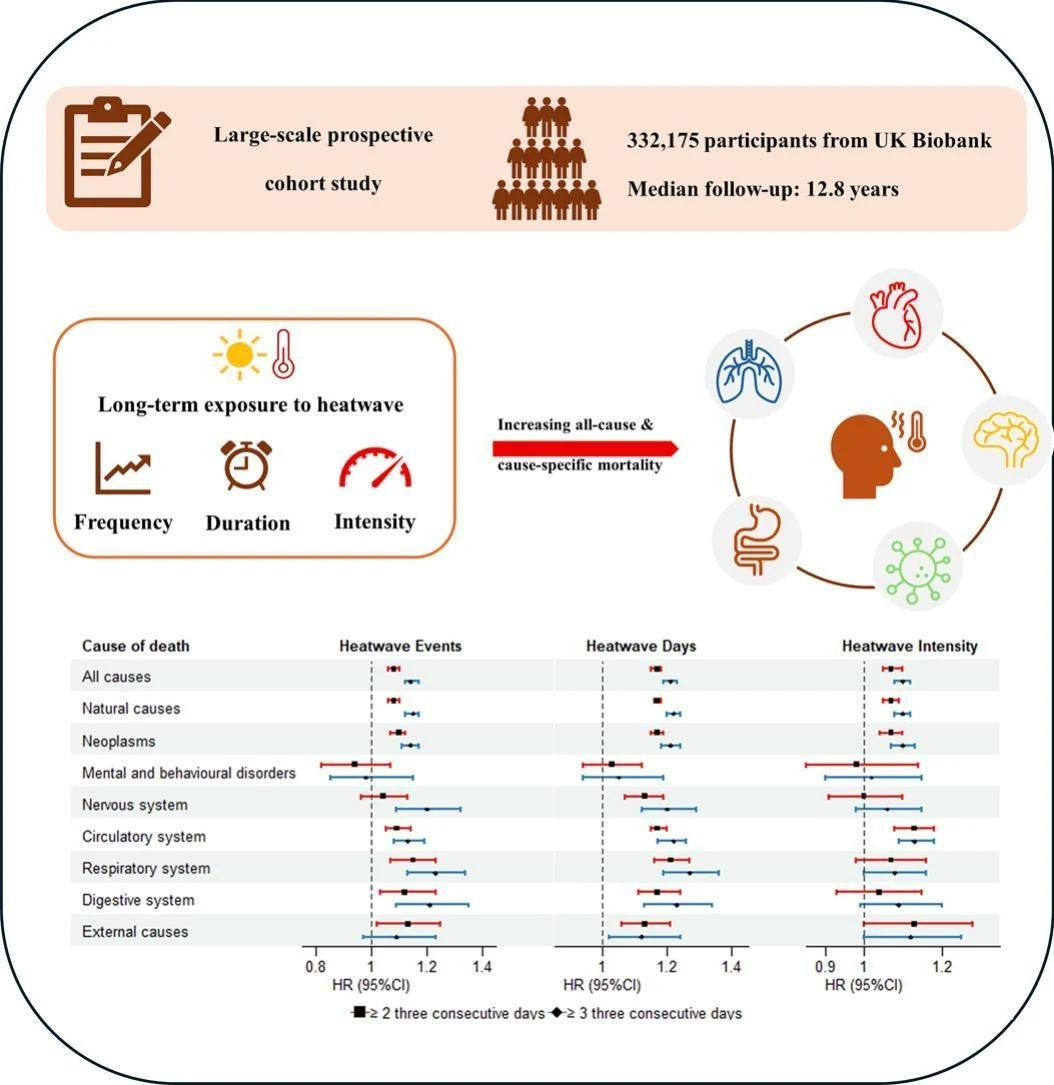
Among 332,175 UK Biobank adults enrolled between 2006 and 2010, a prospective cohort study tracked heatwave exposure and deaths. Researchers measured cumulative exposure through the number of heatwave events, heatwave days and heatwave intensity. Over a median 12.8 years, 23,836 participants died.
For heatwaves lasting at least three consecutive days, greater exposure was associated with higher death risk. For increases spanning the middle half of exposure levels, relative risks were 14% higher for heatwave events, 21% higher for heatwave days and 10% higher for intensity. Links to deaths from specific causes varied by exposure measure and cause. Higher risks were observed among people with lower socioeconomic status and those living in northern areas.
Why it matters
Long-term heat exposure is relevant to understanding environmental influences on lifespan. The authors called for heat-health adaptation tailored to heatwave patterns and population vulnerabilities.
Caveats
Heatwave exposure was not assigned, and differences in participants’ health or living conditions could also have contributed to the mortality links. The findings concern UK Biobank adults and may not extend to populations in other settings.
The paper
Long-term heatwave exposure and mortality: a prospective cohort study in the UK
Environment International, Nov 2026, CC BY-NC-ND

Comments
Be the first to comment.