Urine markers linked to advanced heart–kidney–metabolic syndrome
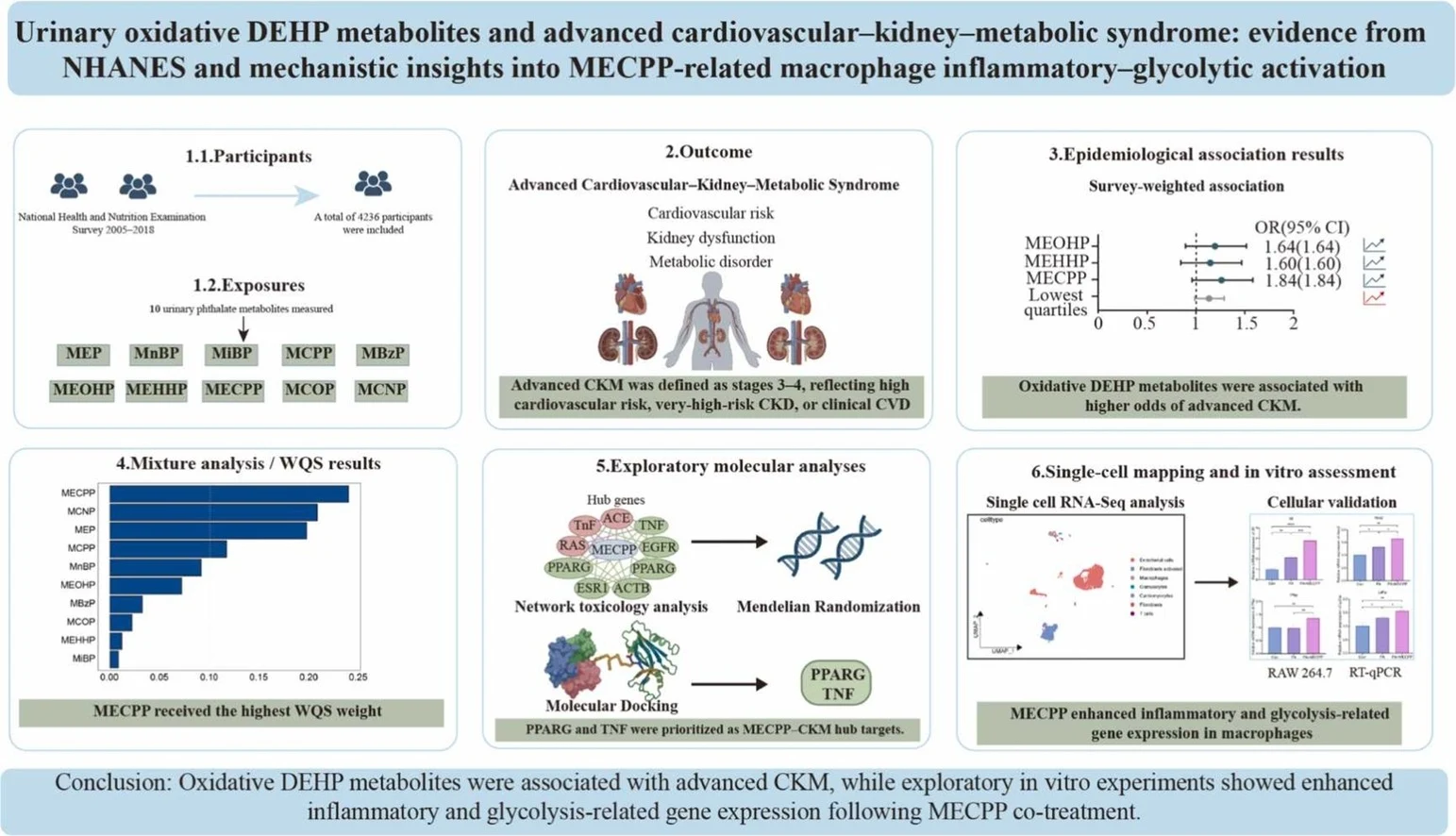
For one phthalate breakdown product, adults in the highest quarter of urine levels had an odds ratio of 1.84 for advanced syndrome versus the lowest quarter.
Our read
Populations- Studied:
- Cross-sectional study of 4,236 US adults, against adults with lowest-quarter urinary MECPP levels (Dose-response)
- What changed:
- Advanced heart–kidney–metabolic syndrome was more common with highest-quarter versus lowest-quarter urine MECPP levels (odds ratio 1.84)
- The catch:
- Higher urinary chemical levels could follow advanced syndrome rather than precede it
- In the record:
- One of 6 papers on Mono(2-ethyl-5-carboxypentyl) phthalate on record: 2 with results in people.
Editor of record: Boris Djordjevic · AgingResearch.News
Among 4,236 US adults surveyed from 2005–2018, an observational analysis examined urine markers of exposure to phthalates, environmental contaminants. Researchers classified 648 participants as having advanced cardiovascular–kidney–metabolic syndrome, which groups risks involving the heart, kidneys and the body’s energy use.
Three breakdown products of the chemical di(2-ethylhexyl) phthalate were associated with higher odds of advanced syndrome after adjustment for other factors. One, mono(2-ethyl-5-carboxypentyl) phthalate, had an odds ratio of 1.84 for the highest versus lowest quarter of urine levels. It also received the highest weight in an analysis of the chemical mixture. In separate experiments with lab-grown macrophages, a type of immune cell, this compound strengthened palmitic acid-induced activity of genes related to inflammation and glycolysis, the breakdown of sugar for energy. Palmitic acid is a fatty acid.
Why it matters
Heart, kidney and metabolic health matter for health in later life. The findings support investigating whether phthalate exposure contributes to the development or progression of this combined syndrome.
Caveats
The survey analysis did not show whether higher urinary chemical levels preceded advanced syndrome. Gene activity in lab-grown immune cells does not establish that the same process occurs in people.
- Di(2-ethylhexyl) phthalate
- Mono(2-ethyl-5-carboxypentyl) phthalate
- Inflammation
- Glycolysis
- Advanced cardiovascular-kidney-metabolic syndrome
- Humans
The paper
Ecotoxicology and Environmental Safety, Nov 4, 2026, Open access, CC BY
Comments
Be the first to comment.