Clearing protein deposits restored liver regrowth in aged mice
Experiments in aged mice found that clearing abnormal protein deposits around blood vessels with anselamimab restored liver regeneration after partial liver removal.
Our read
Interventions- Studied:
- Experiments in aged mice
- What changed:
- Clearing amyloid with anselamimab restored liver regrowth in aged mice after partial liver removal
- The catch:
- The abstract omits group sizes, limiting assessment of result robustness
- Why it’s aging research:
- Old against young, or naturally aged tissue.
Editor of record: Boris Djordjevic · AgingResearch.News
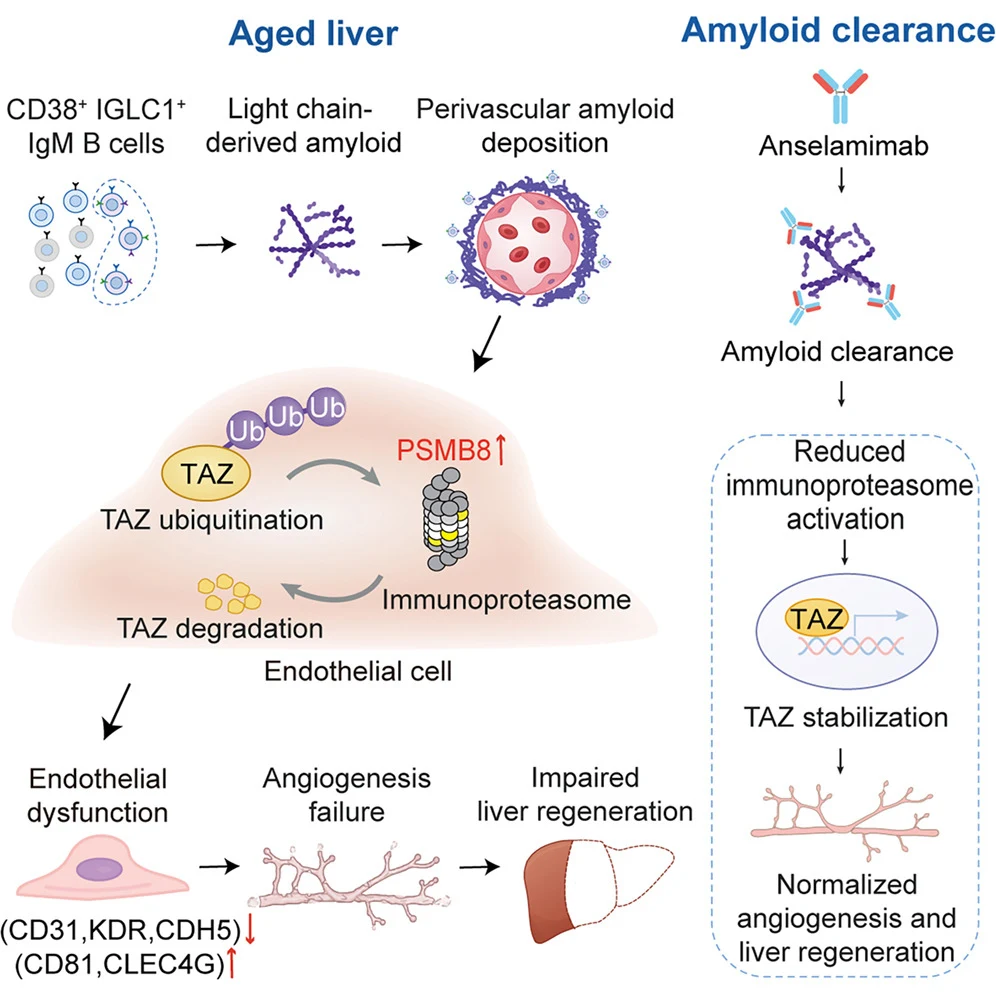
In aged mice, experiments with anselamimab cleared amyloid—abnormal protein deposits around blood vessels—and restored liver regeneration after partial liver removal. These deposits came from antibody fragments called light chains.
After surgery, levels of PSMB8, part of cells’ protein-disposal machinery, rose in cells lining liver blood vessels. Deleting PSMB8 from those cells or inhibiting it with PR-957 promoted new blood vessel growth and restored regeneration. Clearing amyloid with anselamimab reduced excessive activity of this protein-disposal system. It also reversed age-related increases in inflammation-related gene activity in blood vessel lining cells.
Why it matters
Insufficient formation of new blood vessels contributes to declining organ regeneration with age. The authors suggest that amyloid clearance may offer a strategy for addressing age-related loss of liver regeneration.
Caveats
The regeneration results came from mice after partial liver removal, not from people. The abstract does not give group sizes, limiting assessment of how robust the results were.

Comments
Be the first to comment.