Walking-speed age patterns varied across six aging cohorts
The modeled walking-speed transition midpoint was 82.44 years in the UK cohort versus 56.70 years in South Africa, where the estimate extended beyond observed ages.
Our read
Populations- Studied:
- Cross-sectional study of participants in aging cohorts, against South African cohort
- What changed:
- The modeled walking-speed transition midpoint was 82.44 years in the UK cohort versus 56.70 years in South Africa
- The catch:
- The South African midpoint was extrapolated below the observed age range
- In the record:
- The 101st paper on kidney disease with results in people; 889 on record in all.
Editor of record: Boris Djordjevic · AgingResearch.News
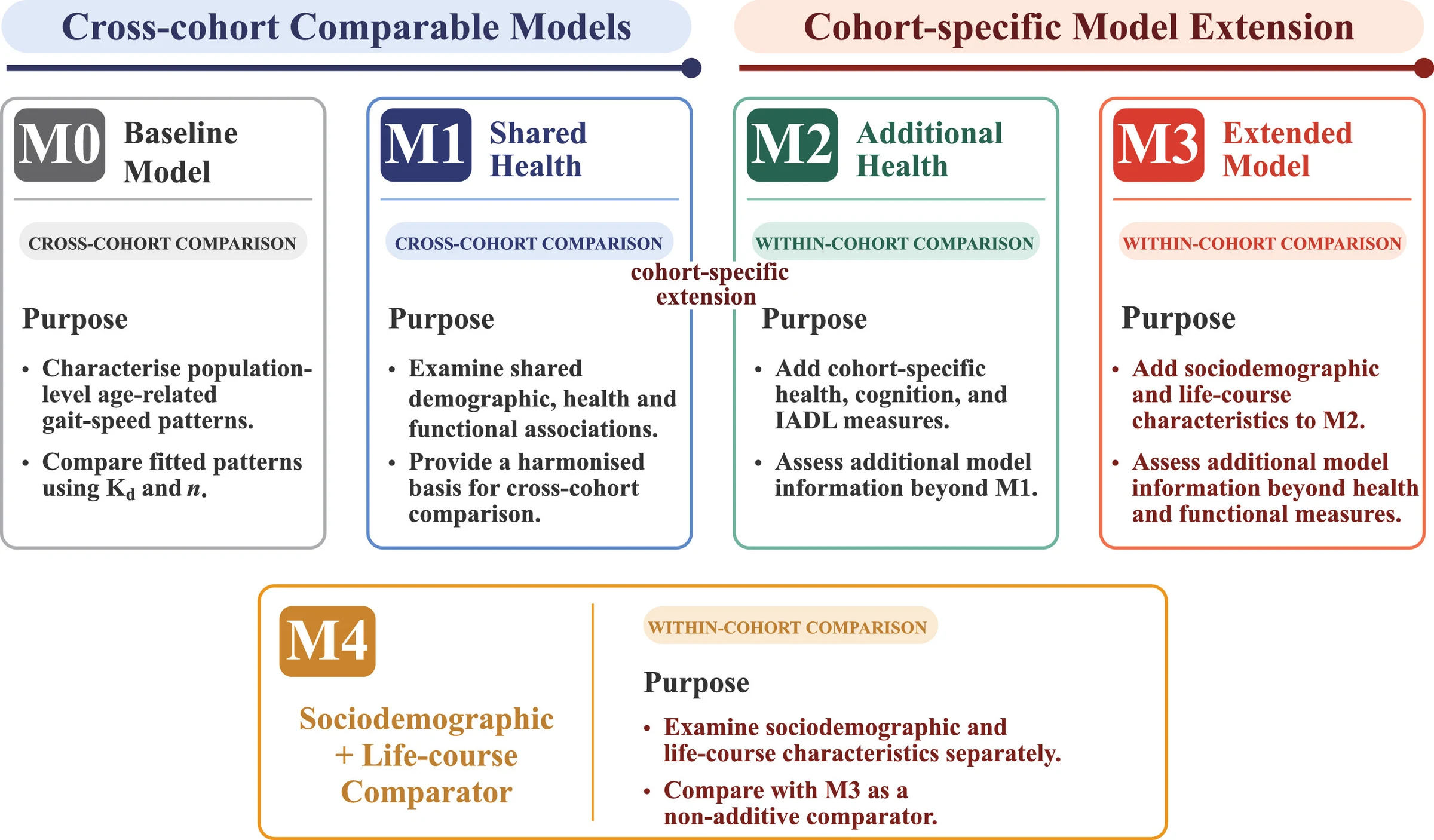
People in six aging cohorts in the UK, US, China, India, Brazil and South Africa contributed 78,697 walking-speed observations to a pooled observational analysis. Researchers fitted mathematical curves to compare population-level patterns across ages. They summarized each pattern using the estimated age at the midpoint of its walking-speed transition.
The reference model placed the UK cohort’s transition later and within a narrower age span. South Africa showed an earlier pattern of poorer walking function. The other four cohorts had intermediate profiles. Limitations in basic daily activities showed the most consistent shared associations with walking speed. Additional health and socioeconomic associations differed across cohorts.
Why it matters
Walking speed is a marker of physical function in later life. The authors suggest that common monitoring approaches may inform prevention planning that accounts for differences between cohorts.
Caveats
The population-level age patterns did not describe how individuals changed as they aged. The South African midpoint fell below the ages analyzed, making it an estimate beyond the observed age range.
The paper
Archives of Gerontology and Geriatrics, Nov 2026, CC BY

Comments
Be the first to comment.