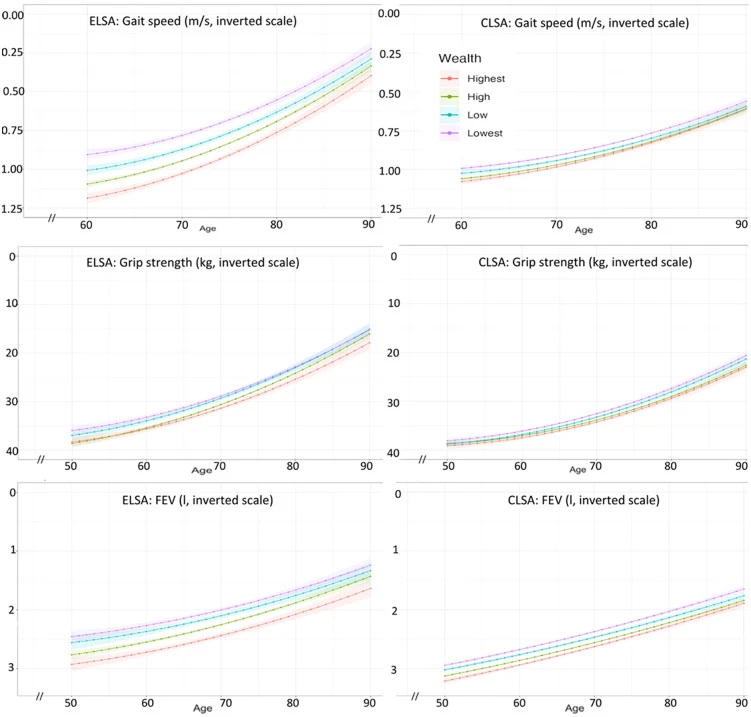
England had generally wider wealth-linked gaps in physical ability
On average, at 60, the least wealthy had walking speeds matching the wealthiest people 15 years older in England and 9 years older in Canada.
22,605 participants
Limit: The cohorts measured wealth differently
Edited by Boris Djordjevic · AgingResearch.News
The observational cohort study included 8,511 adults in England (55% women) and 22,605 in Canada (49% women), aged 50–85 at baseline. Researchers compared household wealth with physical tests and self-reported hearing, eyesight and daily activities. English data covered 2012–2023, except lung function and chair-rise tests, which used 2004–2013 data; Canadian data covered 2012–2021.
Less wealth was linked to poorer functioning across outcomes in both cohorts, and steeper declines in mobility and the ability to handle daily tasks. Wealth-related gaps in functioning were generally larger in England. The walking-speed comparisons were model estimates of equivalent functioning at different ages, not lifespan differences. Associations weakened but persisted after accounting for chronic conditions, weight, health behaviors and social connections. Wealthier participants in England lost walking speed faster, but still walked faster throughout follow-up.
Why it matters
The authors suggest that addressing inequalities in how people function as they age requires approaches aimed at individuals alongside broader societal measures.
Caveats
This observational study cannot establish cause and effect, and the cohorts measured wealth differently. The findings concern adults aged 50–85 at baseline, and the analysis did not examine socioeconomic conditions earlier in life.
The paper
University Hospital of Geneva; University of Geneva
PLOS Medicine, Aug 13, 2026, Open access