Higher-intensity exercise improved function more in older adults
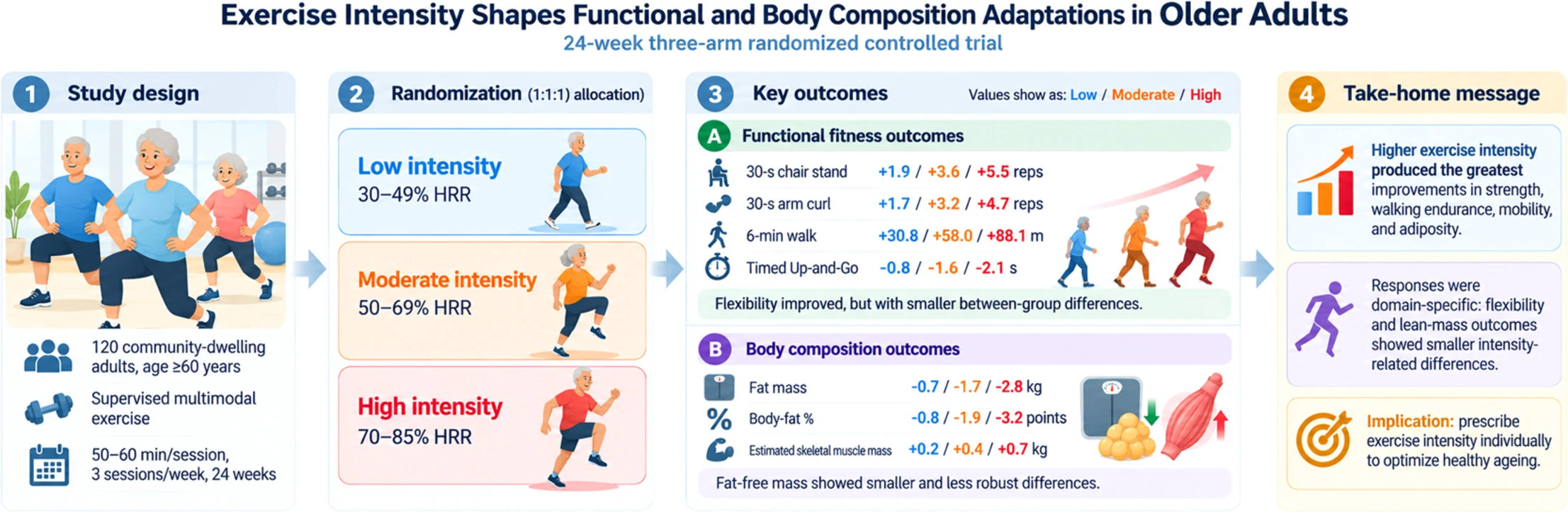
Chair-stand performance rose by 5.5 repetitions with high-intensity exercise, compared with 3.6 at moderate and 1.9 at low intensity over 24 weeks.
Our read
Interventions- Studied:
- Trial in people
Editor of record: Boris Djordjevic · AgingResearch.News
Community-dwelling adults aged 60 or older—120 in total—joined a 24-week, three-arm randomized controlled trial of supervised exercise. Each group exercised three times weekly for 50–60 minutes per session. High, moderate and low intensities targeted 70–85%, 50–69% and 30–49% of heart-rate reserve, the difference between resting and maximum heart rate.
The main outcome was how many times participants could stand from a chair in 30 seconds. Gains were 5.5, 3.6 and 1.9 repetitions in the high-, moderate- and low-intensity groups, respectively. Fat mass fell by 2.8, 1.7 and 0.7 kilograms. Higher intensity also brought larger gains in strength, walking endurance and mobility. Flexibility and estimated muscle-mass responses were less pronounced. No serious adverse events occurred. Follow-up was 92.5%.
Why it matters
Preserving physical function and favorable body composition matters for healthy aging. The authors concluded that exercise intensity should be individualized rather than assuming uniform benefits across outcomes.
Caveats
The 24-week comparison cannot show whether the differences persist over years. Participants lived in the community, so the findings may not extend to older adults in residential care.
The paper
Archives of Gerontology and Geriatrics, Nov 2026
Comments
Be the first to comment.