Bladder leakage patterns linked to falls and functional decline
New and persistent leakage were linked to 2.28 and 2.16 times the odds of worsening daily functioning, respectively, versus no leakage at either assessment.
Our read
Populations- Studied:
- Cohort study of 85,788 people
- In the record:
- The 117th paper on urinary incontinence with results in people; 389 on record in all.
- Why it’s aging research:
- It measures an outcome that worsens with age.
Editor of record: Boris Djordjevic · AgingResearch.News
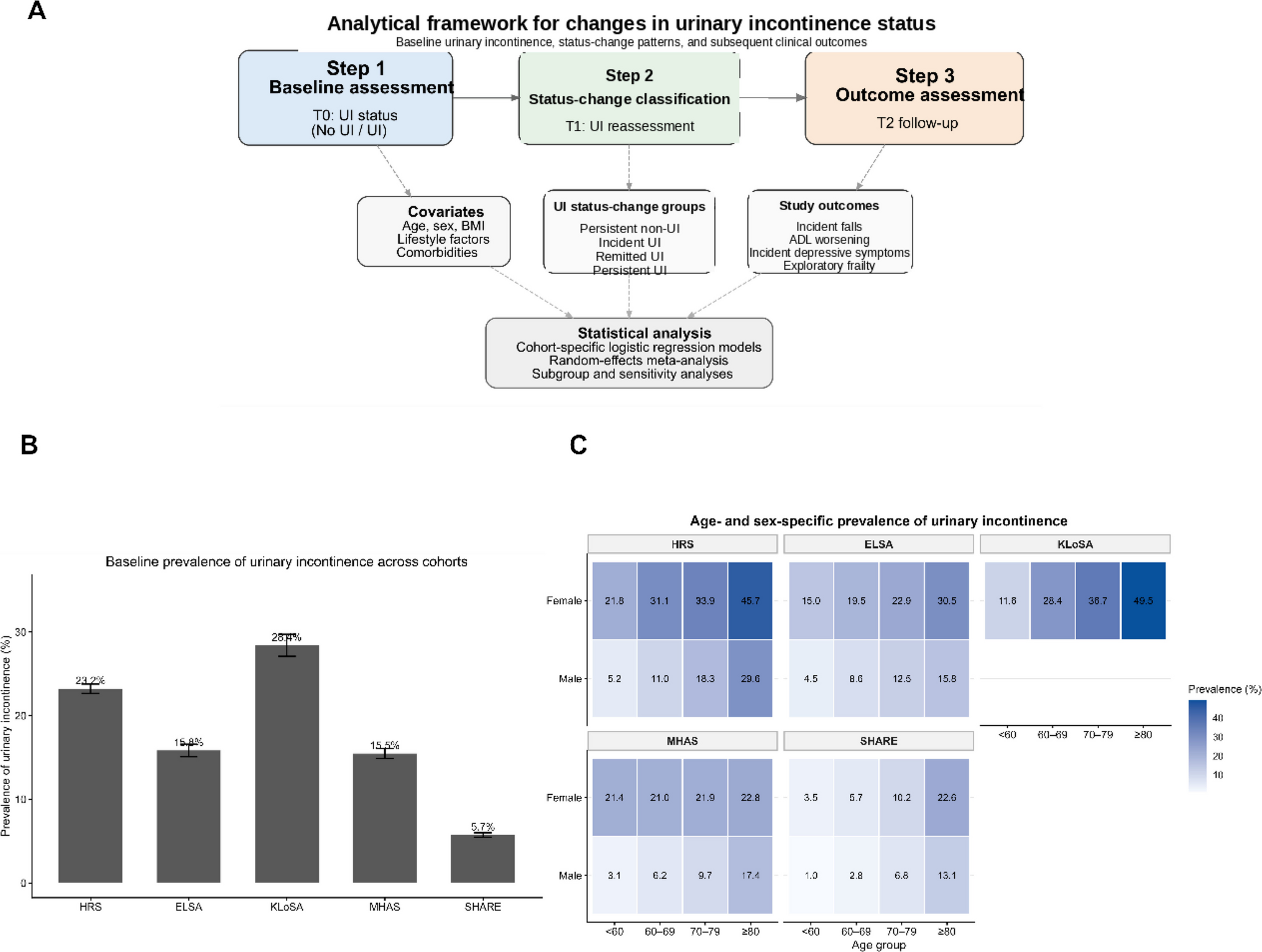
Men and women in five international aging cohorts contributed 85,788 cohort-specific analytical records to a longitudinal observational analysis. Researchers tracked urinary incontinence, or bladder leakage, across two assessments. They then examined subsequent falls, worsening ability to carry out basic daily activities, and new depressive symptoms.
Compared with no leakage at either assessment, leakage that began, stopped or persisted was associated with all three later outcomes. New and persistent leakage had the strongest links to worsening daily functioning. Even leakage that stopped remained associated with higher risks. Compared with no baseline leakage, baseline leakage corresponded to absolute risks higher by 7.5 percentage points for falls, 9.9 percentage points for worsening daily functioning and 6.4 percentage points for depressive symptoms.
Why it matters
Repeated checks of bladder control in aging populations may offer clinically useful information about later health beyond a single assessment.
Caveats
Other health problems may have contributed to both bladder leakage and the later outcomes. The abstract does not give follow-up durations, limiting interpretation of the absolute risk differences.
The paper
International Urogynecology Journal, Nov 6, 2026


Comments
Be the first to comment.