Atomoxetine not linked to lower Alzheimer’s risk in older adults
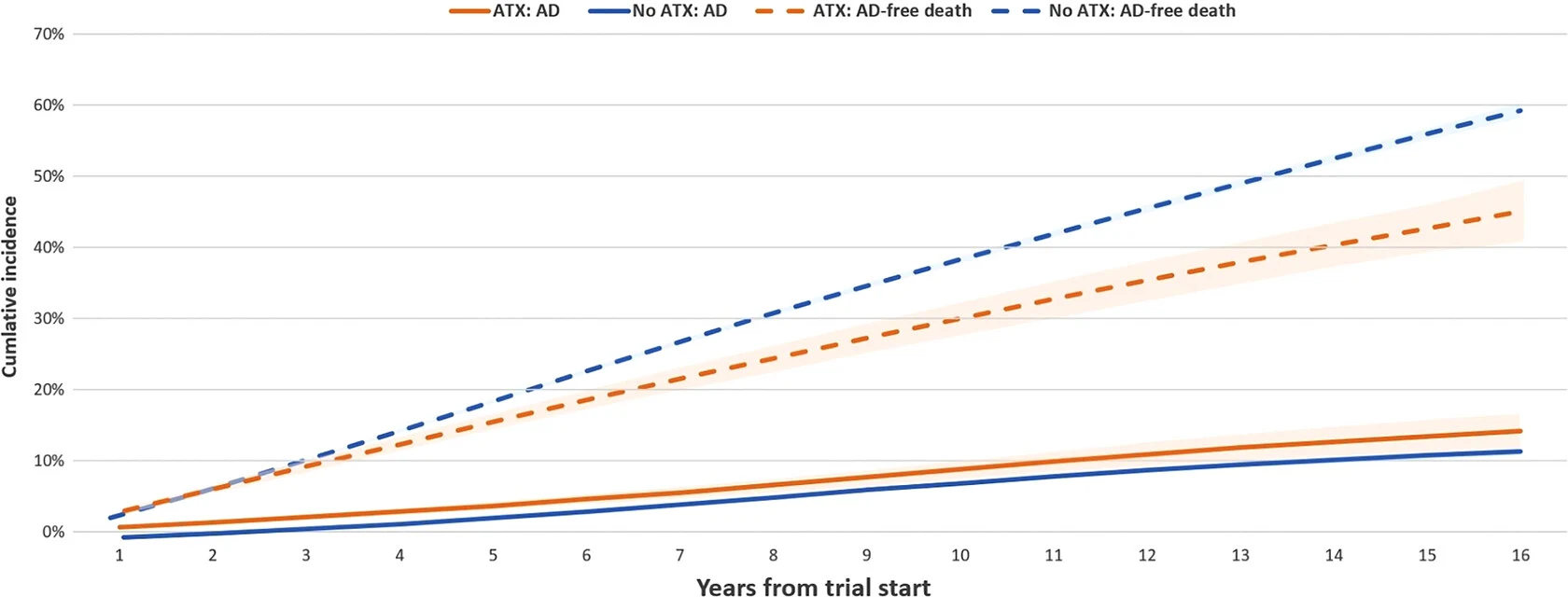
An analysis of 70,225 Medicare beneficiaries aged 66 or older compared people who started the drug with nonstarters over five and 10 years.
Our read
Populations- Studied:
- Cohort study of 70,225 older Medicare beneficiaries, against atomoxetine non-initiators
- What changed:
- Alzheimer's risk was similar in atomoxetine initiators and non-initiators at 5-year follow-up (risk ratio 1.10)
- The catch:
- Baseline cognitive status and mental illness severity were unmeasured potential confounders
- In the record:
- One of 9 papers on atomoxetine on record: 3 with results in people, 3 in animals.
Editor of record: Boris Djordjevic · AgingResearch.News
Among 70,225 US Medicare beneficiaries aged 66 or older, starting atomoxetine was not associated with lower Alzheimer’s disease risk over five or 10 years. The non-concurrent prospective study used existing insurance records to mimic a hypothetical randomized trial. It compared people who started atomoxetine with those who did not. Some people entered more than once, producing 70,367 study entries; 59.5% involved women.
The estimated five-year difference in Alzheimer’s risk was zero, with a range of likely values that included no difference. Participants had no previous diagnosis of mild cognitive impairment, Alzheimer’s disease or related dementias. Among people with depression, starting atomoxetine was associated with lower five-year Alzheimer’s risk. That association weakened at 10 years.
Why it matters
Alzheimer’s prevention is a proposed use for atomoxetine. The authors said its possible role among older people with depression warrants further study.
Caveats
The authors note that 87% discontinued atomoxetine within one year, limiting assessment of sustained use over several years. The results may not extend to younger people or Medicare Advantage enrollees.
From the paper
- Result
The 5-year risk of AD was similar in atomoxetine initiators and non-initiators (RR, 1.10; 95% CI, 0.93 to 1.29; RD, 0.00; 95% CI, 0.00 to 0.01) …
- Limitation
Dementia outcomes were identified using claims-based algorithms and may be subject to misclassification, including delayed or incomplete ascertainment.
Quoted word for word from the full text on alz-journals.onlinelibrary.wiley.com.
The paper
Atomoxetine and risk of Alzheimer's disease in older adults
Intermountain Healthcare Department of Population Health Sciences Divisions of Health System Innovation and Research and Biostatistics Spencer Fox-Eccles School; Herbert Wertheim School of Public Health and Human Longevity Science University of California San Diego La Jolla California USA
Alzheimer's & Dementia, Nov 16, 2026, Open access, CC BY-NC-ND


Comments
Be the first to comment.