Older minipigs modeling Huntington’s show more gene activity changes
Gene activity differed from unmodified minipigs for seven genes at age 4 and 3,324 at age 8.
Our read
Mechanisms- Studied:
- Preprint: experiments in transgenic and wild-type minipigs, against minipigs aged 4 years
- What changed:
- Gene activity differences from wild-type minipigs increased from seven genes at 4 years to 3,324 at 8 years
- The catch:
- The model lacks somatic repeat expansion, a major driver of Huntington’s progression
Editor of record: Boris Djordjevic · AgingResearch.News
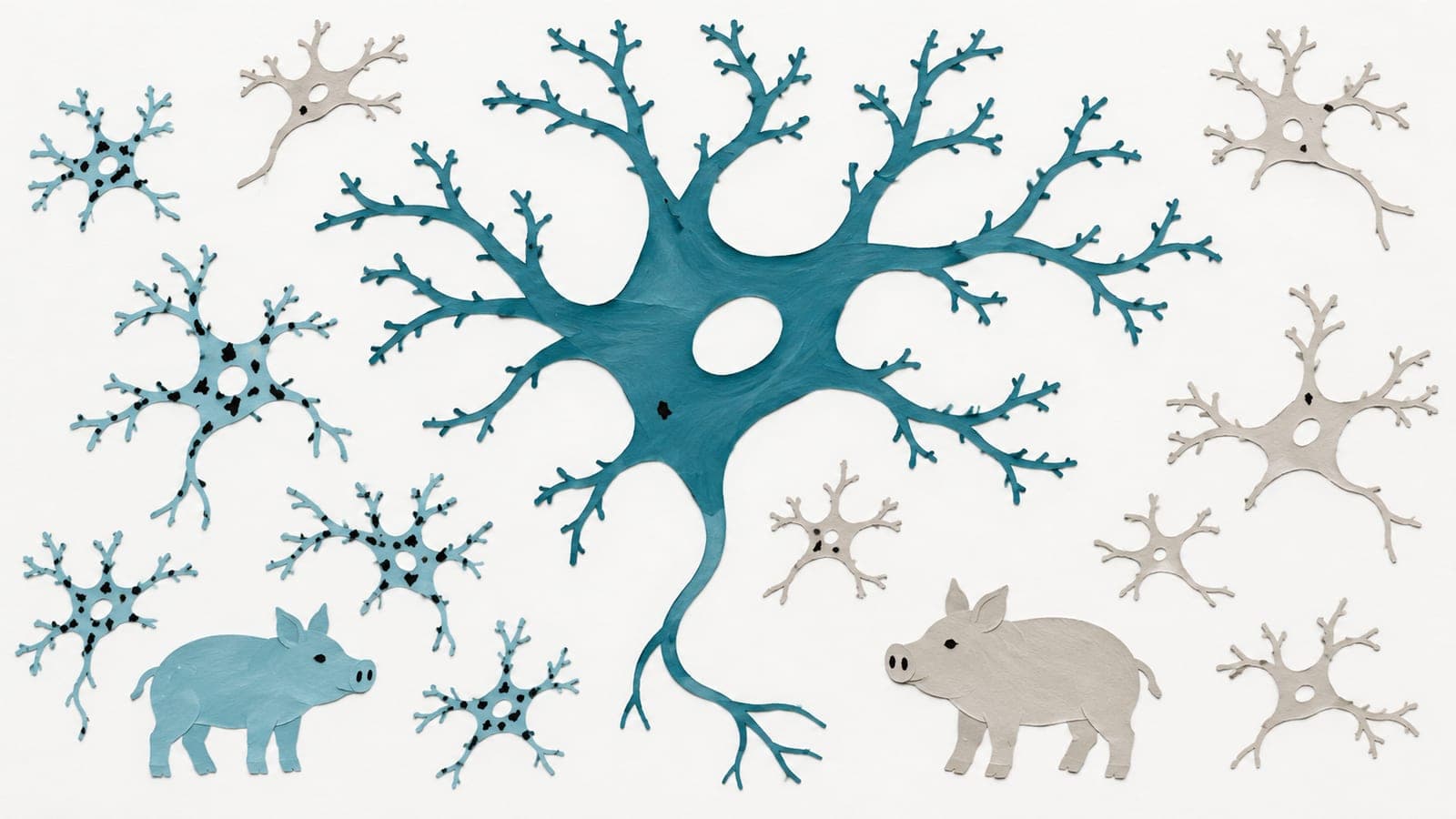
Genetically modified minipigs modeling Huntington’s disease were compared with unmodified minipigs at ages 4 and 8 in an animal experiment. The team measured gene activity and proteins in the putamen, a brain region that degenerates early in people with the disease. Gene activity differed for seven genes at 4 years and 3,324 at 8 years. At 8 years, gene activity and protein measurements pointed to similar changes in biological processes.
Markers of one type of nerve cell were reduced at 8 years in both analyses. The authors proposed that these reduced markers reflected a loss of nerve-cell identity rather than cell death. They suggested that the minipigs may model the disease’s slow early phase, when treatment is arguably most likely to help.
Why it matters
Huntington’s disease has no treatment that changes its course. Long-lived minipigs offer a way to follow the effects of a single gene-therapy dose for years.
Caveats
The minipig model lacks the expansion of repeated DNA within cells that is a major driver of progression in human Huntington’s disease. This preprint has not been peer-reviewed.
The paper
Institute of animal physiology and genetics
bioRxiv, Nov 16, 2026, Open access, CC BY-NC-ND, Preprint, not yet peer-reviewed



Comments
Be the first to comment.