Nutrient-sensing circuit guides gut cell development in flies
Fruit fly experiments identified signals that controlled the development of nutrient-absorbing gut cells; disrupting the circuit impaired renewal during aging and shortened lifespan.

Our read
Mechanisms- Studied:
- Preprint: experiments in fruit flies
- What changed:
- In fed flies, PWP1 was needed for immature gut cells to become nutrient-absorbing cells and could trigger that development
- The catch:
- The abstract omits group sizes for the lifespan experiments
- Why it’s aging research:
- Lifespan, survival or healthspan.
Editor of record: Boris Djordjevic · AgingResearch.News
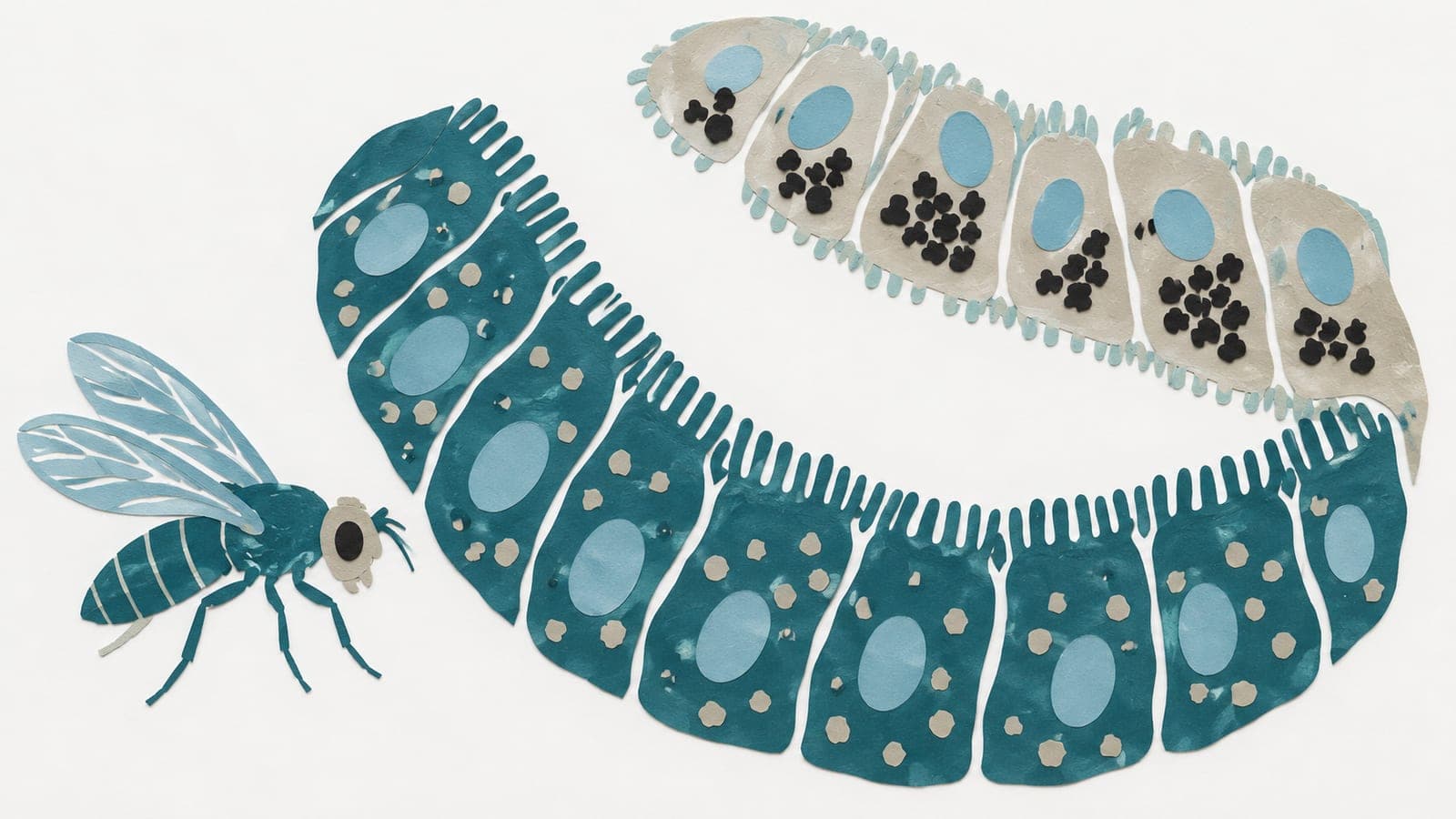
In fruit flies, experiments identified a nutrient-responsive circuit that guided immature gut cells to become enterocytes, the cells that absorb nutrients. The circuit involved mTORC1, a nutrient-responsive protein complex, and PWP1, a protein acting downstream of it. In fed flies, PWP1 was needed for this development and could also trigger it. When mTORC1 activity was high, PWP1 controlled gene activity to promote a signaling pathway called Hedgehog. This pathway drove the immature cells to become enterocytes.
Disrupting the circuit caused enterocyte replacement to fail progressively as flies aged and shortened lifespan. The aged guts maintained their barrier function, but defective renewal disrupted the regulation of intestinal metabolism.
Why it matters
The authors propose that nutrient-responsive cell growth helps determine when gut cells can specialize, linking the control of cell development to organ renewal during aging.
Caveats
The experiments tested gut renewal in fruit flies, not people. The preprint has not been peer-reviewed, and its abstract does not give group sizes for the lifespan experiments.
The paper
University of Helsinki
bioRxiv, Nov 4, 2026, Open access, CC BY, Preprint, not yet peer-reviewed

Comments
Be the first to comment.