Frailty patterns linked to stroke risk in Chinese women
Over three years, stroke incidence ranged from 2.7% in women with low, progressing frailty to 7.2% in those with high, stable frailty.
Our read
Populations- Studied:
- Preprint: cohort study of 4,954 people
Editor of record: Boris Djordjevic · AgingResearch.News
Among 4,954 Chinese women averaging 58.9 years old, a longitudinal cohort study linked patterns of accumulating health problems, or frailty, to later stroke. None reported a physician’s diagnosis of heart disease or stroke during 2011–2015. Researchers assessed frailty using 14 items covering daily activities, chronic conditions unrelated to the heart or blood vessels, and thinking tests. They grouped changes through 2015 into four patterns and tracked self-reported physician-diagnosed strokes from 2015 to 2018.
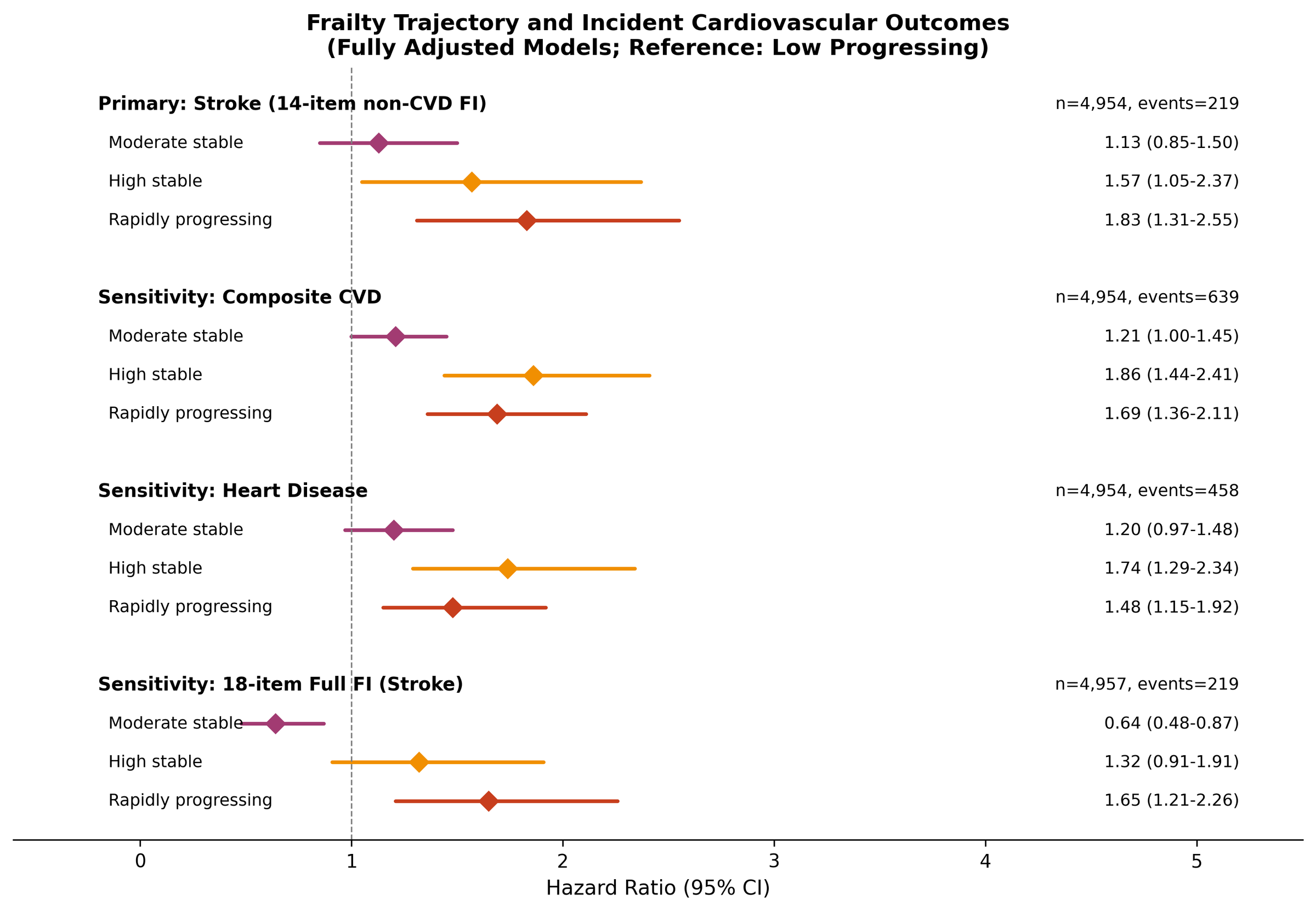
After accounting for age and other factors, rapidly progressing frailty had the strongest association with stroke. Its hazard ratio—a measure of relative risk—was 1.83 compared with low, progressing frailty. High, stable frailty was also associated with higher risk. The findings appeared in a preprint that has not been peer-reviewed.
Why it matters
Repeated assessments of accumulating health problems may help identify women at elevated stroke risk as they age, the authors suggest.
Caveats
Stroke outcomes relied on women reporting a physician’s diagnosis, and other health differences could have contributed to the association. The results concern Chinese women without reported heart disease or stroke through 2015, not men or people with those conditions.
From the paper
- Participants
Among 4,954 women (mean age 58.9 years), four trajectories emerged: Low progressing (n = 2,349, 47.4%), Moderate stable (n = 2,201, 44.4%), High stable (n = 567, 11.4%), and Rapidly progressing (n = 937, 18.9%).
- Result
In fully adjusted models (reference: Low progressing), High stable was associated with higher stroke risk (HR 1.57, 95% CI: 1.05–2.37), and Rapidly progressing showed the strongest association (HR 1.83, 95% CI: 1.31–2.55).
Quoted word for word from the full text on researchsquare.com.
- Stroke
- Heart disease
- Cardiovascular disease
- Incident stroke
- 14-item non-cardiovascular frailty index
- Humans
The paper
Jinhua People’s Hospital
Research Square, Nov 10, 2026, Open access, Preprint, not yet peer-reviewed



Comments
Be the first to comment.