Age-Related Differences in Segment-Specific Center-of-Mass Acceleration During One-Leg Standing: Associations With Pelvic–Spinal Alignment
Abstract
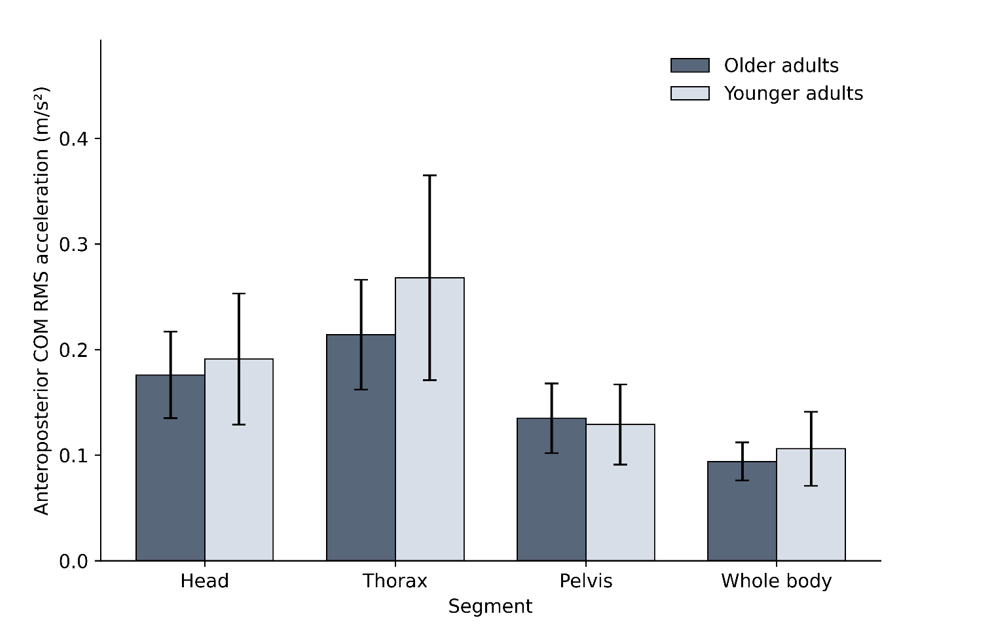
Background One-leg standing (OLS) is widely used to assess static balance, but OLS duration provides limited information regarding biomechanical control. Whether segment-specific center-of-mass (COM) acceleration differs between older and younger adults during OLS and whether these regional patterns are associated with sagittal pelvic–spinal alignment in older adults remain unclear. We compared segment-specific COM control during OLS between age groups and examined associations with pelvic–spinal alignment in older adults. Methods Seventeen older adults (72.4 ± 3.9 years) and 16 younger adults (20.3 ± 0.6 years) performed OLS. Three-dimensional motion capture was used to calculate root mean square (RMS) accelerations of the head, thorax, pelvis, and whole-body COM in the anteroposterior (AP) and mediolateral (ML) directions. Thoracic kyphosis, lumbar lordosis, and pelvic tilt were measured using a Spinal Mouse device. Welch's t-test and Pearson’s correlation coefficients were used for group comparisons and associations, respectively. Results Older adults had greater ML COM RMS acceleration in the head, thorax, pelvis, and whole body (all p ≤ 0.022; Cohen's d = 0.83–1.96), whereas AP outcomes did not differ significantly. In older adults, greater posterior pelvic tilt was associated with greater ML COM RMS acceleration of the head, pelvis, and whole body (r = -0.654 to -0.522), and greater thoracic kyphosis with greater pelvic ML COM RMS acceleration (r = 0.492). Lumbar lordosis was not significantly associated with COM outcomes. Conclusions Older adults showed greater ML COM acceleration during OLS, with these patterns associated with sagittal pelvic–spinal alignment. COM acceleration may complement OLS duration in characterizing lateral balance.
- Anteroposterior center-of-mass RMS acceleration
- Center-of-mass acceleration outcomes
- Lumbar lordosis
- Mediolateral center-of-mass RMS acceleration
- Pelvic tilt
- Humans
The paper
Josai International University; Chiba Prefectural University of Health Sciences
Research Square, 14 Oct 2026, Open access, Preprint, not peer-reviewed