Alcohol Intake Amplifies the Association Between Triglyceride–Cholesterol–Body Weight Index (TCBI) and Incident Hypertension: A Nationwide Cohort Study
9 years, dose-response
Abstract
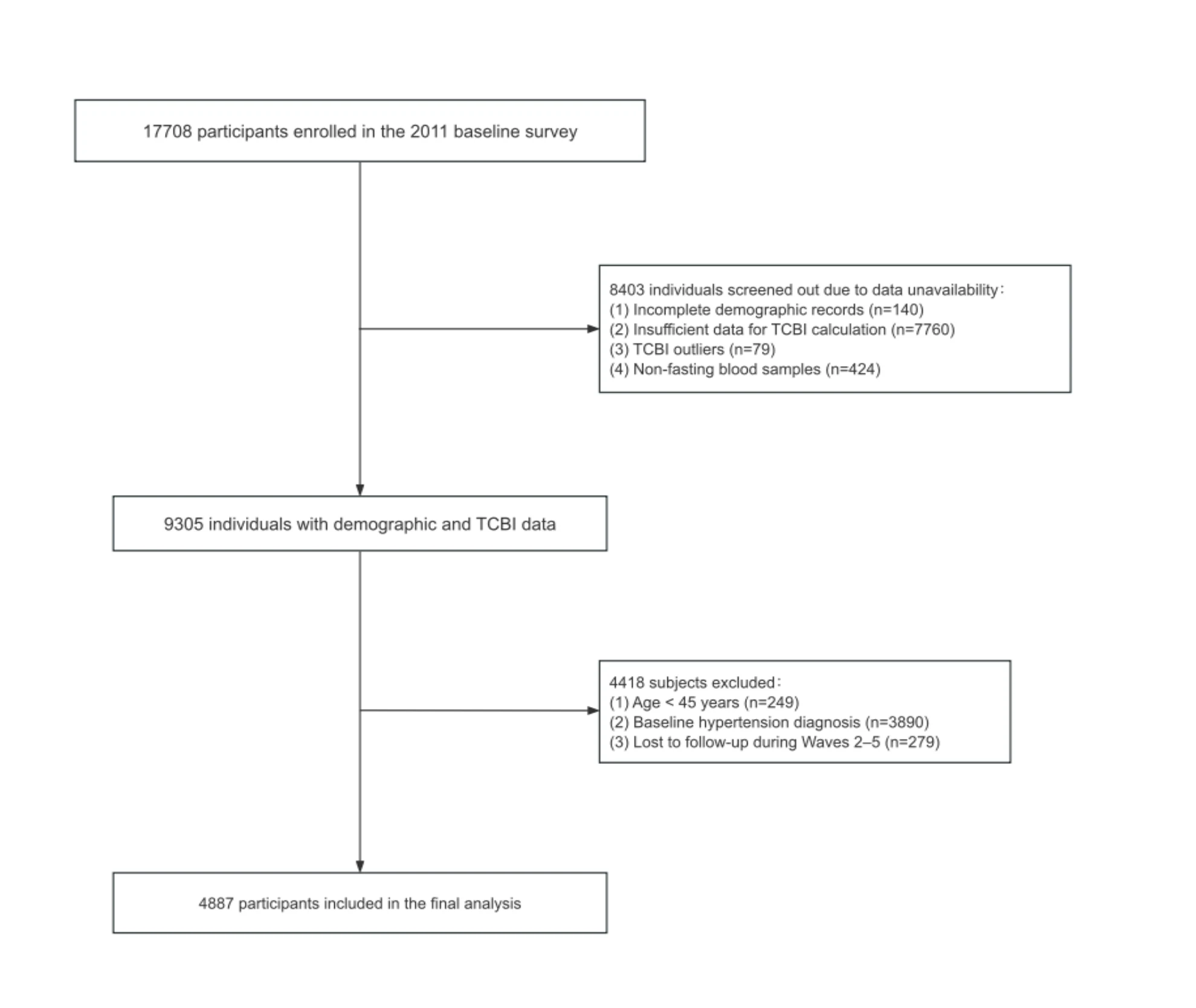
Background Hypertension remains a major public health challenge, yet early identification of individuals at high risk is still inadequate. The triglyceride–cholesterol–body weight index (TCBI) is a simple metabolic and nutritional marker, but its role in incident hypertension is not well understood. It also remains unclear whether alcohol intake modifies this association. We therefore examined the relationship between TCBI and incident hypertension and explored the modifying effect of alcohol intake in a nationwide Chinese cohort. Methods We analyzed data from the China Health and Retirement Longitudinal Study (CHARLS). The study included 4,887 adults aged 45 years or older who were free of hypertension at baseline. Alcohol intake was defined according to self-reported intake of any alcoholic beverage in the previous year. Cox proportional hazards models were used to estimate hazard ratios (HRs) and 95% confidence intervals (CIs) for incident hypertension. We also added an interaction term for TCBI and alcohol intake. In addition, restricted cubic spline (RCS) models were used to examine dose–response patterns, receiver operating characteristic (ROC) analyses were conducted to assess predictive performance across drinking-status groups, and subgroup and sensitivity analyses were performed to evaluate the robustness of the findings. Results During a median follow-up of 9 years, 1,743 participants developed hypertension, yielding an incidence density of 51.93 per 1,000 person-years. In the fully adjusted model, high TCBI was associated with a higher risk of incident hypertension (HR 1.35, 95% CI 1.23–1.49), whereas alcohol intake alone was not independently associated with risk (HR 1.10, 95% CI 0.99–1.23). Joint analyses showed that participants with both high TCBI and drinking had the greatest risk of incident hypertension (HR 1.54, 95% CI 1.33–1.78) compared with low-TCBI non-drinkers. The interaction between TCBI and alcohol intake was significant (P for interaction = 0.006). RCS analyses further showed a linear dose–response association, with a steeper increase in risk among drinkers. Adding TCBI to the base prediction model led to a modest improvement in model discrimination in the overall cohort when compared with the base model (AUC, 0.641 vs. 0.627; P < 0.001). A similar pattern was seen among drinkers, where the AUC increased from 0.631 to 0.649 (P = 0.026). Among non-drinkers, the improvement was relatively small and did not reach statistical significance (AUC, 0.645 vs. 0.639; P = 0.056). Sensitivity analyses yielded consistent results. Conclusion Higher TCBI was independently associated with incident hypertension, and this association was stronger among drinkers. Individuals with both high TCBI and alcohol intake had the highest risk. These findings suggest that incorporating drinking status may improve risk stratification and support more targeted prevention of hypertension.
The paper
Shandong University
Research Square, 14 Oct 2026, Open access, Preprint, not peer-reviewed