County-Level Radiologist Workforce Density, Cancer Mortality, and the Modeled Impact of AI-Augmented Diagnostic Capacity: A U.S. Ecological Analysis
Abstract
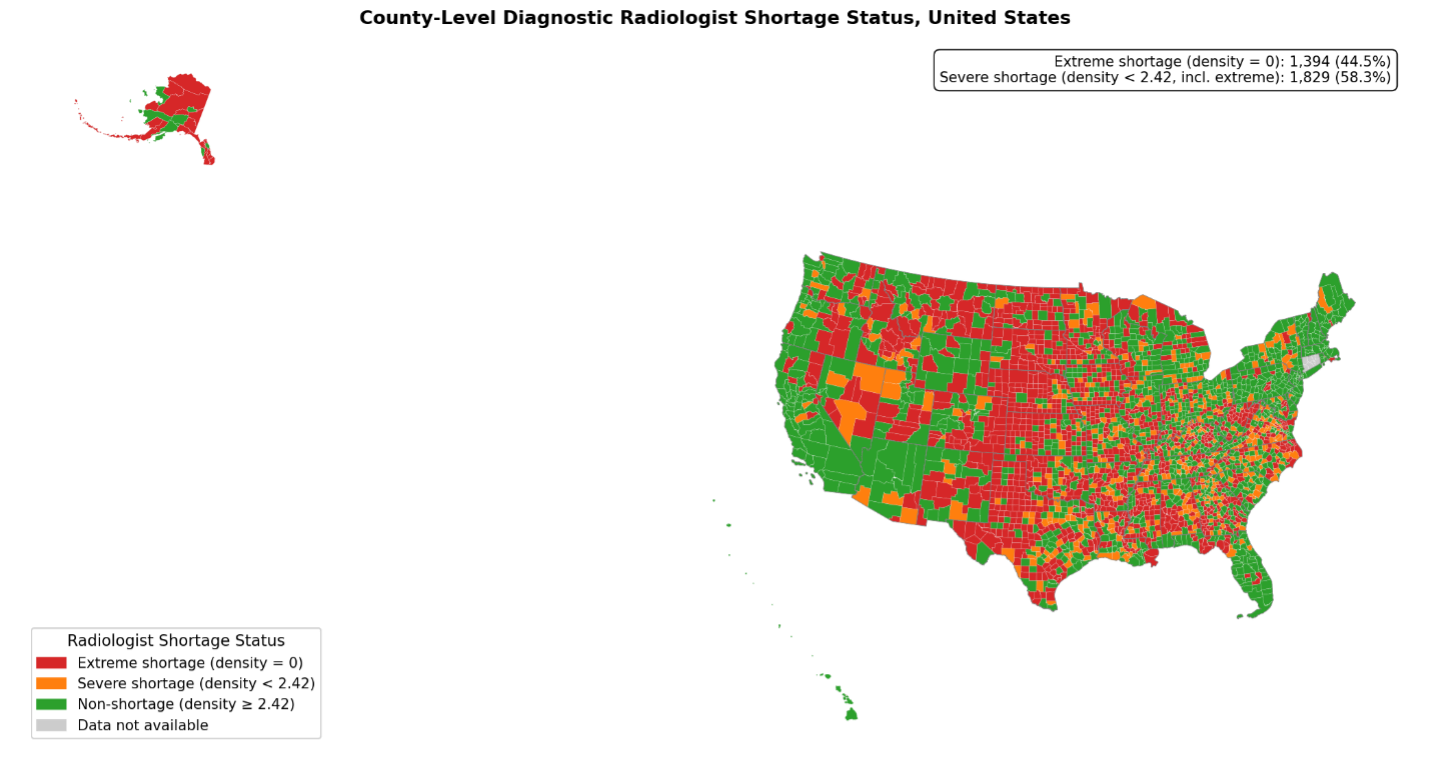
Timely cancer diagnosis depends on adequate diagnostic imaging capacity, yet radiologist workforce availability remains unevenly distributed across U.S. counties. This study examined the association between county-level diagnostic radiologist density and age-adjusted cancer mortality across 3,073 U.S. counties using cross-sectional ecological analysis integrating provider enrollment, cancer registry, socioeconomic, and population data. In the fully adjusted model, higher log-transformed radiologist density was significantly associated with lower cancer mortality (β = −2.01 per 100,000; 95% CI: −2.82 to − 1.19; p < 0.001), with results robust to spatial autocorrelation (spatial error model β = −1.96) and twelve sensitivity analyses. Counties with zero radiologist presence (n = 1,334; population 22.6 million) were identified as having the greatest modeled mortality burden. Decision-analytic scenario modeling estimated that AI-equivalent augmentation matching the median nonzero-county density (ΔAI = 6.05 per 100,000) would correspond to a modeled annual mortality difference equivalent to approximately 887 deaths in this subgroup. The modeled association showed diminishing marginal differences, with larger estimated differentials when capacity was introduced into zero-radiologist counties than in higher-density settings. These findings suggest radiologist workforce distribution may represent a policy-relevant marker of diagnostic capacity and highlight zero-radiologist counties as targets for further evaluation of capacity-expanding interventions, including AI-equivalent approaches.
The paper
Independent Researcher
Research Square, 14 Oct 2026, Open access, Preprint, not peer-reviewed