Model infers spatial neighborhoods in dissociated single cells
The computational tool predicted cellular proximity across brain regions and identified age-associated neighborhood remodeling in an 8-month Alzheimer dataset.
Our read
AI & data- Studied:
- Preprint: computational study
- In the record:
- One of 12,957 papers on Alzheimer's disease on record: 2,814 with results in people, 185 in animals.
Editor of record: Boris Djordjevic · AgingResearch.News
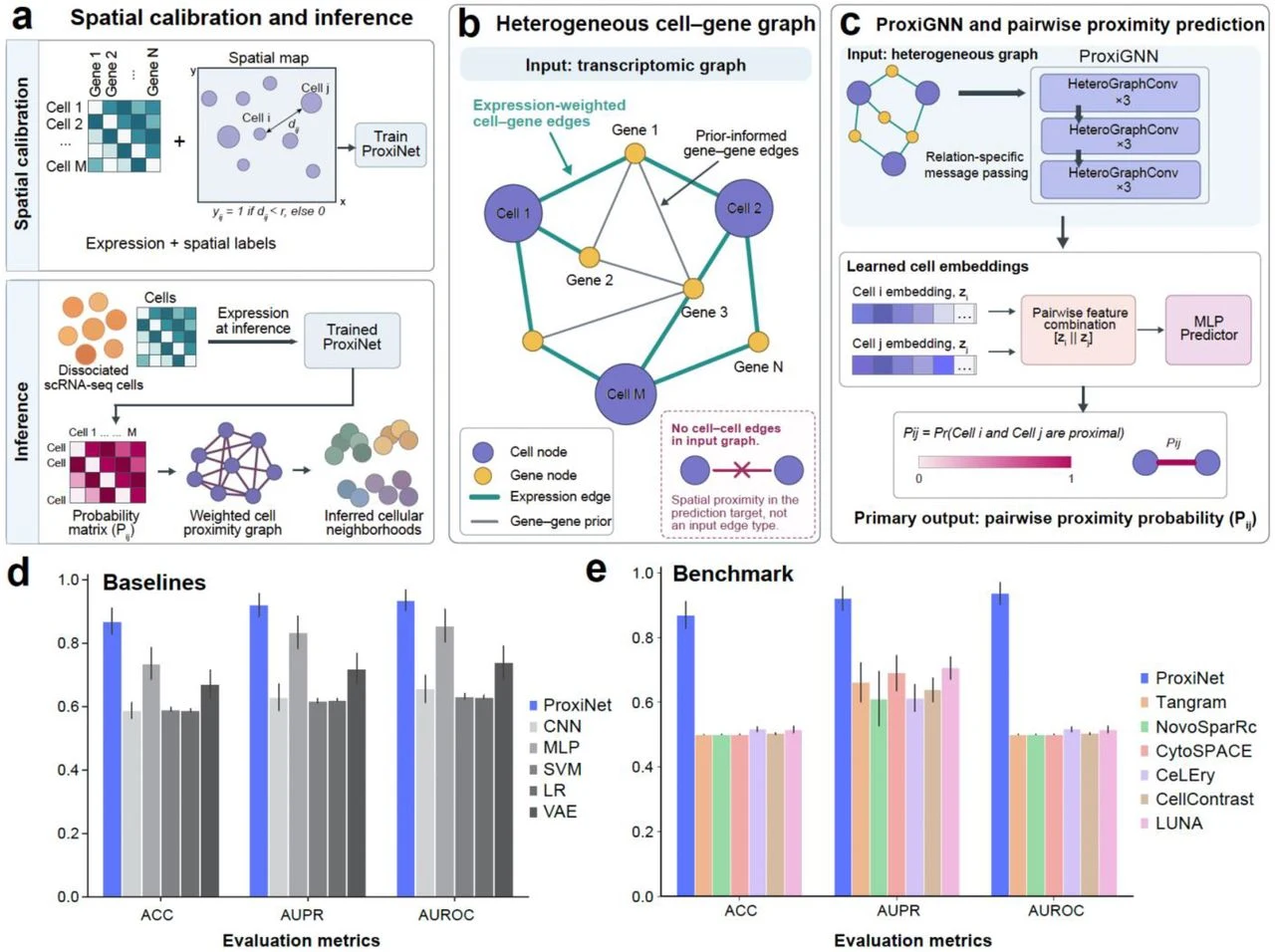
In brain tissue transcriptomic datasets, researchers tested ProxiNet, a computational framework designed to infer cellular proximity from dissociated single-cell RNA sequencing. While spatial transcriptomics captures intact tissue architecture, dissociated single-cell methods lose spatial context. ProxiNet trains on spatial reference data to learn expression signatures of pairwise cell proximity and transfers those relationships to dissociated cells.
The framework predicted proximity across brain regions and across different spatial technologies. In datasets with known coordinates, it recovered anatomical structures and reproducible tissue organization. When applied to dissociated single-cell data, ProxiNet revealed cellular neighborhoods and candidate cell communication programs. In an Alzheimer dataset, the model detected age-associated neighborhood remodeling, including an altered neighborhood at 8 months marked by distinct astrocyte and neuronal transcriptional states.
Why it matters
Mapping how cellular neighborhoods reorganize over time could clarify how localized cell-to-cell communication programs change during aging and neurodegeneration.
Caveats
The findings were reported in a preprint and rely on computational inference, meaning the predicted spatial relationships and communication programs require direct experimental confirmation.
From the paper
- Limitation
Although we found generalization across anatomical regions and three spatial technologies, testing additional organs, species, and disease contexts will be necessary to establish broader transferability.
Quoted word for word from the full text on bioRxiv.
The paper
ProxiNet transfers spatially learned cellular proximity to dissociated single-cell transcriptomes
Whitehead Institute for Biomedical Research
bioRxiv, Sep 30, 2026, Open access, Preprint, not yet peer-reviewed


Comments
Be the first to comment.