Human blood cell model outperforms 35 age-assessment methods
Trained on data from 1,284 donors, the computational framework predicted age more accurately than comparison methods in tests that included independent datasets.
Our read
Biomarkers- Studied:
- Computational study of clinically healthy blood donors, against 35 comparison methods
- What changed:
- The model predicted donors’ ages more accurately than 35 comparison methods
- The catch:
- Benchmarks measured chronological age, not clinical immune function
- In the record:
- The 46th paper on systemic lupus erythematosus with results in people; 245 on record in all.
Editor of record: Boris Djordjevic · AgingResearch.News
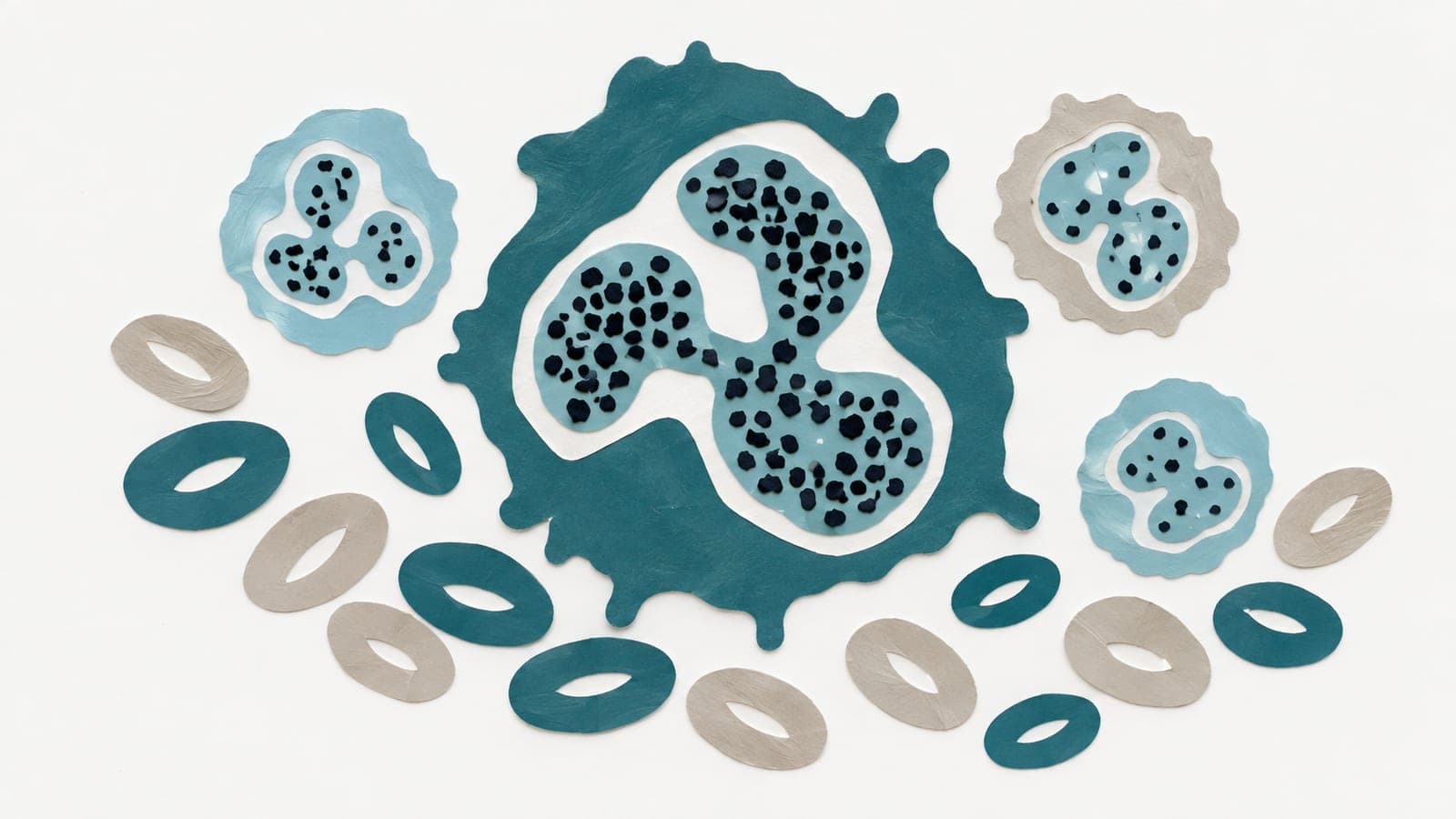
In a computational study of human peripheral blood mononuclear cells, immune cells isolated from blood, researchers built IDEAL-Age to predict donors’ chronological ages from individual cells’ gene activity. They trained it on 1,284 donors. Independent tests included groups of 48, 96 and 421 donors. Benchmarking used only clinically healthy people.
IDEAL-Age outperformed 35 comparison methods. Its analyses identified genes whose contributions to age predictions changed steadily or followed more complex patterns across life. It also identified cell groups associated with youth or aging. Applied to data from people with systemic lupus erythematosus, an autoimmune disease, the model indicated accelerated immune aging. The authors linked this to shifts in monocytes, a type of immune cell, associated with interferons, proteins involved in immune signaling.
Why it matters
Immune aging increases susceptibility to infection and reduces vaccine responsiveness. Cell-level analysis offers a way to investigate age-related variation that measurements averaging many cells can obscure.
Caveats
The benchmarks measured agreement with chronological age, not clinical immune function. The computational associations do not establish that the identified genes or cells caused immune aging.
The paper
Chinese Academy of Sciences
Genome Biology, Jul 27, 2026, Open access
Comments
Be the first to comment.