Plasma proteins link to metabolomic aging and disease risk
In over 400,000 UK Biobank participants, an NMR metabolomic aging score tracked mortality and pinpointed six candidate causal plasma proteins across adulthood.
medRxiv
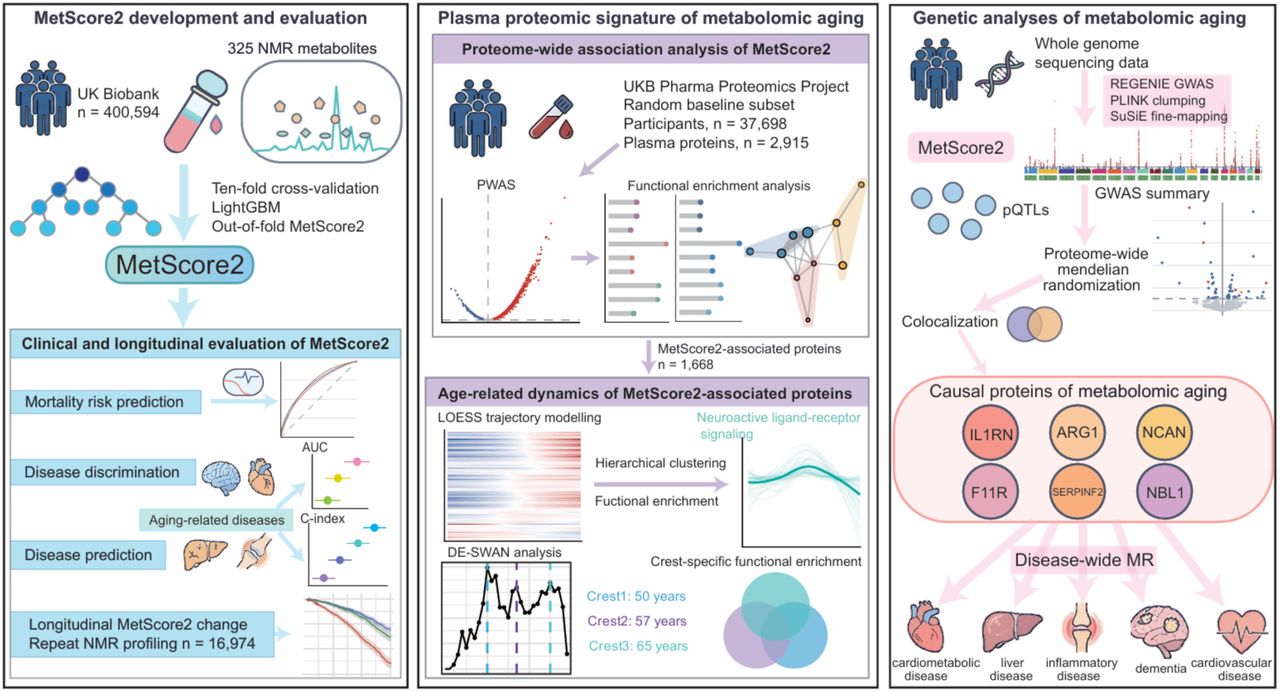
In an observational study of 400,594 UK Biobank participants, researchers developed MetScore2, a biological aging metric derived from 325 nuclear magnetic resonance metabolomic biomarkers. Higher MetScore2 values marked earlier onset of age-related diseases, and faster increases in the score over time predicted higher mortality. Integrating circulating proteomics revealed plasma proteins tied to the score. This protein signature was broadly similar across sexes but showed undulating shifts across mid-to-late adulthood, with peaks at 50, 57 and 65 years of age. Combining genome-wide association data, Mendelian randomization and colocalization identified six putative causal proteins: IL1RN, ARG1, NCAN, F11R, SERPINF2 and NBL1, each linked to distinct disease patterns.
Why it matters
Connecting blood metabolites with circulating proteins helps clarify the molecular architecture of biological aging. Prioritizing these putative causal proteins offers specific candidate pathways for future work on age-related disease mechanisms.
Caveats
The analysis relies on observational and genetic association models in a single population cohort. The work is a preprint and has not yet completed peer review.
The paper
Metabolomic profiling identifies plasma protein biomarkers of biological aging
Show 10 more authors
Yu Zhao, Hanzhu Zhao, Yuanfeng Huang, Gao Shuo, Yijing Wang, Xingxing Jian, Guihu Zhao, Ying Zhang, Jinchen Li, Julian Mutz,Central South University
medRxiv · 28 Sep 2026 · Preprint, not peer-reviewed