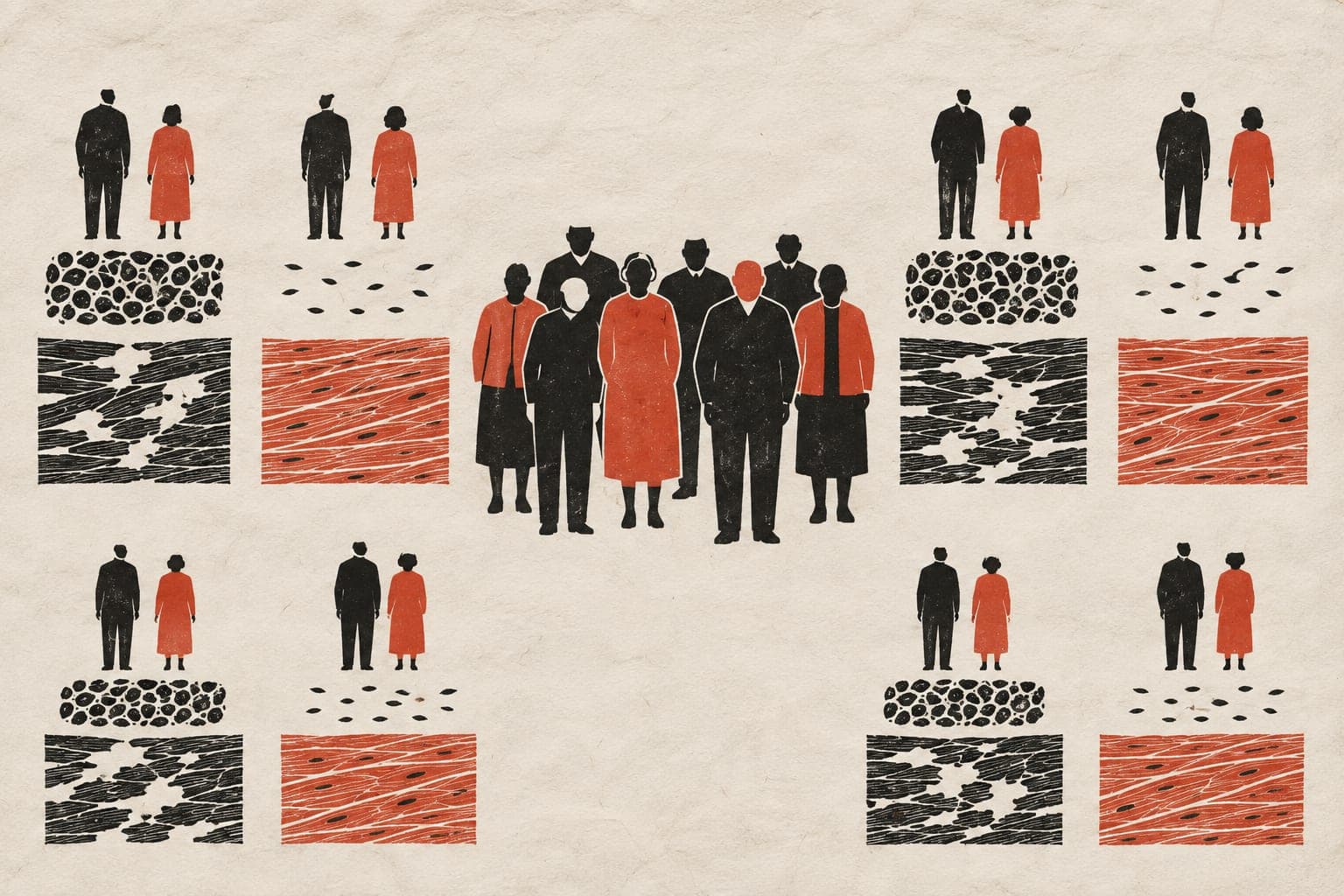
Joint pain-depression burden profiles and subsequent activities-of-daily- living disability in older adults with arthritis: a five-cohort population- based study
Abstract
Background. Arthritis is a leading contributor to disability in older adults. Chronic pain and depression each predict loss of functional independence, and they commonly co-occur. Whether their combined longitudinal profile —rather than symptom severity at a single visit—is associated with activities-of-daily-living (ADL) disability across countries and health systems remains uncertain. Methods. We performed a parallel replication across five ageing cohorts: HRS (United States), SHARE (multiple European countries), ELSA (England), CHARLS (China), and MHAS (Mexico). Community-dwelling adults aged ≥ 50 years with doctor-diagnosed arthritis at baseline were eligible. Pain and depression were assessed across five waves in four cohorts and four waves in CHARLS. Joint pain–depression profiles were identified with Gaussian-mixture clustering of standardized longitudinal profiles (k = 5). The outcome was any ADL disability at each cohort's final scheduled wave. Age- and sex-adjusted logistic regression (reference: lowest composite-burden class) and a random-effects meta-analysis quantified the association [11] . Results. Among 17,264 arthritis participants, 7,427 had complete pain–depression profiles and 7,424 contributed to the primary final-wave ADL model. In every cohort, the highest composite-burden class carried the highest prevalence of ADL disability at follow-up (range 31%–58%) and the highest odds versus the lowest composite-burden class (age- and sex-adjusted OR 2.42–9.26). The pooled random-effects OR was 4.77 (95% CI 2.67–8.54; approximate 95% prediction interval 1.23–18.55), with high between-cohort heterogeneity (I²=90%). Lag-adjusted cross-lagged coefficients were estimated descriptively; no causal directionality was inferred. Conclusions. Among older adults with arthritis, joint longitudinal pain–depression burden profiles were consistently associated with later ADL disability across five cohorts. The highest-burden class may help identify a subgroup with higher odds of disability, but the result is observational and does not establish that symptom worsening causes disability.
From the paper
- Participants
Among 17,264 arthritis participants, 7,427 had complete pain–depression profiles and 7,424 contributed to the primary final-wave ADL model.
- Result
The pooled random-effects OR was 4.77 (95% CI 2.67–8.54; approximate 95% prediction interval 1.23–18.55), with high between-cohort heterogeneity (I²=90%).
- Limitation
The weighting analysis addressed measured baseline predictors and missingness indicators, but its validity depends on the selection model and it cannot account for unmeasured mechanisms [27].
Quoted word for word from the full text on researchsquare.com.
The paper
Peking University Cancer Hospital
Research Square, 11 Sep 2026, Preprint, not peer-reviewed