Hobbies linked to lower risk of functional disability
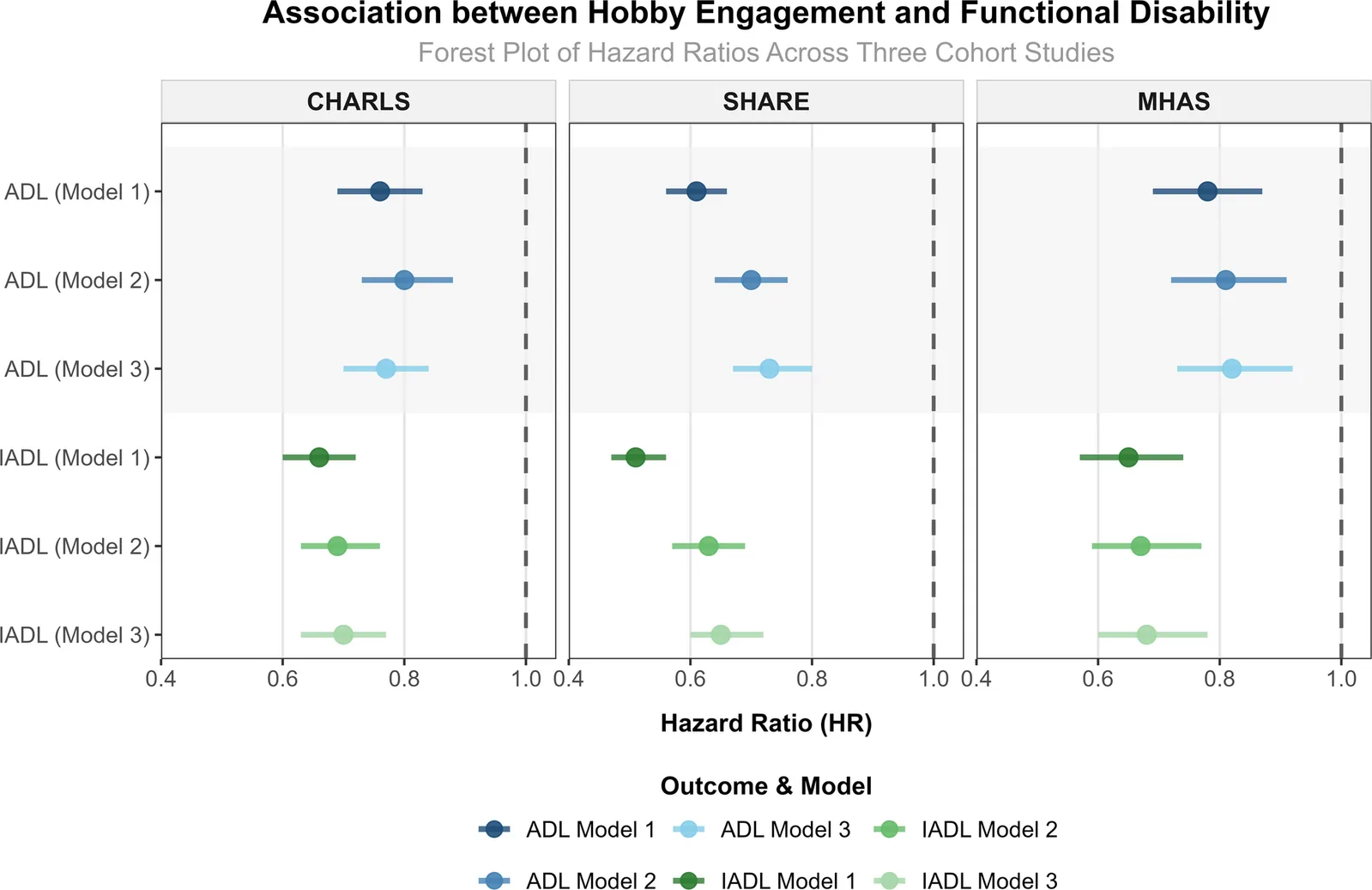
In three cohorts, hobby engagement was linked to lower ADL disability risk, with hazard ratios of 0.77 in China, 0.73 in Europe, and 0.82 in Mexico.
BMC Public Health
Researchers analyzed longitudinal data from participants in the China Health and Retirement Longitudinal Study, the Survey of Health, Ageing and Retirement in Europe, and the Mexican Health and Aging Study. Participants self-reported hobby engagement and depressive symptoms, while functional disability was assessed using Activities of Daily Living (ADL) and Instrumental Activities of Daily Living (IADL) measures. Across all three cohorts, hobby engagement was associated with a reduced risk of ADL disability, with hazard ratios of 0.77 in China, 0.73 in Europe, and 0.82 in Mexico. It was similarly associated with reduced IADL disability risk, yielding hazard ratios of 0.70, 0.65, and 0.68, respectively. Linear mixed models showed hobbies were linked to a slower annual rate of functional decline. Depressive symptoms partially mediated these associations, accounting for 21.05% to 32.25% of the relationship for ADL disability and 12.53% to 14.52% for IADL disability.
Why it matters
Maintaining functional independence is a major target in longevity and public health research. The findings suggest that engaging in hobbies may help preserve physical function in older adults, partly by mitigating depressive symptoms across diverse cultural settings.
Caveats
The study relies on observational data, meaning these associations cannot establish a causal relationship. Furthermore, both hobby engagement and depressive symptoms were self-reported, and functional status was assessed via questionnaire measures rather than direct physical performance tests.
The paper
Wuhan Children's Hospital · Wuhan University
BMC Public Health · 8 Sep 2026