Polypharmacy and mortality in older persons: findings from a sub-cohort of SABE Colombia
Abstract
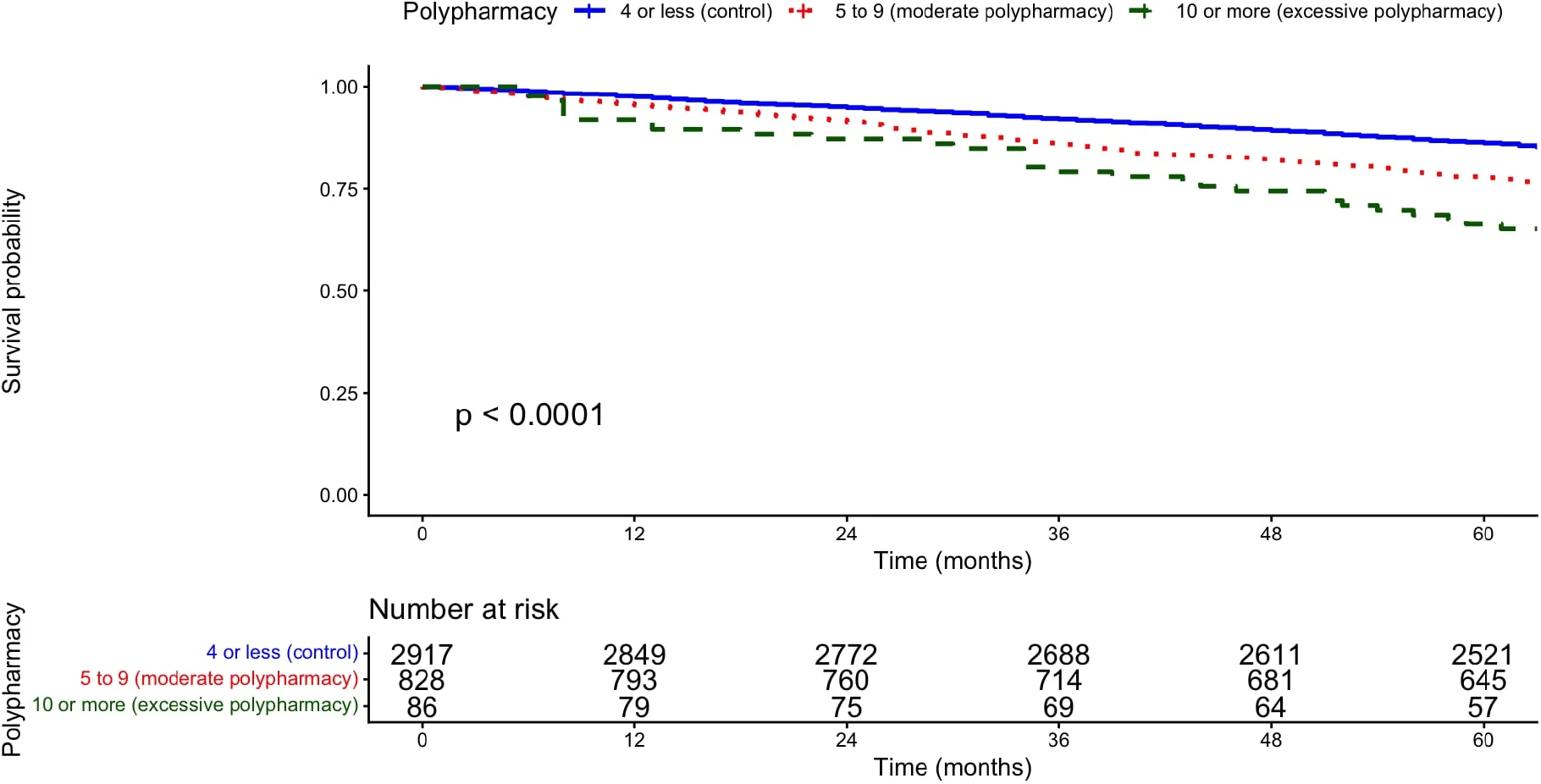
BackgroundPolypharmacy is an escalating global health challenge, yet longitudinal evidence regarding its impact on mortality in Latin American aging populations remains limited. This study evaluated the association between medication burden and all-cause mortality among community-dwelling older adults in a rapidly aging region of Colombia. MethodsA longitudinal analysis was conducted using a sub-cohort of 4,110 participants (aged [≥]60 years) from the SABE Colombia survey (Antioquia, Caldas, Risaralda, and Quindio). Vital status was adjudicated via the National Health System Resources Administrator (ADRES) database over a mean follow-up of 79 months. Polypharmacy was defined as the concurrent use of 5-9 medications and excessive polypharmacy as [≥]10. Extended Cox proportional hazards models were employed to estimate hazard ratios (HR), adjusting for sociodemographic factors, multimorbidity, and functional dependency. ResultsAt baseline, 20.2% of participants presented polypharmacy and 2.1% excessive polypharmacy. A total of 1,092 deaths (26.6%) were recorded during follow-up. After multivariable adjustment, both moderate polypharmacy (HR 1.17; 95% CI 1.02-1.31; p=0.029) and excessive polypharmacy (HR 1.82; 95% CI 1.34- 2.47; p<0.001) were identified as independent predictors of mortality. Notably, the risk was markedly higher at the [≥]10 medication threshold, suggesting a non-linear relationship between pharmacological burden and survival. ConclusionsPolypharmacy is a significant and independent predictor of mortality in Colombian older adults, with the risk nearly doubling in cases of excessive medication use. These findings underscore the urgent need for structured medication review and deprescribing interventions tailored to resource-constrained healthcare systems to mitigate the risks associated with high pharmacological accumulation.
The paper
Universidad Pontificia Bolivariana; University of Caldas
medRxiv, 25 Aug 2026, Preprint, not peer-reviewed