Heart rhythm disorder linked to poorer brain health beyond stroke
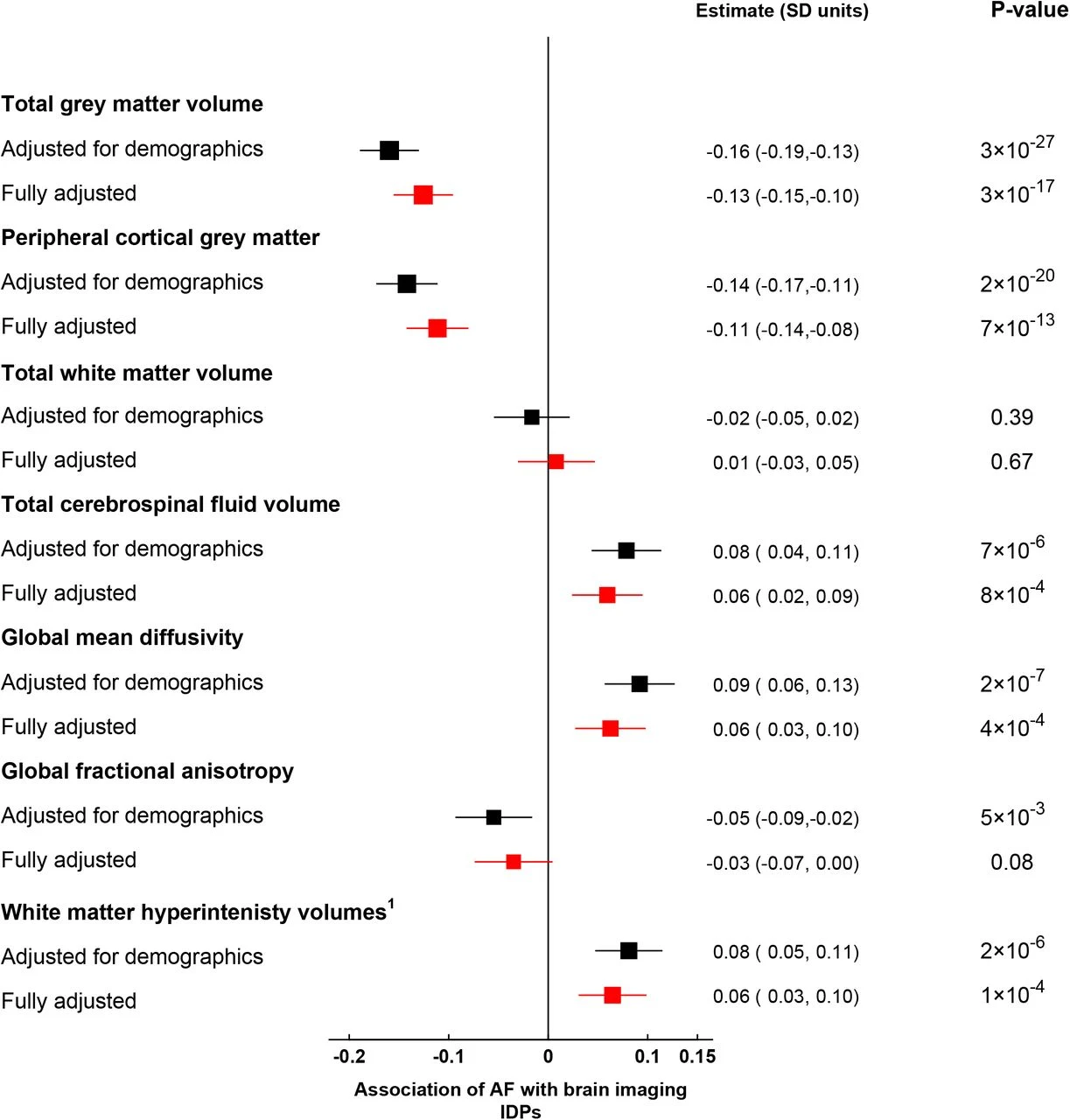
Gray matter volume was 0.13 standard deviations lower with the disorder than without it, even after accounting for stroke and other cardiovascular factors.
Our read
Populations- Studied:
- Preprint: cohort study of 72,973 UK Biobank participants with brain scans
- What changed:
- Gray matter volume was 0.13 standard deviations lower with atrial fibrillation than without it, after accounting for stroke
- The catch:
- Brain scan participants were younger and more educated than the overall cohort
- In the record:
- The 493rd paper on atrial fibrillation with results in people; 1,915 on record in all. Its result on cognitive function agrees with 9 of 10 other findings on record; 1 found no change.
- Why it’s aging research:
- It measures an outcome that worsens with age.
Editor of record: Boris Djordjevic · AgingResearch.News
An observational cohort study analyzed 502,099 UK Biobank participants, whose mean age at recruitment was 56.5 years and who had no previously recorded dementia. Researchers examined atrial fibrillation, an irregular heartbeat, alongside brain scans, thinking tests and dementia diagnoses. Follow-up records extended to 2023.
Among 72,973 people with brain scans, 2,538 had the disorder before scanning. It was linked to less gray matter, brain tissue rich in nerve-cell bodies, after accounting for stroke and cardiovascular factors. The difference was measured in standard deviations, which describe how widely measurements vary. Small differences in three of four thinking tests also persisted after these adjustments. In contrast, the authors concluded that ischemic stroke, caused by blocked blood flow, largely explained the dementia association. Mendelian randomization analyses, which used genetic variants to examine these links, supported a stroke-independent association with lower gray matter volume.
Why it matters
For dementia and other aspects of brain health in later life, the authors suggest that stroke prevention is necessary but may not be sufficient.
Caveats
The observational comparisons cannot establish cause and effect, and the imaging and cognitive groups were younger and more educated than the overall cohort. This preprint has not been peer-reviewed.
The paper
University of Oxford
medRxiv, Aug 12, 2026, Open access, CC BY, Preprint, not yet peer-reviewed


Comments
Be the first to comment.