Giving birth linked to delayed heart dysfunction in mice
In a heart failure model, mice that had given birth once developed heart relaxation problems later and had denser heart blood vessel networks than those that had not.
Our read
Mechanisms- Studied:
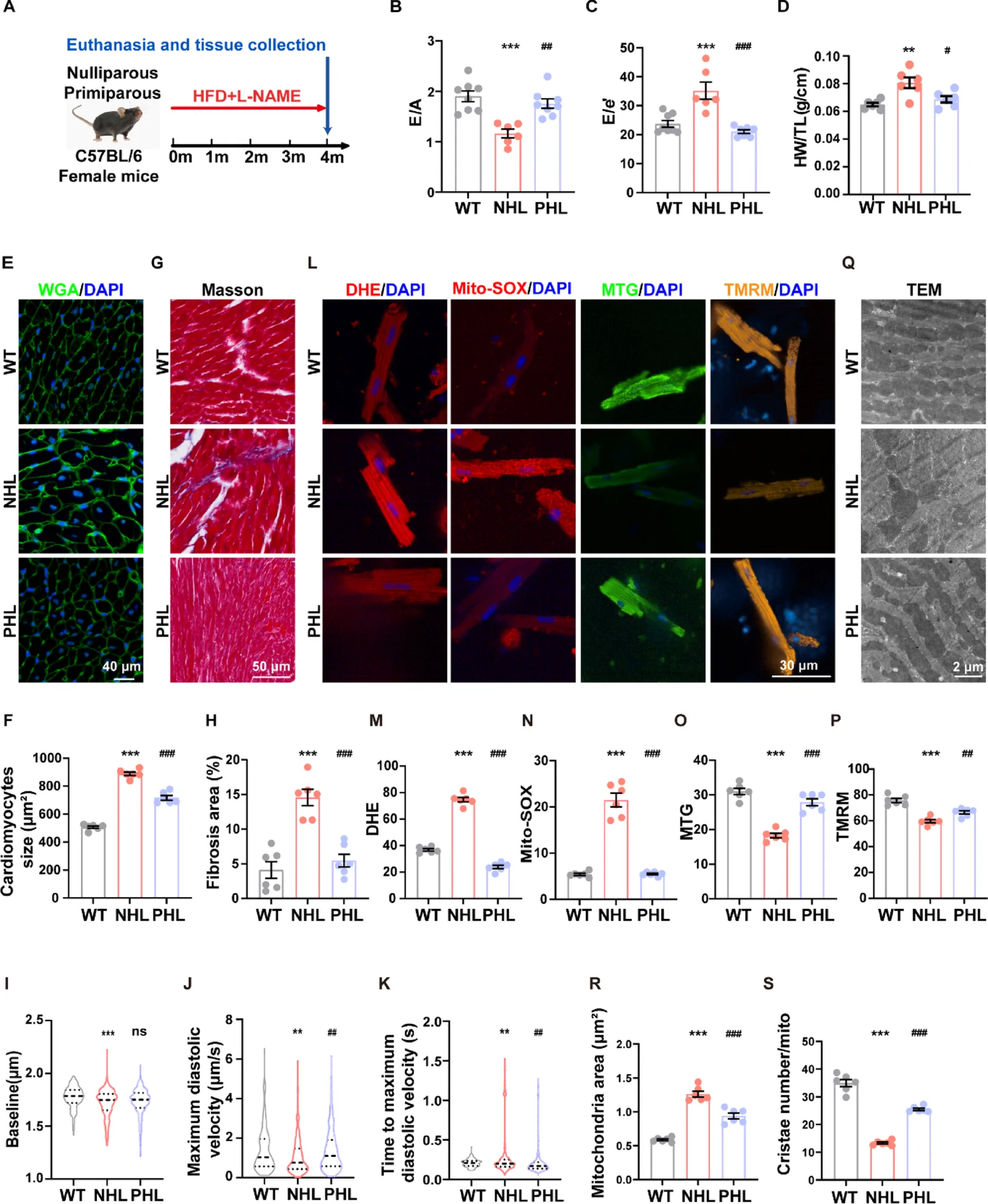
- Experiments in female mice challenged to develop HFpEF, 16 weeks
- What changed:
- Under heart-failure induction, heart relaxation problems developed later in mice that had given birth than in mice that had not
- The catch:
- Hormonal and metabolic changes after birth could contribute to protection independently of microvascular remodeling
- Stake:
- An author works for Juvensis Therapeutics and at least one founded it, and two hold shares in it.
- In the record:
- One of 3 papers on parturition on record: none yet with results in people, 2 in animals.
Editor of record: Boris Djordjevic · AgingResearch.News
Female mice that had given birth once were compared with mice that had never given birth in an animal experiment using a high-fat diet and stress from reactive nitrogen molecules. The experiment modeled heart failure with preserved ejection fraction, in which the heart pumps out a normal share of blood but has trouble relaxing. Mice that had given birth had denser networks of tiny heart blood vessels and developed relaxation problems later. They also showed less senescence, a state in which cells stop dividing, in blood vessel cells and heart muscle cells.
Drug experiments supported a requirement for blood vessel cell senescence in heart muscle cell senescence and relaxation problems. In lab-grown cells, substances released by senescent blood vessel cells disrupted the protective ends of chromosomes in heart muscle cells.
Why it matters
Cell senescence is an aging-related process. The findings support investigating signals between blood vessel cells and heart muscle cells as contributors to this form of heart failure.
Caveats
The authors noted that the experiments did not establish whether senescence specifically in blood vessel cells caused the heart changes in living mice. The induced mouse model also cannot establish whether childbirth protects women.
From the paper
- Result
Using univariate and multivariate logistic regression models, we confirm that short LTL was significantly associated with HFpEF with an odds ratio (OR) of 1.890 [95% confidence interval (CI): 1.280 – 2.790, P = 0.001] (Table S2).
Results, Parous women show an observational trend toward higher myocardial microperfusion
- Limitation
Our study establishes that endothelial senescence is an important factor for HFpEF progression in the HFD/L-NAME model and is associated with parturition.
Quoted word for word from the full text on link.springer.com.
- Parturition
- TERT
- Cellular senescence
- Heart failure with preserved ejection fraction
- Diastolic dysfunction
- Mice
The paper
Shanghai Jiao Tong University
Cardiovascular Diabetology, Aug 30, 2026, Open access


Comments
Be the first to comment.