Shortening sleep linked to later daily difficulties in older adults
Compared with stable moderate sleepers, people whose sleep shortened had relative risks of 1.34 for self-care difficulties and 1.22 for difficulties managing daily life.
Our read
Populations- Studied:
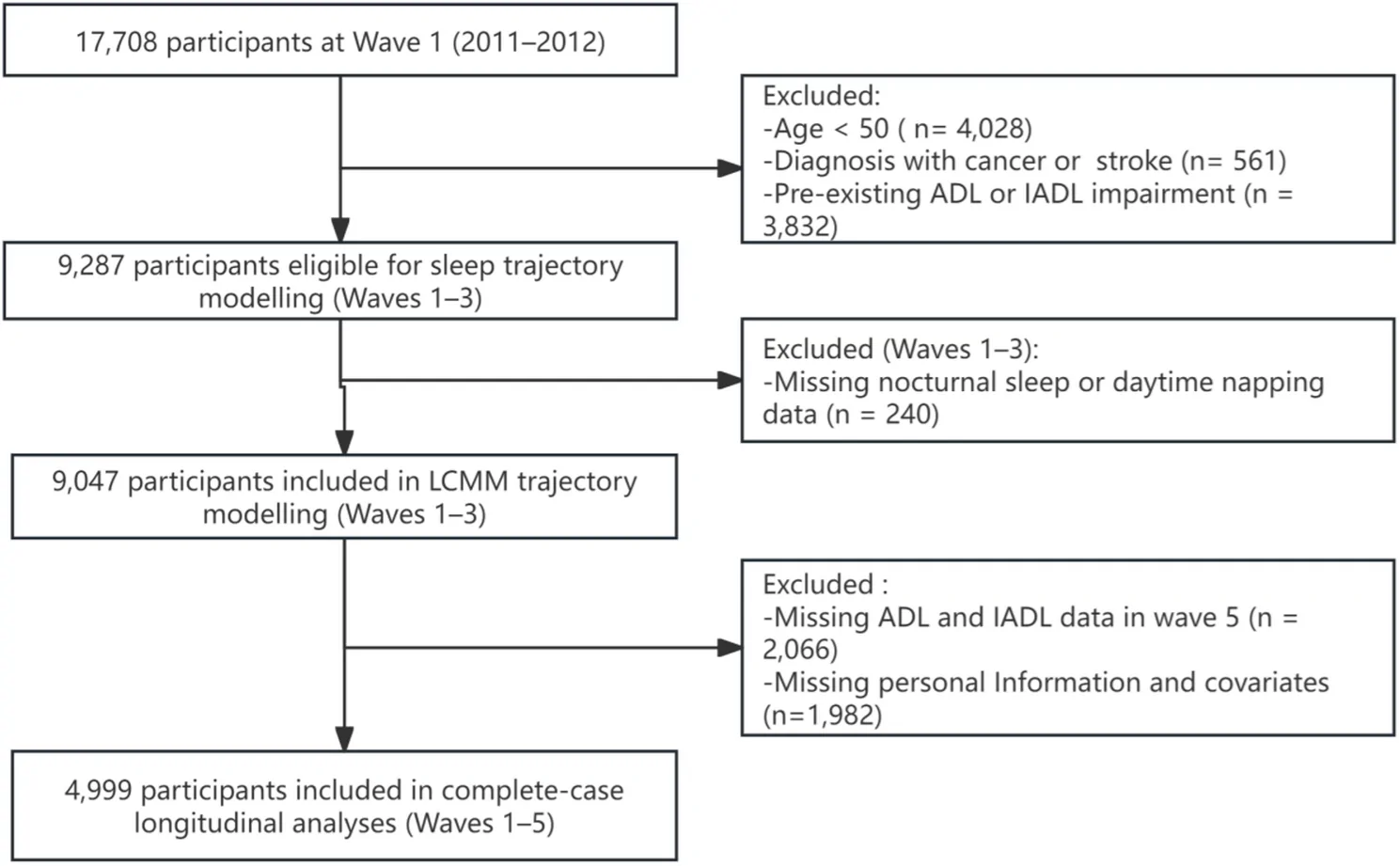
- Cohort study of 4,999 Chinese adults without baseline functional limitations
- What changed:
- Daily self-care difficulties were more likely with shortening sleep than stable moderate sleep (risk ratio 1.34)
- The catch:
- Sedative use and changing physical activity could account for the sleep–disability association
Editor of record: Boris Djordjevic · AgingResearch.News
In China, 4,999 adults aged 50 or older who initially had no functional limitations were followed in a national longitudinal cohort study. Researchers added self-reported nighttime sleep and afternoon naps, then grouped changes over four years into three patterns. They assessed daily-task difficulties at the fifth survey.
Compared with stable moderate sleepers, people whose sleep shortened from about 5.1 to 3.9 hours daily had higher risks of self-care difficulties, such as bathing, and difficulties managing daily life, such as shopping. Sleep lengthening from about 8.4 to 9.2 hours was not linked to either outcome overall. In exploratory analyses, it was linked to severe limitations in both categories, defined as difficulty with at least two tasks. Shortening sleep was also linked to severe self-care limitations.
Why it matters
The authors suggest that tracking sleep changes may help identify older adults at risk of losing independence.
Caveats
The authors note that daily difficulties may have developed during the four years used to define sleep patterns, leaving open whether sleep changes preceded them. Participants were adults aged 50 or older in China without functional limitations at the start.
From the paper
- Participants
Following the exclusion of participants with missing outcome or covariate data, the final complete-case analytic sample comprised 4,999 participants followed through Wave 5.
- Result
Compared with the Stable Moderate group, the Progressively Short trajectory was associated with higher risks of ADL limitation (RR = 1.34; 95% CI: 1.18–1.52) and IADL limitation (RR = 1.22; 95% CI: 1.08–1.37) at Wave 5, as well as severe ADL limitation.
- Limitation
First, sleep duration was based on self-reports without objective measurements of sleep quality, timing, or specific sleep disorders; thus, the reported changes may reflect alterations in time spent in bed rather than actual sleep duration.
Quoted word for word from the full text on link.springer.com.
The paper
Central South University
BMC Public Health, Aug 20, 2026, Open access

Comments
Be the first to comment.