Walking linked to better thinking scores in older adults
In the 12-week trial, estimated differences in score trends versus controls were 0.39 for thinking and minus 1.28 for loneliness, favoring walking.
Our read
Interventions- Studied:
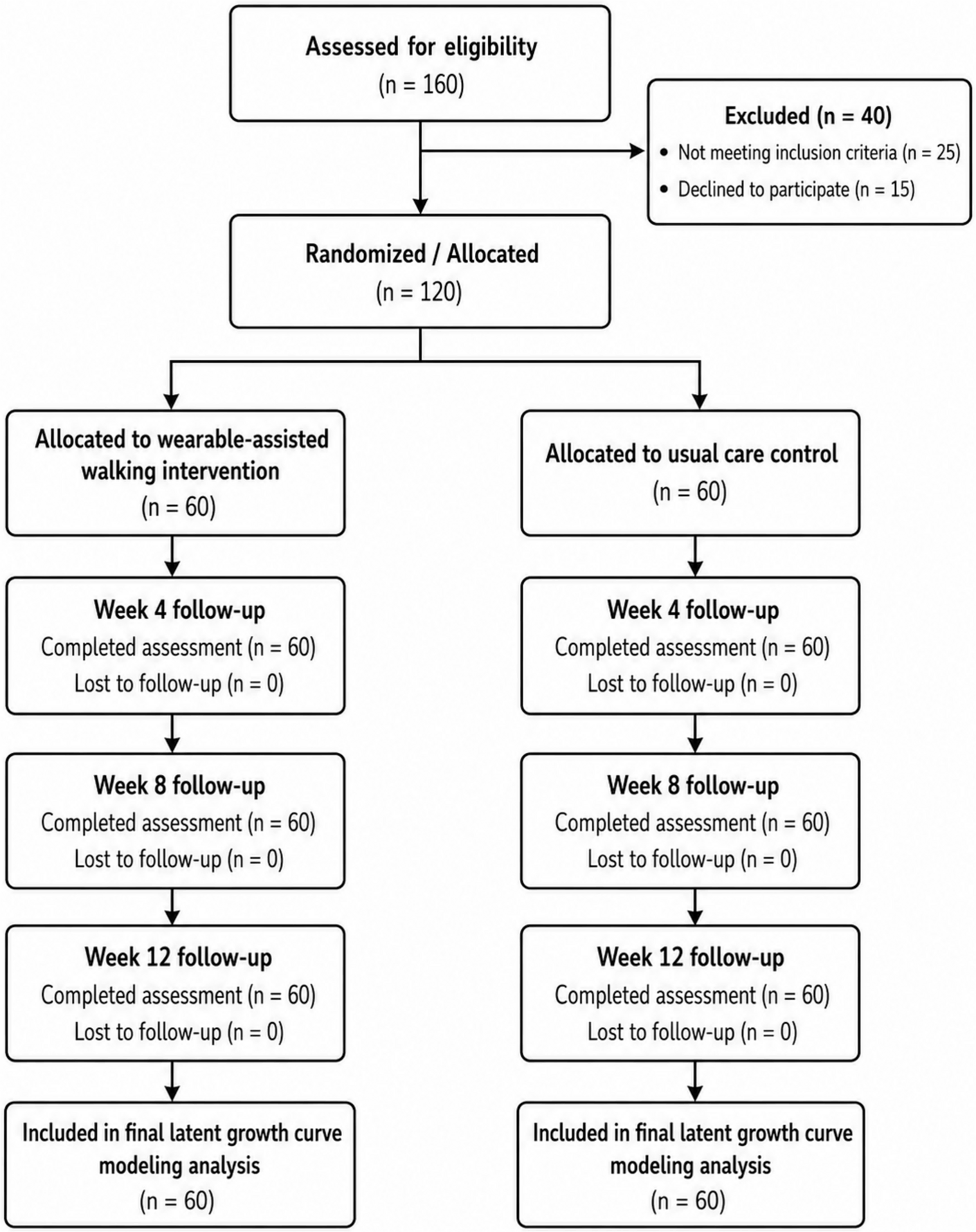
- Randomized trial in 120 community-dwelling older adults, 12-week, against usual-activity controls (Sample size calculated, registered NCT07650292)
- What changed:
- Thinking scores rose more with wearable-assisted walking: 1.63 points against 0.65 points in controls
- The catch:
- Walking's effects cannot be separated from wearable monitoring, feedback, and behavioral support
- In the record:
- The 301st paper on walking with results in people; 923 on record in all. Its result on cognitive function agrees with 18 of 25 other findings on record; 1 points the other way and 6 found no change.
Editor of record: Boris Djordjevic · AgingResearch.News
Community-dwelling adults aged 65 or older in Taiwan took part in a 12-week randomized controlled trial of wearable-assisted walking. The 120 participants included 74 women and had a mean age of 71.47 years. Half were prescribed five moderate-intensity, 30-minute walks weekly, tracked with an Apple Watch. Controls maintained usual activities without structured walking.
Walking was associated with faster gains on a thinking-skills screening test and faster declines on a loneliness questionnaire than usual activity. Mean thinking scores rose from 21.80 to 23.43 with walking and from 21.78 to 22.30 in controls. All participants completed follow-up. Neither group reported serious adverse events or falls. Three walking participants reported mild, temporary muscle or joint discomfort; it resolved without medical treatment or interrupting the program. Controls reported no minor adverse events.
Why it matters
Declining thinking skills and loneliness are challenges in later life. The authors suggest wearable-assisted walking may offer an accessible way to support older adults’ thinking skills and psychological well-being.
Caveats
The authors note that trial registration occurred after enrollment began and say the analyses should be regarded as exploratory. The results do not cover adults under 65.
From the paper
- Limitation
Although the intervention procedures, outcomes, and assessment schedule had been defined in advance through an IRB-approved protocol, and no changes were made after data collection, retrospective registration remains a methodological limitation.
Quoted word for word from the full text on link.springer.com.
- Walking
- Loneliness
- 8-item UCLA Loneliness Scale
- Appendicular skeletal muscle mass index
- Montreal Cognitive Assessment
- Humans
The paper
National Taiwan College of Performing Arts
BMC Geriatrics, Aug 13, 2026, Open access

Comments
Be the first to comment.