Hip surgery from the front not linked to fewer deaths
One-year death rates were 26% with surgery from the front, versus 26%, 26% and 27% with three other approaches.
Our read
Interventions- Studied:
- Cohort study of 40,981 people (1 year)
- In the record:
- One of 5 papers on direct anterior approach on record: 5 with results in people.
Editor of record: Boris Djordjevic · AgingResearch.News
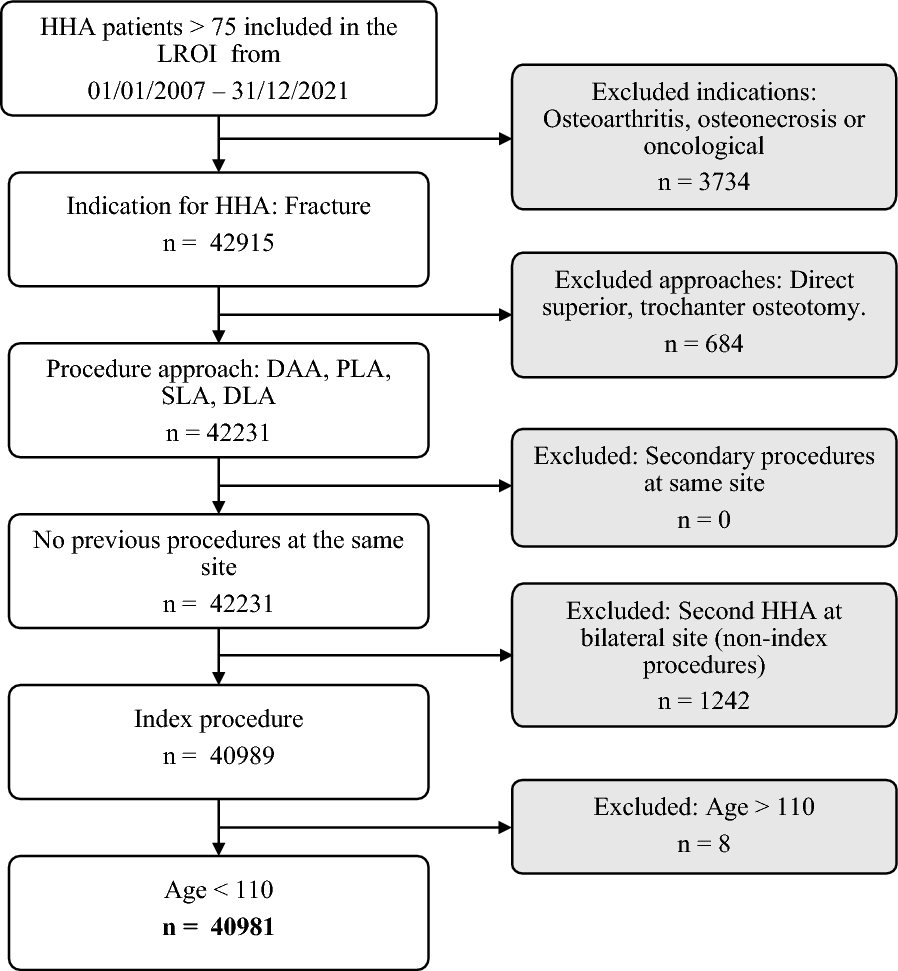
Among 40,981 Dutch patients aged 75 or older who had partial hip replacement after a hip fracture, a retrospective cohort study emulated a trial comparing surgical approaches. Registry records covered operations from 2007 through 2021. Patients’ average age was 85.1 years, and 67.5% were women.
The researchers matched 21,393 patients on characteristics including age, sex and measures of health to make the groups more comparable. Within one year, 26% died after the direct anterior approach, which reaches the hip from the front. Death rates were 26% for the back-and-side approach, 26% for the side approach and 27% for the front-and-side approach. The analysis found no statistically significant differences in one-year mortality between the front approach and the other three.
Why it matters
Hip fractures pose challenges in later life. This comparison addresses whether potential benefits of operating from the front extend to survival after partial hip replacement.
Caveats
The authors note that registry data captured only part of patients’ health and frailty, so remaining differences could have affected the comparisons. The results do not address younger patients or people having total hip replacement.
Where the evidence stands
Direct anterior approach
- 5 independent labs in 4 countries
- 1 finding against
Hemiarthroplasty
- 19 independent labs in 8 countries
- 5 findings against
- Funders: Medical Science and Technology Project of Zhejiang Province and 6 more
From the paper
- Participants
Overall, 40,981 eligible patients were included.
- Limitation
Although the LROI contains reliable data on all HHA patients from 2007 onwards, errors can still occur, e.g., incomplete data registration, including missing cases (limited generalizability) …
Quoted word for word from the full text on link.springer.com.
The paper
Leiden University Medical Center
Journal of Orthopaedics and Traumatology, Aug 13, 2026, Open access
Comments
Be the first to comment.