Total hip replacement linked to better hip fracture outcomes
Partial hip replacement and repair with screws, pins or nails were linked to 2.5 and 2.3 times the one-year odds of death, respectively, versus total hip replacement.
Limit: Healthier patients were selected for total hip replacement, potentially explaining its apparent benefits
Edited by Boris Djordjevic · AgingResearch.News
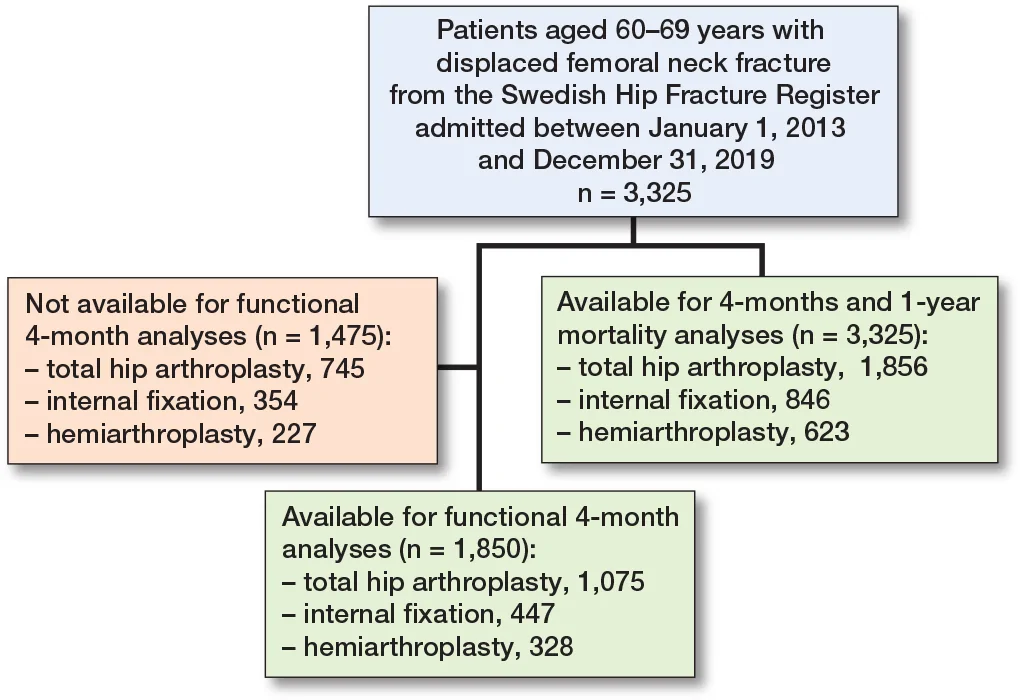
An observational cohort study examined 3,325 patients aged 60–69 with displaced femoral neck fractures—breaks near the top of the thighbone with bone ends out of alignment. Researchers used Swedish registry data to compare total hip replacement, partial hip replacement and internal fixation, which holds broken bone together with screws, pins or nails. They assessed deaths over one year and function at four months.
Overall, 8.3% died within one year. Survival analyses found lower survival after partial replacement or fixation than after total replacement among patients in poorer baseline health, but not among healthier patients. Total replacement was linked to better maintenance of independent living and outdoor walking among healthier patients who had those abilities before the fracture. Functional differences between operations were smaller among patients in poorer health.
Why it matters
Preserving mobility and independence after hip fracture matters for functioning later in life. This study addresses whether links between the operation and recovery differ according to patients’ baseline health.
Caveats
Surgery was not randomized and depended strongly on baseline health, so these associations do not establish cause and effect. Functional follow-up covered only 1,850 patients (56%), and the results may not apply outside ages 60–69.
From the paper
- Limitation
Treatment allocation was not randomized but strongly influenced by baseline health, functional status, and comorbidity, introducing a risk of residual confounding.
Quoted word for word from the full text on PubMed Central.
The paper
Karolinska Institutet; ArtroFotkliniken AB
Acta Orthopaedica, Sep 3, 2026, Open access


Comments
Be the first to comment.