Frail smokers had the highest heart and blood vessel disease risk
Estimated 10-year coronary artery disease risk was 9.97% in frail current smokers versus 4.06% in nonfrail never smokers.
Our read
Populations- Studied:
- Study in people
- Why it’s aging research:
- It bears on staying healthy in midlife and later life.
Editor of record: Boris Djordjevic · AgingResearch.News
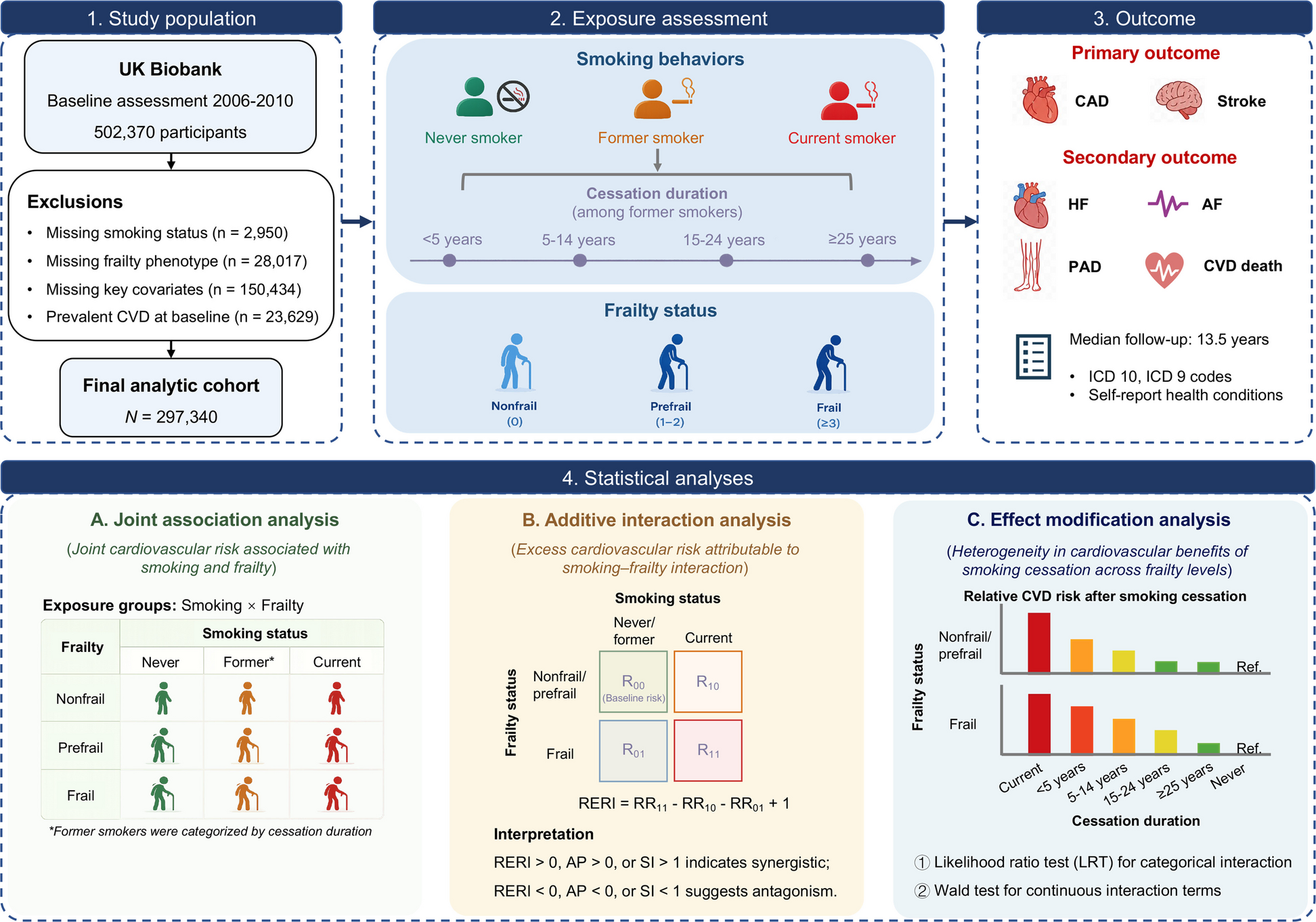
UK Biobank participants aged 40–69 at recruitment and free of cardiovascular disease were followed in a prospective observational study of 297,340 people. Their median age was 57, and 44.8% were male. Researchers assessed self-reported smoking and physical frailty, using weight loss, exhaustion, low activity, slow walking and weak grip.
Over a median 13.5 years, current smokers with frailty had the highest risk across the cardiovascular outcomes studied. For coronary artery disease, which affects the heart’s blood supply, and disease in arteries supplying the limbs, the joint association exceeded the sum of smoking’s and frailty’s separate associations. The strongest joint links were with limb artery disease and heart failure. Longer time since quitting was associated with lower cardiovascular risk across all frailty categories.
Why it matters
Physical frailty is an aging-related concern. The authors suggest considering it alongside smoking history to guide earlier quitting support and more intensive cardiovascular prevention.
Caveats
Smokers with frailty may also have differed in health and lifestyle in ways the adjusted analysis did not capture, and smoking was self-reported. The findings do not cover people who already had cardiovascular disease at enrollment.
From the paper
- Participants
A total of 297,340 individuals from the UK Biobank who were free of CVD at baseline were included in this study.
- Follow-up
After a median follow-up period of 13.5 (IQR: 12.7–14.2) years, 20,621 participants (6.9%) developed incident CAD and 5,696 (1.9%) experienced stroke.
- Result
Compared with never smokers, current smokers exhibited significantly higher hazard across all cardiovascular outcomes, including CAD (HR = 1.55, 95% CI: 1.48–1.61) and stroke (HR = 1.79, 95% CI: 1.66–1.94) (Table 1).
- Absolute difference
For CAD, the standardized 10-year risk was 9.97% among frail current smokers and 4.06% among non-frail never smokers, corresponding to an absolute risk difference of 5.92 percentage points, or 59.2 excess events per 1,000 persons.
Results, Joint association of smoking behaviors and frailty phenotypes with incident CVD
- Limitation
First, all smoking traits and several frailty components (particularly exhaustion and slow gait speed) were derived from baseline self-reported questionnaires, so measurement error or misclassification cannot be fully ruled out.
Quoted word for word from the full text on link.springer.com.
The paper
Shandong University; Shandong Provincial Hospital
Archives of Public Health, Aug 6, 2026, Open access

Comments
Be the first to comment.