RNA delivery boosts responses in aged human T cells in the lab
In laboratory experiments, delivering several gene-regulating RNAs together enhanced activation and cell-killing responses in aged human T cells.
Our read
Interventions- Studied:
- Experiments in aged human CD8+ T cells
- What changed:
- Delivering several microRNAs together improved activation and cell-killing responses in aged human T cells
- The catch:
- Responses to infection or vaccination were not measured
- Why it’s aging research:
- Repairing, replacing or regenerating the aging body.
Editor of record: Boris Djordjevic · AgingResearch.News
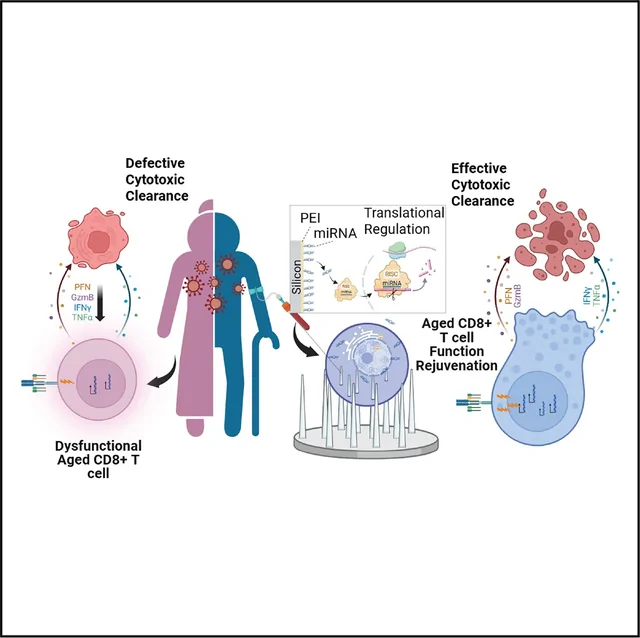
Aged human CD8+ T cells, immune cells that can kill infected or abnormal cells, received small gene-regulating RNAs in laboratory experiments. Researchers delivered these microRNAs using silicon nanowires coated with a polymer, avoiding viruses as delivery vehicles. The platform temporarily altered gene activity involved in cell activation, metabolism, multiplication and specialization.
Delivering several microRNAs together enhanced the human cells’ activation and cell-killing responses. It also kept the cells primed to carry out immune functions during early activation and multiplication. The method improved function in cells from healthy donors and from donors with current or past cancer.
Why it matters
Age-related changes in T cells weaken responses to infection and vaccination. The work explores whether adjusting gene activity can help these aging immune cells respond more effectively.
Caveats
The human findings came from cells studied outside the body, so they do not show whether the method improves responses to infection or vaccination in people.
The paper
miRNA delivery via nanowires restores functional responses in aged T cells
Georgia Institute of Technology
Cell Biomaterials, Jul 3, 2026, Open access


Comments
Be the first to comment.