Ultrasound AI identified early heart failure in adults
For distinguishing early disease, the AI scored 0.77 versus 0.70 for a clinical score in 2,544 adults without diagnosed heart failure.
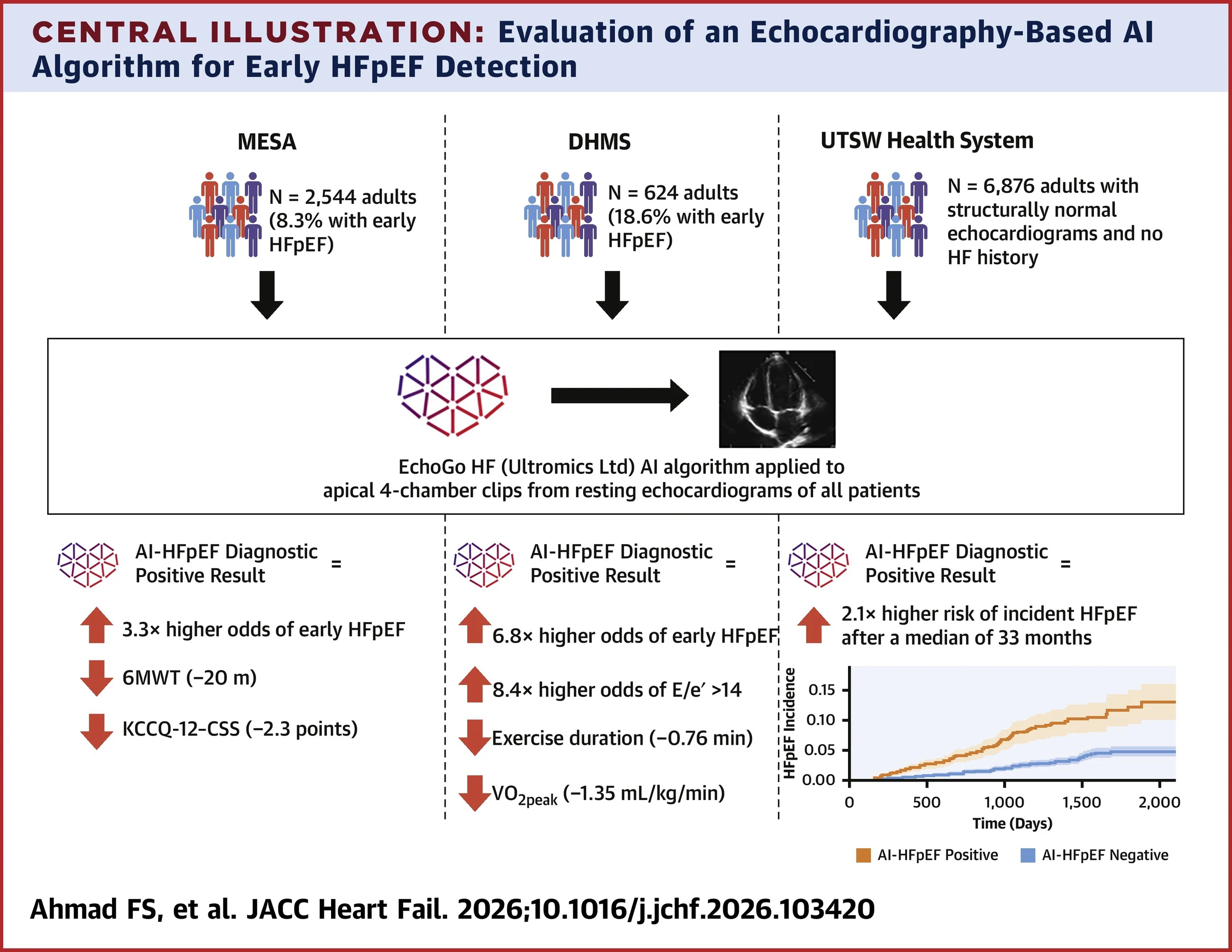
6,876 participants
Limit: Early disease was a research-defined pattern rather than clinically diagnosed heart failure
Stake: Author Disclosures Ultromics funded the study. Authors work for Ultromics, founded it and hold shares in it.
Edited by Boris Djordjevic · AgingResearch.News
In an observational study of 2,544 and 624 community-dwelling adults without diagnosed heart failure, researchers evaluated an artificial intelligence model using heart ultrasound videos. The model targeted heart failure with preserved ejection fraction, in which the heart pumps out a normal share of its blood. Researchers defined early disease as impaired exercise capacity or health-related quality of life alongside evidence of elevated pressure as the heart filled. The AI distinguished early disease better than a clinical score in both cohorts.
A separate analysis followed 6,876 health-system adults with structurally normal heart ultrasounds and no prior heart failure for a median of 33 months. During follow-up, 3.4% developed this form of heart failure. A positive AI result was associated with more than twofold higher relative risk.
Why it matters
Heart failure becomes more common with age. Recognizing its early stages matters for studying the transition from subtle limitations to clinically diagnosed disease.
Caveats
These observational analyses assessed detection and risk associations, not whether AI-guided care improves health. The community findings concerned a research-defined early disease pattern rather than clinically diagnosed heart failure.


Comments
Be the first to comment.