Empagliflozin before bypass showed no clear effect on heart mass
The heart’s main pumping chamber’s muscle mass, adjusted for body size, fell 1.39 grams per square meter with empagliflozin versus 4.55 with standard diabetes therapy.
Registered NCT04523064
Limit: Echocardiography is less sensitive than MRI and can miss subtle changes in heart mass
Edited by Boris Djordjevic · AgingResearch.News
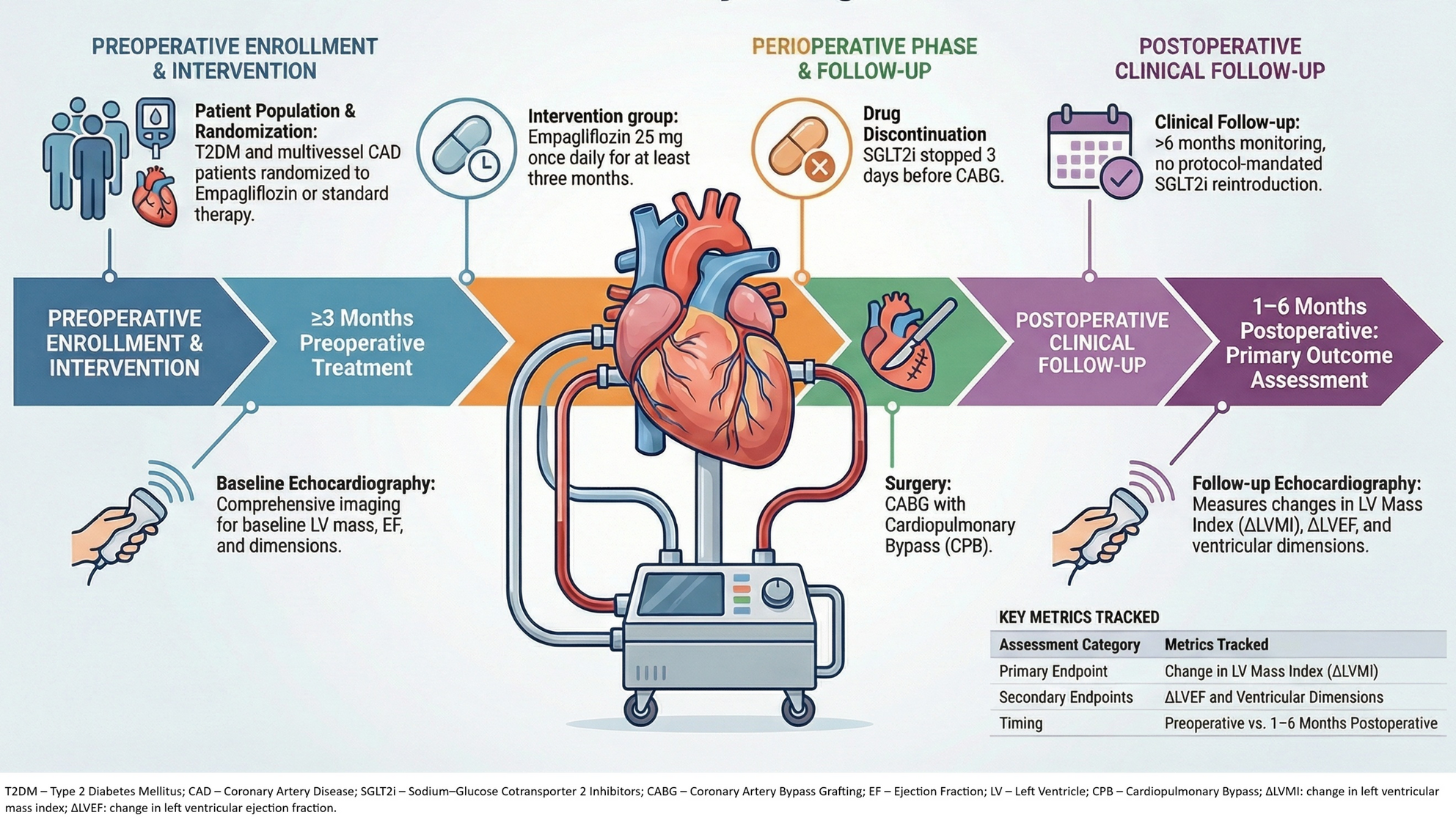
In 118 people with type 2 diabetes and disease affecting multiple coronary arteries, researchers conducted a prespecified secondary analysis of an open-label randomized trial. Before bypass surgery using a heart-lung machine, 53 received empagliflozin, 25 milligrams daily, and 65 received standard diabetes therapy. Empagliflozin was stopped three days before surgery. Use of this drug class afterward was not required by the protocol.
Heart ultrasound scans before surgery and one to six months afterward showed no significant difference between groups in changes in the main pumping chamber’s muscle mass adjusted for body size, pumping function or dimensions. Postoperative complications were comparable. A separate exploratory, non-randomized analysis linked continued use of the same drug class during follow-up to a greater likelihood of reduced chamber muscle mass adjusted for body size.
Why it matters
For age-related coronary artery disease, the trial addressed whether medication before bypass surgery could influence subsequent changes in heart structure.
Caveats
This open-label secondary analysis assessed short-term changes, not sustained postoperative treatment. The continued-use association was hypothesis-generating; the randomized results apply to people with diabetes and multivessel coronary disease undergoing bypass.
From the paper
- Participants
A total of 118 patients were included (53 in the intervention group and 65 in the control group).
- Result
In a separate exploratory, non-randomized multivariable analysis, continued use of SGLT2i during follow-up was associated with a higher likelihood of LVMI reduction (OR 4.69; 95% CI 1.20–18.40; p = 0.03).
- Events by group
The vast majority of patients had three-vessel coronary artery disease (88% in the control group vs. 89% in the intervention group; p = 0.87).
- Limitation
Accordingly, the findings should be interpreted as exploratory and hypothesis-generating.
Quoted word for word from the full text on link.springer.com.
- Empagliflozin
- Cardiopulmonary bypass
- Coronary artery bypass grafting
- Type 2 diabetes
- Coronary artery disease
- Humans
Empagliflozin is part of Bryan Johnson's Blueprint
The paper
Pontifícia Universidade Católica do Paraná; Universidade de São Paulo
Diabetology & Metabolic Syndrome, Jul 28, 2026, Open access


