Model predicted cardiovascular risk in peritoneal dialysis patients
The model scored 0.822 in external validation, compared with 0.784 in training and 0.781 in internal testing, on a measure of its ability to distinguish disease.
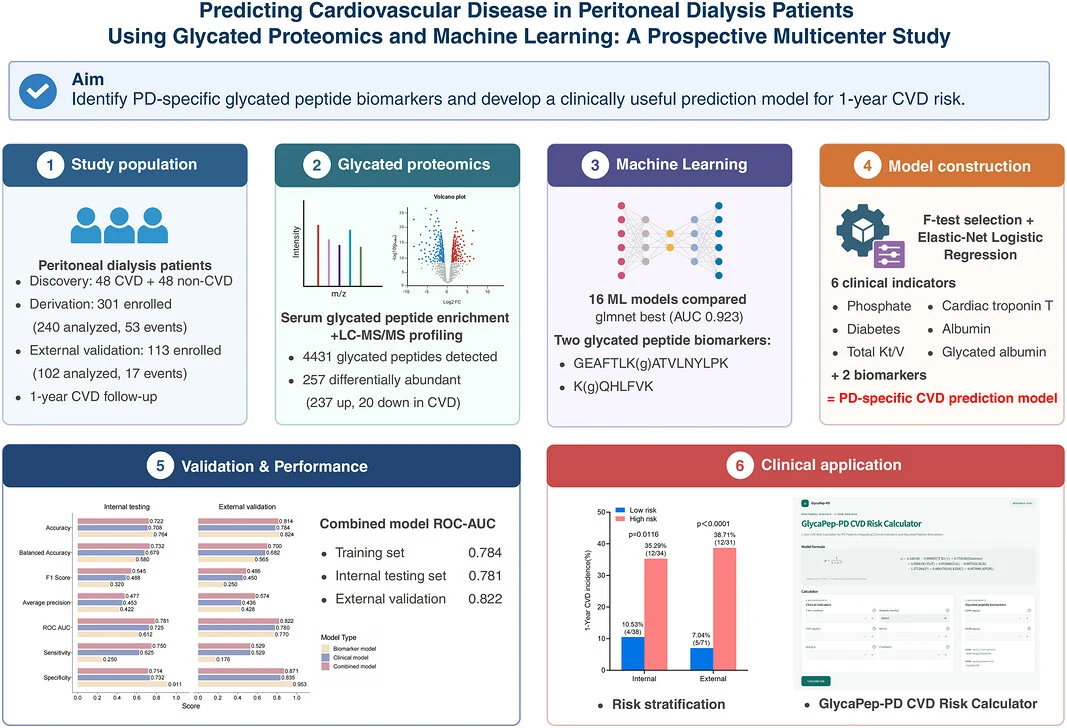
240 participants, independent replication, multicenter
Limit: Excluding participants who died of non-cardiovascular causes could bias the model's predictions
Edited by Boris Djordjevic · AgingResearch.News
This observational study examined patients receiving peritoneal dialysis, which filters blood through the abdominal lining. Researchers compared 48 patients with cardiovascular disease—disease of the heart and blood vessels—with 48 without it. They then measured candidate biomarkers in a prospective cohort of 240 patients and an external cohort of 102 patients from multiple centers.
The final model combined two sugar-modified protein fragments with six clinical indicators. Its area under the receiver operating characteristic curve, a measure of how well it distinguished disease outcomes, was 0.784 in training, 0.781 in internal testing and 0.822 in external validation. Groups classified as high risk had higher one-year cardiovascular disease incidence in both validation cohorts. The model also outperformed three published cardiovascular risk models on this measure.
Why it matters
Cardiovascular disease is the leading cause of death among peritoneal dialysis patients. The authors suggest the model may help identify risk earlier and guide targeted prevention.
Caveats
This observational study tested risk prediction, not whether model-guided prevention reduced cardiovascular events. External validation involved 102 peritoneal dialysis patients, not the general population.
From the paper
- Participants
In total, 102 patients were included, and 17 developed CVD during follow-up (Figure 4A).
Quoted word for word from the full text on onlinelibrary.wiley.com.
The paper
Zhongshan Hospital
Clinical and Translational Medicine, Oct 28, 2026


