Hyaluronic acid increased focusing movements in monkey eyes
Lens thickening during drug-triggered focusing increased by 0.24 millimeters compared with before injection, and the increased anatomical response lasted up to 16 months.
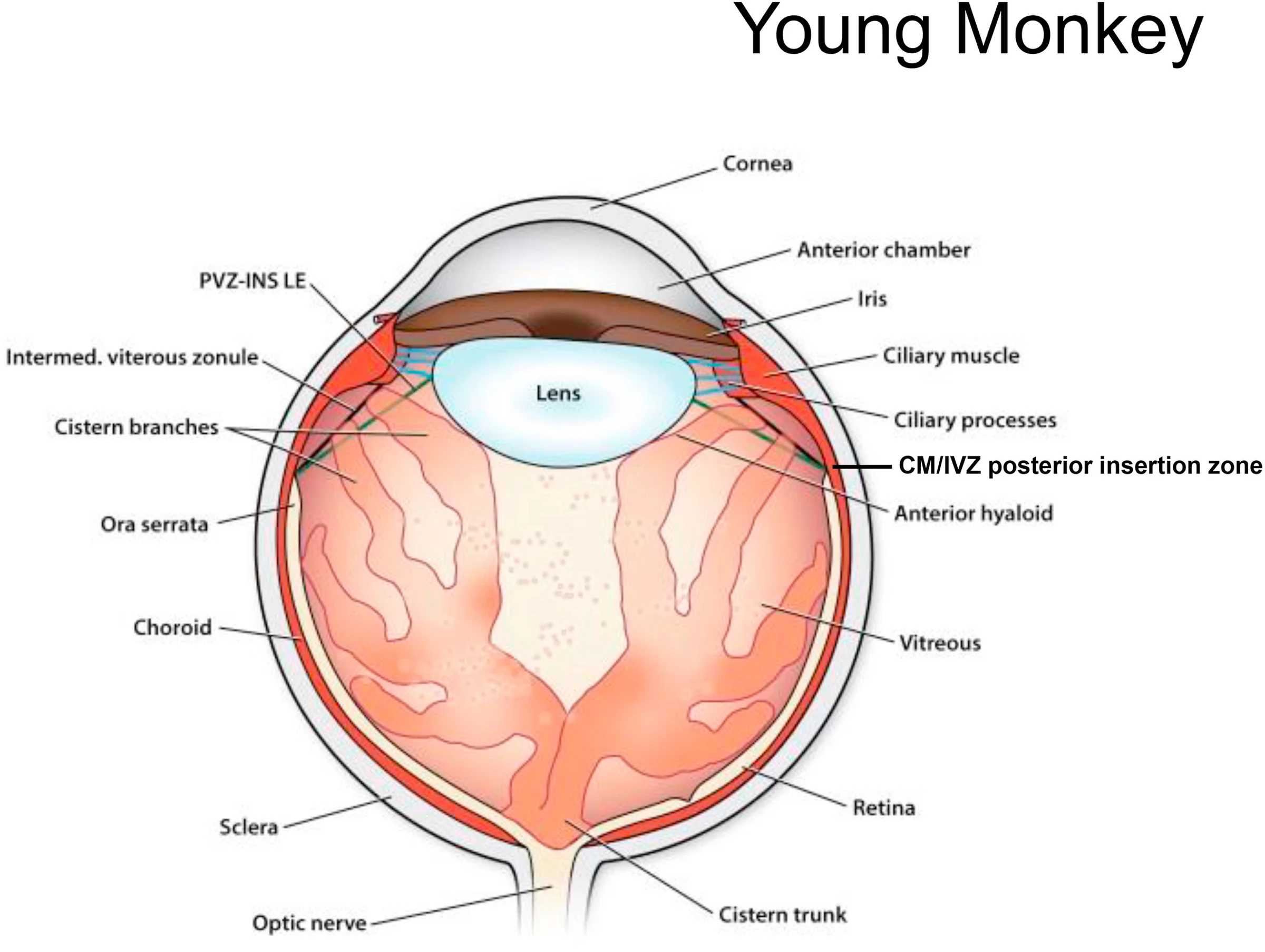
Limit: Everyday near vision was not measured; focusing was experimentally triggered
Edited by Boris Djordjevic · AgingResearch.News
Monkeys with presbyopia, the age-related loss of near focusing, received hyaluronic acid injections in an animal experiment. Researchers injected 0.3 milliliters at a concentration of 14 milligrams per milliliter into the eye’s internal gel, where hyaluronic acid naturally occurs. They triggered focusing with intravenous pilocarpine at 2 milligrams per kilogram of body weight and compared responses before injection and two weeks afterward.
After injection, the lens thickened more and the focusing muscle moved farther forward. Focusing power increased by 1.19 diopters, a unit of lens power, compared with before injection. Uninjected control eyes showed no change in the measured responses. The increased anatomical response—the tissue movements involved in focusing—persisted up to 16 months.
Why it matters
Age-related loss of near focusing is the problem behind presbyopia, and these experiments may offer insights into possible therapies.
Caveats
The experiment measured experimentally triggered focusing responses, not everyday near vision. The abstract did not report the overall number of monkeys, and the findings do not establish benefits in people.
The paper
HYALURONIC ACID (HA)-INDUCED INCREASE IN ANATOMICAL ACCOMMODATION RESPONSE IN PRESBYOPIC MONKEYS
Department of Ophthalmology and Visual Sciences; University of Wisconsin-Madison
Experimental Eye Research, Oct 26, 2026

