Sleep’s link to thinking varied with discrimination in Black adults
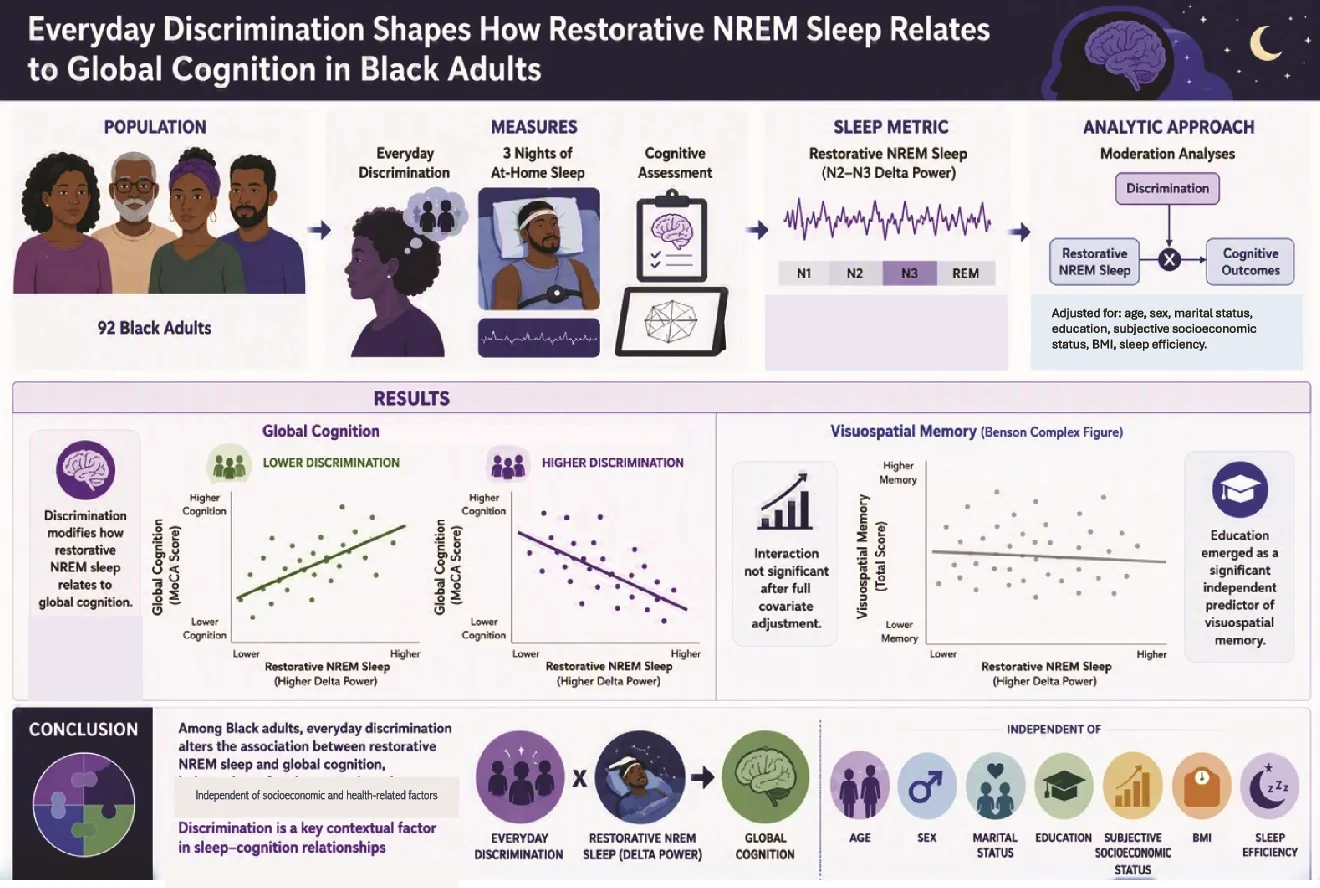
An observational study of 92 Black adults monitored at home over three nights found that a restorative sleep measure related differently to thinking scores depending on reported discrimination.
Limit: Cognitive testing times varied between participants, potentially affecting scores
Edited by Boris Djordjevic · AgingResearch.News
A cross-sectional observational study involved 92 self-identified Black or African American men and women aged 40 to 82 in Kentucky. Participants reported everyday unfair treatment, completed thinking tests and underwent three nights of home sleep monitoring. Researchers used slow brainwave activity as an indicator of restorative sleep.
The link between this sleep measure and overall thinking scores varied with discrimination after adjustment for demographic, socioeconomic and health factors. At lower discrimination, more slow-wave activity corresponded to higher scores, but the range of likely values included no association. At higher discrimination, more activity was linked to lower scores. A separate test of remembering a complex figure showed no statistically significant sleep–discrimination pattern after adjustment.
Why it matters
Research on sleep and cognitive aging may need to account for everyday discrimination, rather than considering sleep in isolation.
Caveats
The cross-sectional design could not establish cause and effect or changes in thinking over time. This small, highly educated Kentucky sample does not establish whether the pattern holds in younger adults or other populations.
From the paper
- Participants
A total of 96 participants were recruited into the ongoing study.
- Limitation
The cross-sectional design prevents the determination of temporal ordering and does not support the conclusion that greater NREM delta activity causes poorer cognition under high discrimination.
Quoted word for word from the full text on PubMed Central.
- Everyday discrimination
- Restorative non-rapid eye movement sleep
- Benson Complex Figure Task
- Everyday Discrimination Scale
- Montreal Cognitive Assessment
- Humans
The paper
University of Kentucky; Johnson University
Sleep Advances, Sep 24, 2026, Open access