Four frailty tools linked to colorectal cancer surgery outcomes
In a cohort of 615 older patients, all four tools predicted outcomes; a 32-item index took 18 minutes versus six for the quickest assessment.
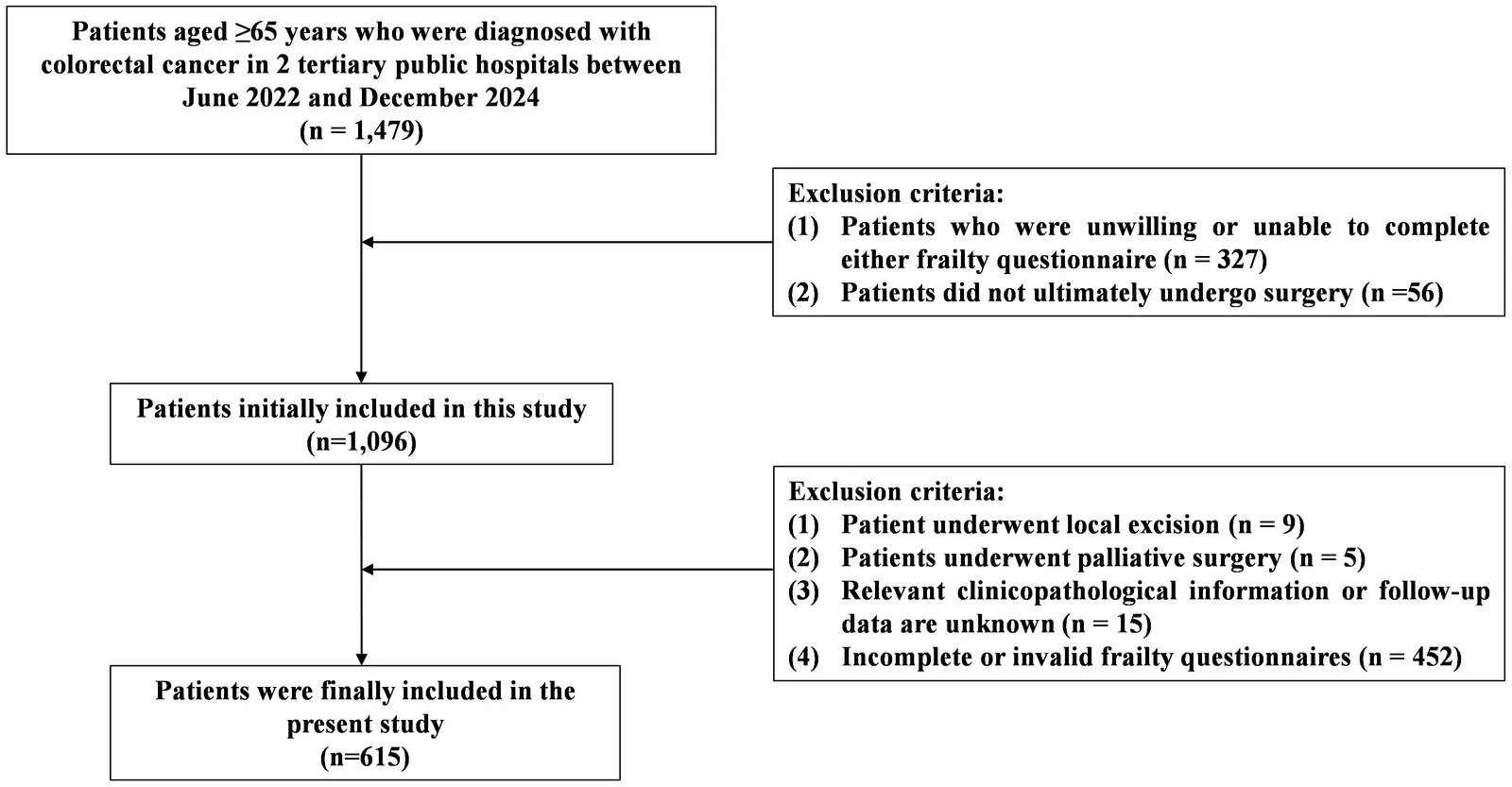
1,096 participants, multicenter
Limit: Pre-frailty cutoffs lack sufficient validation, risking misclassification of patients
Edited by Boris Djordjevic · AgingResearch.News
A prospective observational cohort study assessed frailty before surgery in 1,096 colorectal cancer patients aged 65 or older. Frailty means reduced resilience to health problems. The final comparison included 615 patients who completed all four tools: the Clinical Frailty Scale, Frailty Phenotype, Geriatric-8 scale and 32-item Frailty Index.
All four tools were linked to complications, recovery after surgery, readmission within 30 days and death within one year. After adjustment for other factors, the Geriatric-8 scale and Frailty Index remained independently linked to clinically relevant complications. Only the Frailty Index retained an independent link to death within one year. That index took a median of 18 minutes to complete, compared with six minutes for the Clinical Frailty Scale.
Why it matters
Frailty assessment addresses older adults’ vulnerability to health problems around surgery. This comparison may help clinicians choose an assessment suited to their clinical setting and available time.
Caveats
The observational comparison included only patients who completed all four assessments and cannot establish that using a tool improves outcomes. The findings concern colorectal cancer patients aged 65 or older.
From the paper
- Participants
From June 2022 to December 2024, a total of 1,096 patients were included in the primary analysis.
- Result
Subsequent multivariate analysis demonstrated that age ≥80 years (OR = 3.160, 95%CI: 1.714-5.825, P = 0.002), surgical approach (minimally invasive surgery, OR = 4.018, 95%CI: 2.373-6.804, p<0.001), clinical T stage (T3-4, OR = 1.718, 95%CI: 1.114-2.649, P = 0.014) …
Results, Risk factors for postoperative clinically relevant complications in older patients with CRC
Quoted word for word from the full text on frontiersin.org.
The paper
First Affiliated Hospital of Xi'an Jiaotong University
Frontiers in Oncology, Oct 9, 2026, Open access