Blood thinners not clearly linked to death after gut bleeding
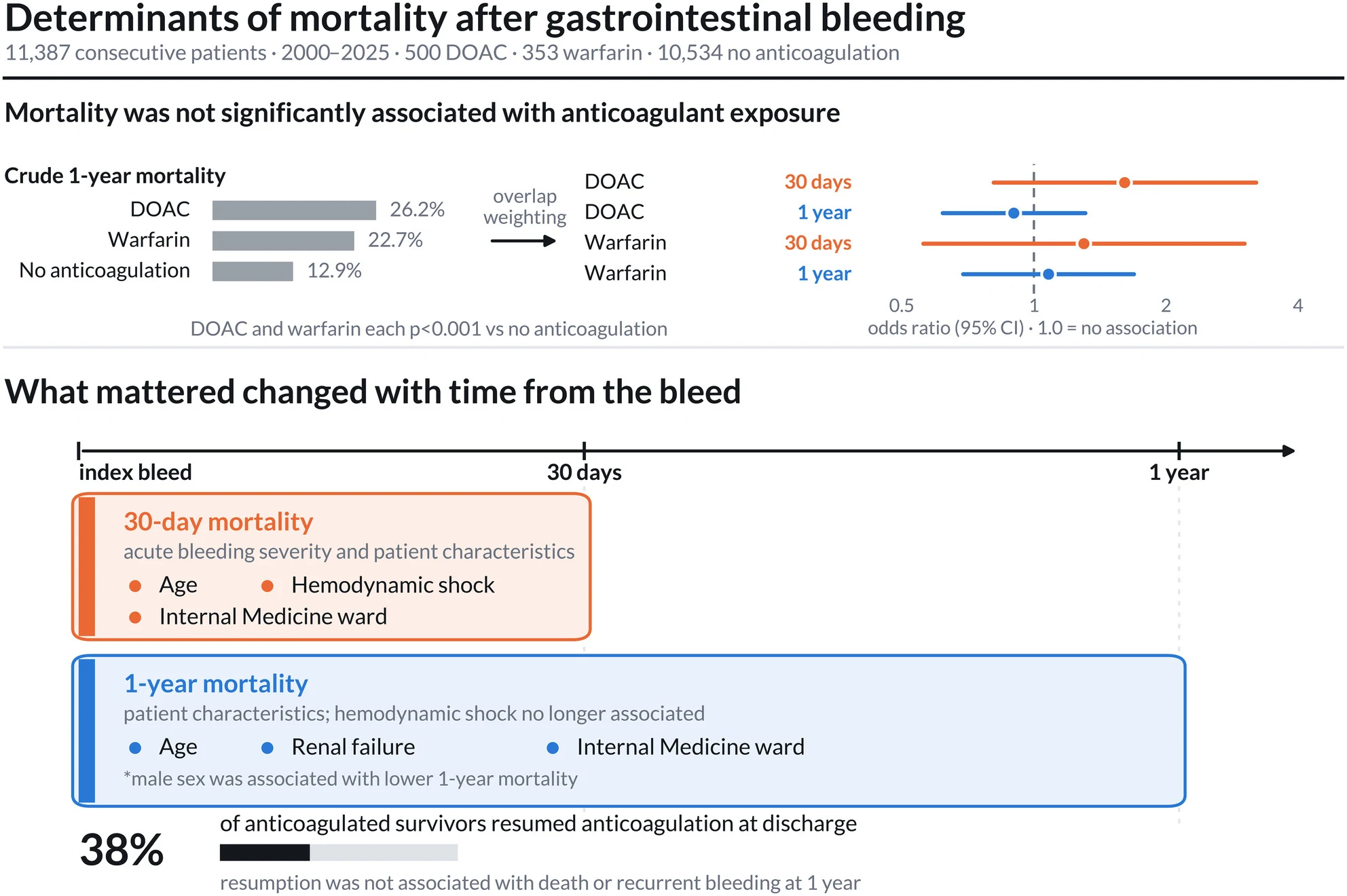
Compared with no blood thinner, 30-day death odds ratios were 1.61 for direct oral anticoagulants and 1.30 for warfarin; both uncertainty ranges included no difference.
11,387 participants
Limit: Residual differences in illness severity could confound the mortality comparison
Edited by Boris Djordjevic · AgingResearch.News
An observational study analyzed 11,387 adults with acute bleeding in the digestive tract seen over 25 years. Among them, 500 took direct oral anticoagulants, drugs that reduce blood clotting, 353 took warfarin and 10,534 took neither. Median ages were 81.7, 75.1 and 58.4 years, respectively.
Patients taking anticoagulants had more other illnesses and higher mortality before statistical adjustment. After weighting the groups to make them more comparable, neither anticoagulant category was significantly associated with death at 30 days or one year. An odds ratio of 1 means no difference; the ranges of likely values included 1 for both categories at both time points. Death within 30 days was associated with age and illness severity on arrival. One-year mortality was associated with age and underlying patient characteristics.
Why it matters
For older adults, separating medication-related risks from risks linked to underlying illness may help inform care after digestive-tract bleeding.
Caveats
This observational study cannot establish cause and effect or rule out all differences between the groups. The results concern adults who had already experienced acute digestive-tract bleeding, not everyone taking blood thinners.
From the paper
- Participants
A total of 11,387 patients presented with acute overt GIB during the study period (Figure 1): 500 receiving a DOAC (4.4%), 353 receiving warfarin (3.1%) and 10,534 non-anticoagulated (92.5%).
- Result
After overlap weighting, neither DOAC nor warfarin was significantly associated with mortality (30-day OR 1.61, 95% CI 0.81–3.21 for DOAC and 1.30, 95% CI 0.56–3.02 for warfarin; 1-year OR 0.90, 95% CI 0.62–1.31 and 1.08, 95% CI 0.69–1.69).
- Limitation
The retrospective single-centre design may limit generalizability and precluded bleeding-severity grading by International Society on Thrombosis and Haemostasis criteria.
Quoted word for word from the full text on onlinelibrary.wiley.com.
The paper
Hebrew University of Jerusalem; The Hebrew University of Jerusalem
Alimentary Pharmacology & Therapeutics, Oct 22, 2026