District-level analysis of temperature-related excess mortality in the Netherlands
Abstract
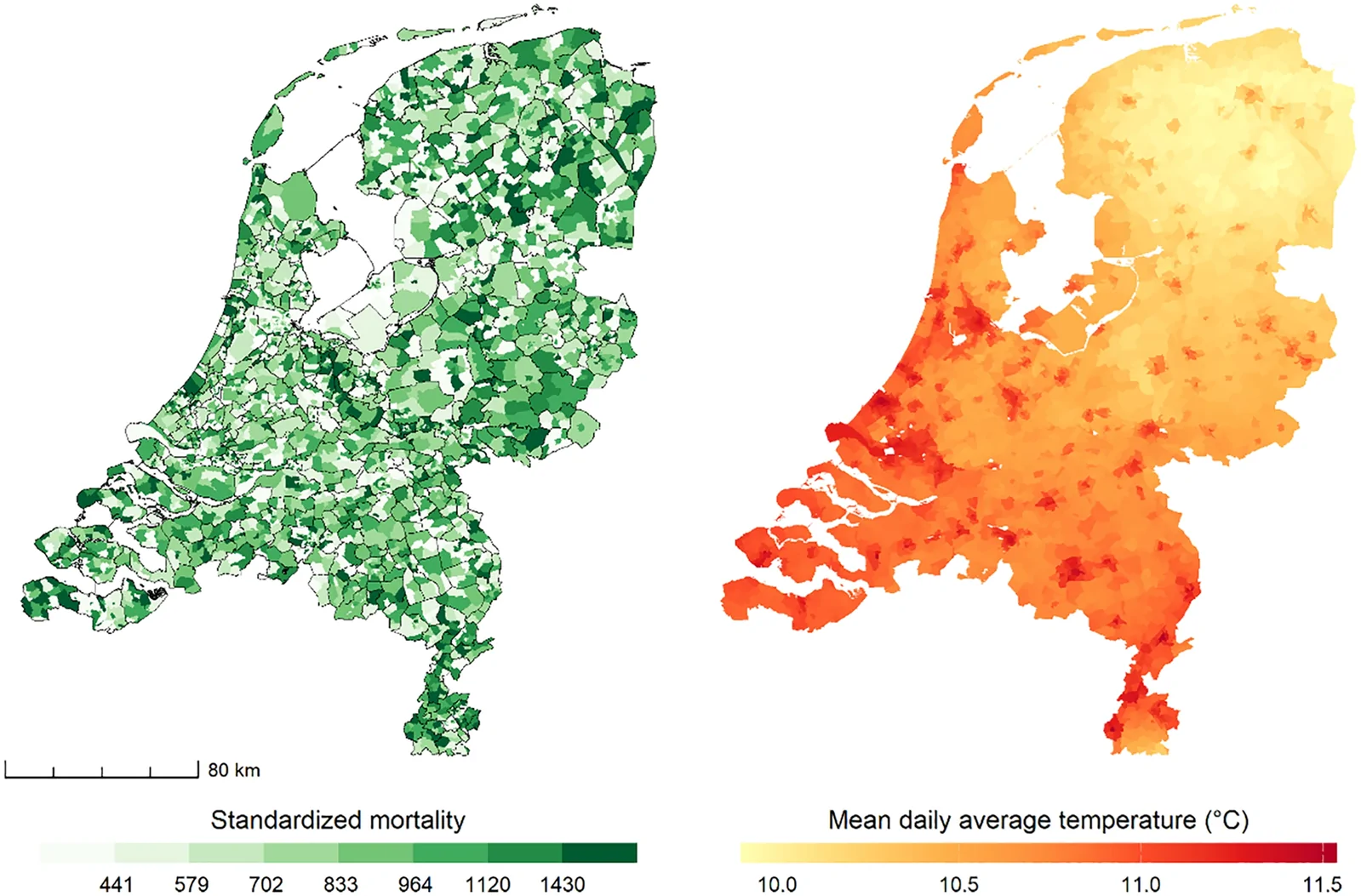
BACKGROUND: While most epidemiological studies have assessed temperature-mortality associations at broad geographical scales, recent research highlights that temperature-related mortality risks are spatially heterogeneous due to local differences in exposure, vulnerability, and adaptive capacity. The aim of this study was to assess the impact of ambient air temperature on all-cause mortality at the district level in the Netherlands. METHODS: A three-stage design was applied to assess the association between daily average air temperature and mortality across 3,116 districts and two age groups (0-74, 75+) for the period 2010-2019. First, a case time series design with distributed lag nonlinear models was used to estimate temperature-mortality associations for 355 Dutch municipalities. Second, municipality-level estimates were pooled using a multivariate meta-regression with municipality-level demographic, socioeconomic, climatological, and topographical predictors. Finally, the meta-regression model was used to downscale the risk estimates to the district level and to estimate standardized excess heat- and cold-related mortality rates. RESULTS: Heat-related excess mortality was elevated in urban areas, whereas cold-related excess mortality was more pronounced in northern and southern districts compared with areas in the center of the Netherlands. During the study period, heat was associated with an average of 346 excess deaths per year (empirical 95% confidence intervals: 44-558), and cold with 11,988 excess deaths per year (7,554-15,609). This corresponds to standardized excess mortality rates of 2.2 (0.3-3.5) and 73.3 (46.8-94.7) per 100,000 person-years for heat and cold, respectively. The 75+ group showed more pronounced mortality risks compared with the younger age group. CONCLUSION: Our results indicate geographical heterogeneity in temperature-related standardized mortality rates, with high heat-related mortality in urban areas and more pronounced regional clustering of cold-related mortality. These findings can help local governments to implement climate adaptation measures to prevent heat- and cold-related excess mortality according to location-specific vulnerabilities.
The paper
National Institute for Public Health and the Environment
Environmental Epidemiology, Oct 15, 2026, Open access
