Healthy older adults’ hands became more alike in movement
Across two assessments averaging 4.5 years apart, 20 healthy older adults developed more similar hand movements; 16 with mild cognitive impairment retained that pattern.
Paper by Vasylenko O, Rodríguez-Aranda C
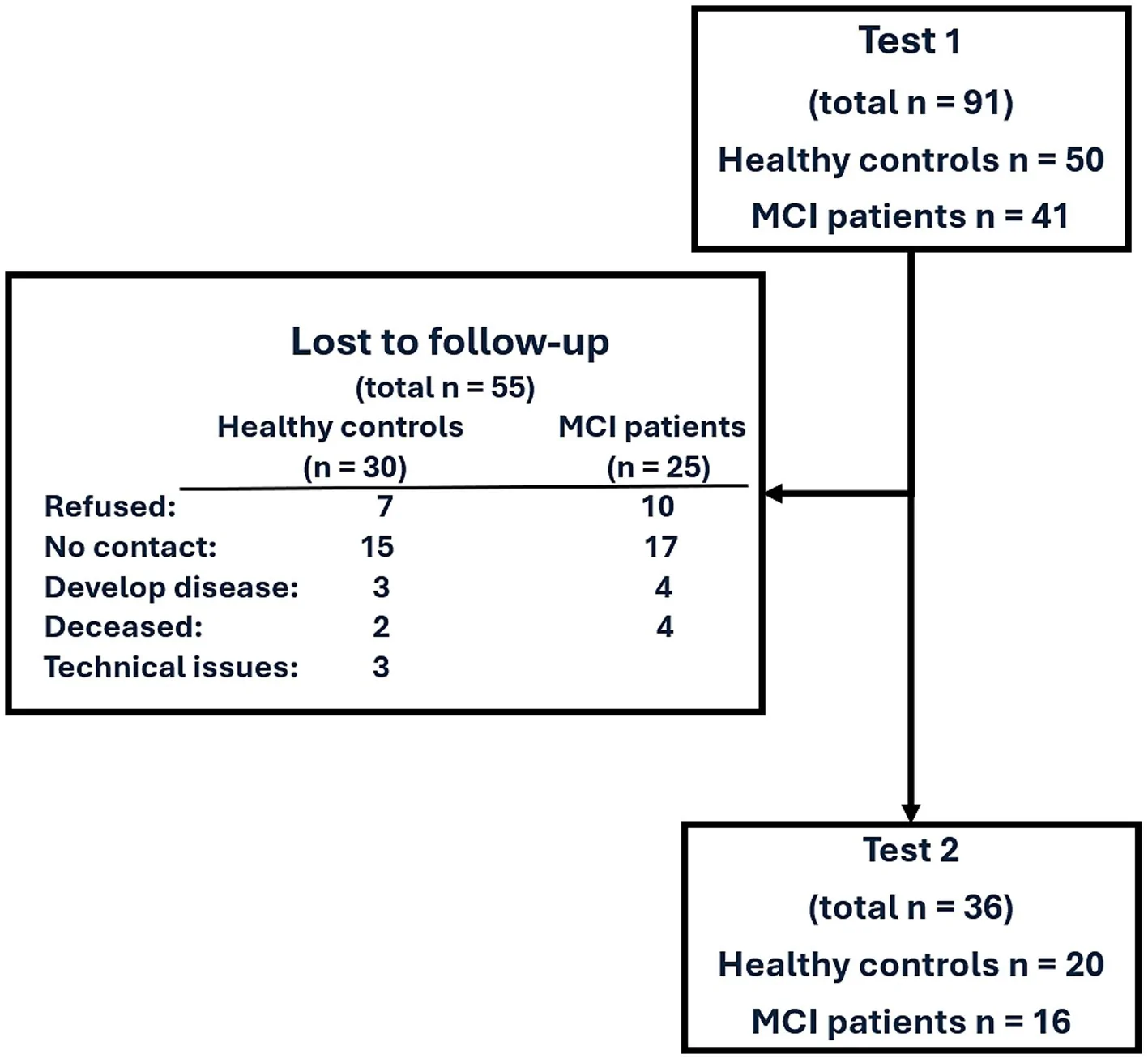
Limit: Only 20 healthy controls contributed to the finding
In a longitudinal observational study, researchers assessed 16 patients with mild cognitive impairment, averaging 69.3 years old, and 20 healthy controls, averaging 69.9 years old. Mild cognitive impairment involves difficulties with memory or thinking. Participants inserted pins into a board with each hand while a motion-capture system recorded movement speed and paths. Assessments took place an average of 3.5 years apart for controls and 5.35 years apart for patients.
Initially, only the patients showed similar movement patterns between their two hands. By the second assessment, the healthy group also showed this symmetry, while the patients retained it. The groups no longer differed in measures of how differently their two hands performed.
Why it matters
The authors suggested that similar performance between hands may reflect adaptation to age-related changes in nerves and muscles, rather than disease alone.
Caveats
This small observational study could not establish why hand performance changed, and follow-up intervals differed between groups. Its findings do not establish the same pattern in younger adults.
The paper
Vasylenko O, Rodríguez-Aranda C
Frontiers in Aging Neuroscience, Oct 2, 2026