Natural Fish Oil Versus Purified Fish Oil: Composition, Efficacy, and Applications
Abstract
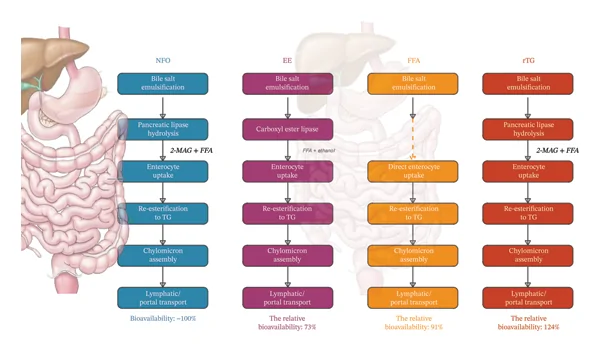
This review proposes a purity-bioavailability-indication framework to systematically differentiate natural fish oil (NFO) and purified fish oil (PFO) and guide clinical decision-making. We categorize fish oil formulations along a therapeutic gradient from nutritional maintenance to targeted intervention, with molecular structure stratification based on bioavailability and safety profiles. NFO retains natural triglyceride structures with superior absorption kinetics but lower ω-3 polyunsaturated fatty acid (PUFA) purity, positioning it for maintenance nutritional supplementation. PFO, through advanced purification, achieves higher purity in ethyl esters (EEs), free fatty acids (FFAs), and re-esterified triglycerides (rTG) forms. The rTG structure uniquely combines high purity with enhanced bioavailability, bridging the gap between NFO and conventional PFO. Within the PFO category, our framework distinguishes eicosapentaenoic acid ethyl ester (EPA-EE) as the evidence-based choice for atherosclerotic cardiovascular disease (ASCVD) risk reduction, combinations of EPA and docosahexaenoic acid (EPA/DHA) as neutral for cardiovascular outcomes, and rTG as the bioavailable alternative for enteral therapeutic applications. For parenteral nutrition, PFO-based lipid emulsions provide formulation and operational advantages. In summary, this framework identifies a fundamental trade-off between natural matrix preservation (NFO) and purity/bioavailability optimization (PFO). PFO, particularly high-purity EPA-EE formulations, demonstrates established efficacy in cardiovascular risk reduction, while rTG offers superior bioavailability with comparable clinical promise; both PFO formulations show advantages in parenteral nutrition. High-dose ω-3 formulations, regardless of EPA monotherapy or EPA/DHA combination, carry a dose-dependent atrial fibrillation risk that warrants age-stratified assessment. NFO remains preferable for general nutritional supplementation given its favorable tolerability and preservation of natural antioxidants. Selection between NFO and PFO should be guided by clinical indication, required dosage, and arrhythmia risk stratification.
- Fish oil
- Eicosapentaenoic acid
- Eicosapentaenoic acid + docosahexaenoic acid
- Atherosclerotic cardiovascular disease
- Atrial fibrillation
- Arrhythmia
The paper
Shanxi Provincial Cancer Hospital; Chinese Academy of Medical Sciences & Peking Union Medical College
Journal of Nutrition and Metabolism, Oct 15, 2026, Open access


