Association of breakfast skipping with diet-quality-based low-carbohydrate and low-fat diet scores and metabolic syndrome components among Korean young adults: Korea National Health and Nutrition Examination Survey 2021-2023
Abstract
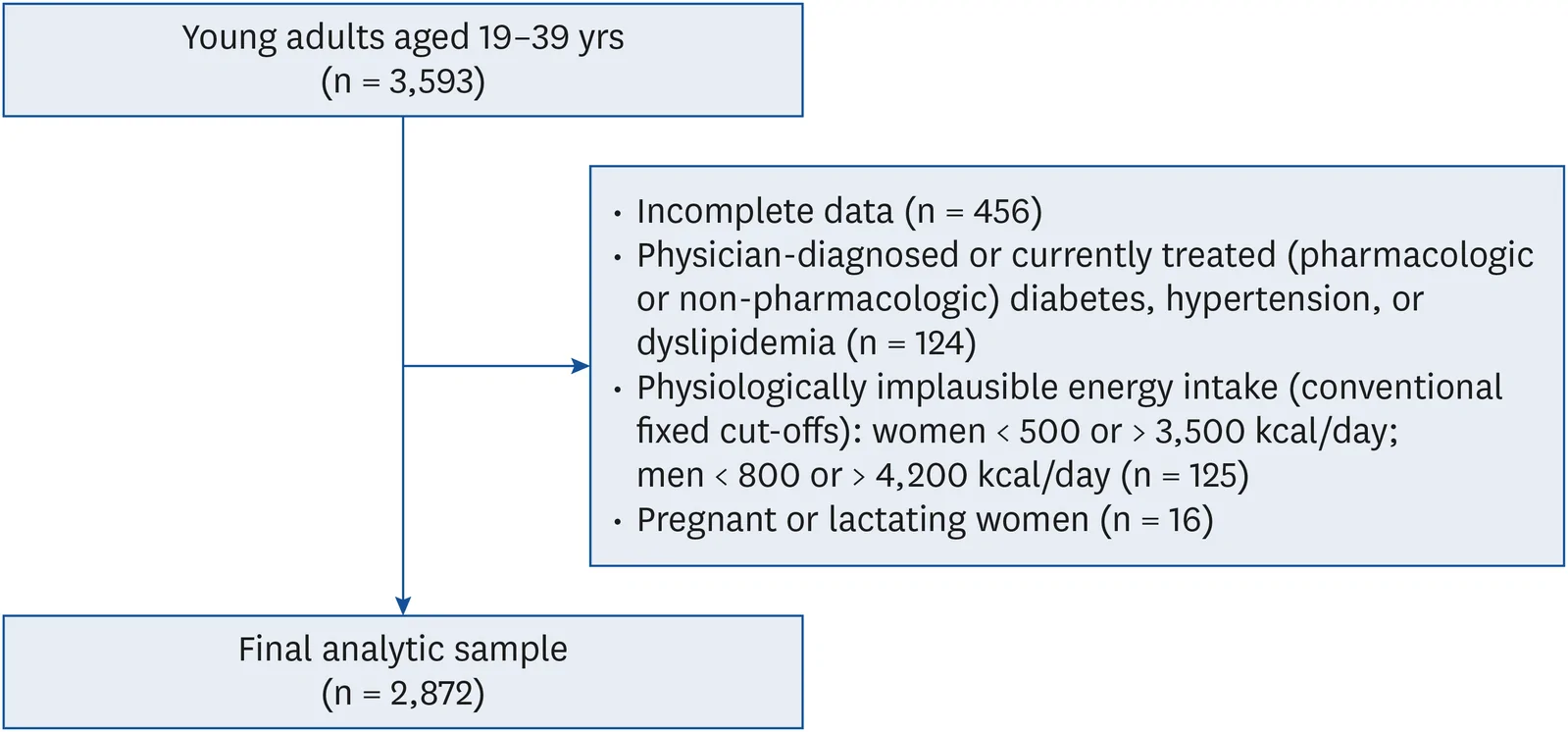
BACKGROUND/OBJECTIVES: The rate of breakfast skipping among Korean young adults has increased rapidly, but its association with the dietary macronutrient composition remains unclear. Using diet-quality-based low-carbohydrate diet (LCD) and low-fat diet (LFD) scoring systems, this study primarily examined the association between breakfast skipping and 6 diet-quality scores. As a secondary analysis, this study assessed how these scores, and breakfast skipping itself, were related to metabolic syndrome and its components, to gauge the metabolic relevance of the scores. SUBJECTS/METHODS: This cross-sectional study analyzed 2,872 adults aged 19-39 yrs from the 2021-2023 Korea National Health and Nutrition Examination Survey, excluding those diagnosed or treated for chronic disease, implausible energy intake, or pregnancy/lactation. Breakfast skipping was defined as no intake reported as "breakfast" in the 24-h recall. The LCD and LFD scores were calculated using the method proposed by Shan et al.'s study. Multivariable complex-sample linear and logistic regression analyses were performed with sequential covariate adjustment. RESULTS: Among the participants, 52.2% (n = 1,500) skipped breakfast. After adjustment, the skippers had significantly higher unhealthy LCD scores (β = 1.19) and lower overall LFD (β = -0.67) and healthy LFD (β = -1.55) scores than those who did not skip breakfast. A comparison of the extreme quartiles showed that the overall LCD score was inversely associated with abdominal obesity (odds ratio [OR], 0.56) and elevated triglycerides (OR, 0.60), a healthy LCD score with elevated triglycerides (OR, 0.70), and an unhealthy LCD score with abdominal obesity (OR, 0.59) and elevated blood pressure (OR, 0.50). CONCLUSION: Breakfast skipping was associated with a lower-quality composition of the same-day diet. Exploratory secondary analyses showed that most associations with metabolic syndrome components were not significant. Nevertheless, the findings should be interpreted with caution because this study was cross-sectional.
From the paper
- Participants
The final analysis included 2,872 participants (Fig. 1).
- Result
In the fully adjusted model, breakfast skippers had significantly higher unhealthy LCD scores than breakfast eaters (β = 1.19; 95% CI, 0.67 to 1.70), whereas the overall (β = −0.67; 95% CI, −1.14 to −0.20) and healthy (β = −1.55; 95% CI, −2.10 to −1.00) LFD scores were significantly lower.
- Limitation
First, temporal and causal relationships cannot be established because this was a cross-sectional study.
Quoted word for word from the full text on e-nrp.org.
The paper
Hallym University
Nutrition Research and Practice, Sep 21, 2026, Open access


