Nonlinear Dose-Response Association Between Exercise Intensity and Urinary Liver-Type Fatty Acid-Binding Protein in Young Men: A Piecewise Threshold Analysis
Dose-response
Abstract
High-intensity physical exercise can induce temporary renal hemodynamic strain and subclinical tubular injury, yet the exact dose-response relationship remains poorly defined. This study investigated the relationship between exercise intensity and urinary liver-type fatty acid-binding protein (L-FABP) concentrations, a sensitive marker of proximal tubular stress, to identify an exploratory intensity threshold. We conducted an observational cohort study of 285 healthy young men undergoing a routine 20 min physical training session. Exercise intensity was quantified as metabolic equivalents of task (METs) using wearable accelerometers, and urinary L-FABP was measured pre-exercise and 30 min post-exercise. Post-exercise urinary L-FABP concentrations increased significantly from baseline (median, 1.89 vs. 0.90 µg/gCr; p < 0.001). Restricted cubic splines confirmed a nonlinear dose-response relationship (p for nonlinearity < 0.001) with an estimated breakpoint at 6.76 METs (95% CI, 5.67 to 7.12). Below 6.76 METs, exercise intensity was not significantly associated with post-exercise L-FABP (β = 0.068, p = 0.358), whereas above this threshold, L-FABP escalated rapidly (β = 0.491, p < 0.001). In conclusion, exercise intensity nonlinearly correlates with proximal renal tubular stress in young men. The 6.76 MET threshold represents an exploratory breakpoint marking an inflection zone beyond which exercise-associated subclinical renal tubular stress accelerates.
From the paper
- Participants
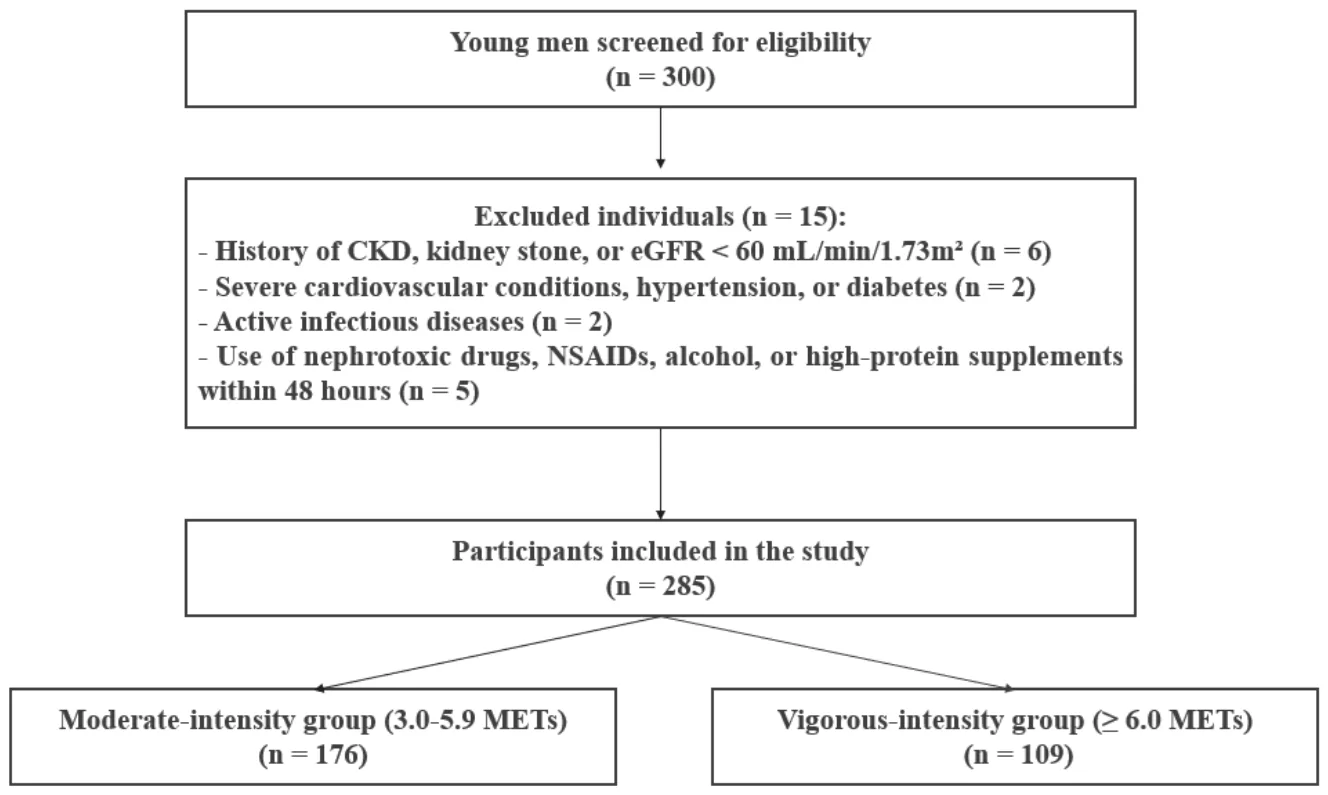
The final study cohort comprised 285 healthy young men who successfully completed the 20 min physical training (Figure 1).
Results, 2.1. Clinical and Laboratory Characteristics of Participants
- Result
In the unadjusted model (Model 1), each 1 MET increase in exercise intensity was associated with a 0.338 increase in post-exercise urinary L-FABP (β = 0.338; 95% CI, 0.280 to 0.395).
- Limitation
First, our cohort was restricted to healthy young adult males, which limits the direct generalizability of our findings to females, older populations, or patients with underlying chronic kidney disease or reduced microvascular reserve.
Quoted word for word from the full text on mdpi.com.
The paper
108 Military Central Hospital
International Journal of Molecular Sciences, Sep 24, 2026, Open access


