Role of regular preventive dental visits in moderating lifestyle-related disease medical expenditures among employed adults
Abstract
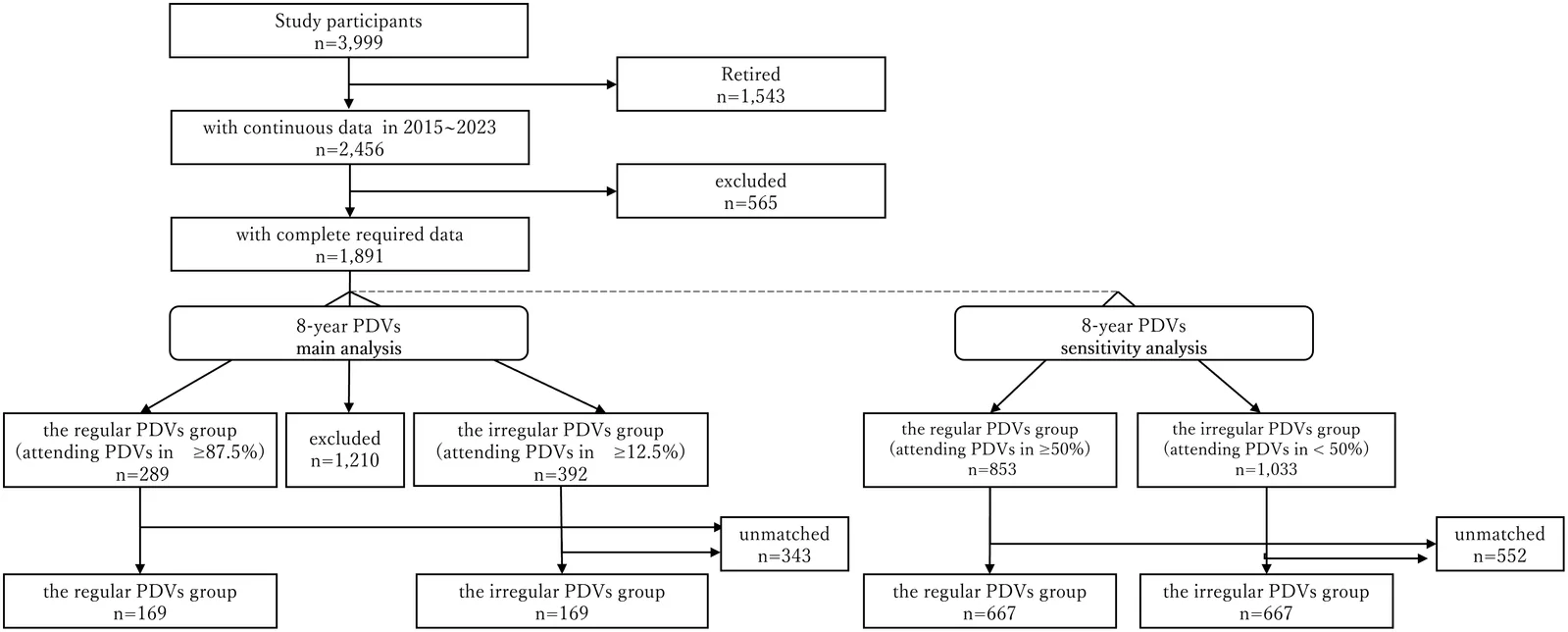
This study aimed to elucidate the impact of preventive dental visits (PDVs) over a 9-year follow-up period on cumulative medical expenditures (MEs) related to lifestyle-related diseases. To this end, the study included 1,891 full-time employees (1,478 males and 413 females), aged 19-57 years, of a manufacturing company in Japan over a 9-year period. This historical cohort study was conducted from 2015 to 2023. The year 2015 served as the baseline, with the subsequent 8 years (2016-2023) used for follow-up. Based on an 8-year dental check-up follow-up survey from 2016 to 2023, participants were classified into two groups, those who reported PDVs in ≥87.5% of the years they answered the survey (regular PDVs) and those who reported PDVs in <12.5% of those years (irregular PDVs). Using 2015 as the baseline, adjustments were made for sex, age, division, Community Periodontal Index, oral health literacy, number of outpatient visits, annual MEs, annual lifestyle-related diseases medical expenditures (LDMEs), lifestyle habits, and health risks. Cumulative LDMEs per capita from 2016 onwards were examined in each group classified as with or without regular PDVs. To adjust for confounding variables between the two groups, we performed a propensity score matching. Although no significant differences in the proportion of individuals incurring LDMEs between the groups with and without regular PDVs, the LDMEs per capita among those who incurred expenditures were significantly lower in the group with regular PDVs. In sensitivity analysis, the threshold for group classification was changed. Specifically, the analysis was conducted with participants who had PDVs in ≥50% vs. those who had PDVs in <50% yielded similar findings as those obtained in the main model. Our results suggest that regular PDVs are associated with moderating LDMEs. These findings may serve as a motivation for promoting preventive dentistry in both corporate and public health initiatives.
From the paper
- Participants
Before propensity score matching, the regular and irregular PDV groups comprised 289 and 392 participants, respectively; after matching, each group included 169 participants.
- Limitation
Since the study involved employees from a single company, potential biases regarding region, age demographics, and industry sectors could not be excluded.
Quoted word for word from the full text on journals.plos.org.
The paper
Lion Corporation; Juntendo University
PLOS One, 15 Oct 2026