Association of renal resistive index with coronary artery calcification in patients with preserved renal function
Abstract
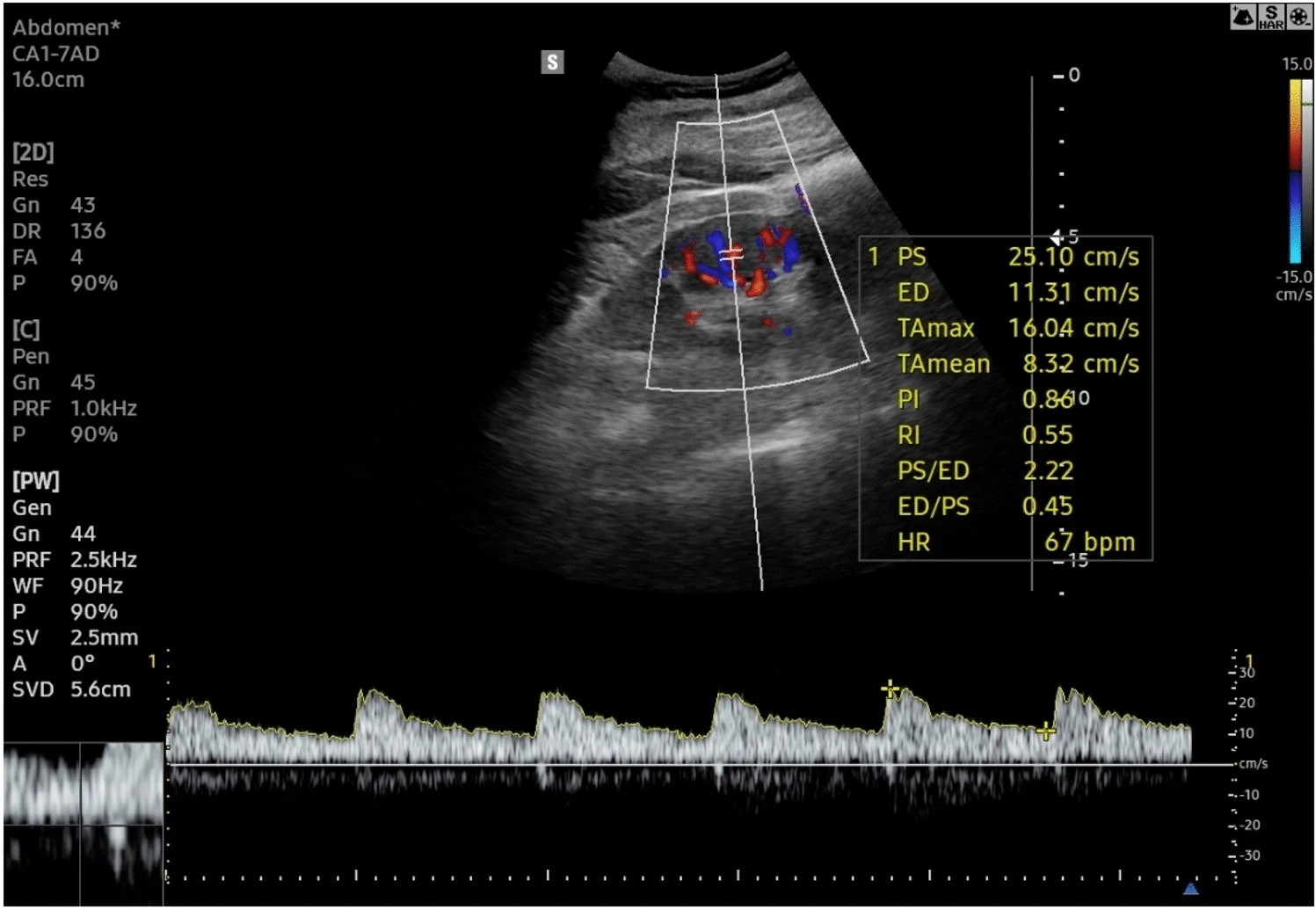
PURPOSE: To investigate whether renal resistive index (RRI) is independently associated with the presence of coronary artery calcification in patients with preserved renal function undergoing coronary computed tomography angiography (CCTA), and to explore its unadjusted associations with continuous coronary artery calcium score (CACS) and Coronary Artery Disease Reporting and Data System (CAD-RADS) categories. METHODS: This prospective cross-sectional study included 120 patients with preserved renal function who underwent renal Doppler ultrasonography before CCTA. The primary outcome was the presence of coronary artery calcification, defined as a CACS > 0. Associations of RRI with continuous CACS and CAD-RADS categories were evaluated in exploratory, unadjusted analyses. Multivariable logistic regression evaluated the independent association between RRI and CACS > 0. A clinical model and the same model supplemented with RRI were compared using receiver operating characteristic analysis. RESULTS: RRI was higher in patients with CACS > 0 than in those with CACS = 0 (0.697 ± 0.051 vs. 0.646 ± 0.054, p < 0.001) and correlated with CACS (r = 0.474, p < 0.001). RRI also differed across CAD-RADS categories (p < 0.001). After adjustment for age, sex, hypertension, diabetes mellitus, smoking, and dyslipidaemia, each 0.01-unit increase in RRI was independently associated with higher odds of CACS > 0 (adjusted OR 1.137, 95%CI 1.041-1.242; p=0.005). Adding RRI improved model fit (likelihood-ratio p=0.003) but did not significantly improve discrimination (AUC 0.782 vs. 0.819; DeLong p = 0.129). CONCLUSION: RRI was independently associated with the presence of coronary artery calcification in patients with preserved renal function. Associations with continuous CACS and CAD-RADS categories were exploratory and unadjusted.
- Renal resistive index
- Coronary artery calcification
- Coronary artery disease
- CAD-RADS category
- Coronary artery calcium score
- Humans
The paper
Journal of Ultrasound, Oct 15, 2026


